

Belgium endive (also known as witloof chicory) is a leafy crop whose leaves are used in fresh salad or cooked as vegetables. It is grown in two steps.
- Plants are grown in the ground over the summer, then the roots are harvested.
- The roots are trimmed of all green leaves, then replanted in sand in a dark location to force new growth.
The result is the familiar pale torpedo-shaped head of dense leaves, called a chicon.
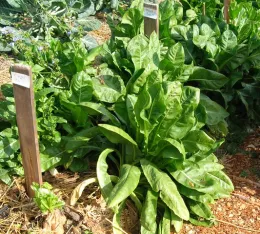
Planting
- Transplant seedlings 4 to 6 inches apart in May to July.
- If growing your own seedlings, start the seeds 6 weeks before you want to plant.
Forcing the chicons

- Dig up the roots in November when the weather has turned cold. The more robust the roots, the more growth you will get when forcing the chicons.
- Completely remove all green leaves, leaving just the growing tip. Any leaf material that remains may decay and rot.
- Replant the roots in large pots filled with damp sand. Trim long roots as needed.
- Keep the pots in total darkness and as cool as possible. It is critical to keep the forced growth in complete darkness or the leaves will be too bitter.
Harvesting
- In about 4 weeks, the leaves should be large enough to harvest.
- If they don’t form tight heads like commercial Belgian endive, they can still be enjoyed as individual leaves. An advantage of harvesting leaf by leaf is that it spreads the harvest out for several weeks.
See our Belgian Endive Trial for more details on how we grew it.
More links
- Belgium endive, Cornell Cooperative Extension, College of Agriculture & Life Sciences
- Witloof Chicory (Belgian Endive), Oregon State University, Department of Horticulture