

Vents are important elements that help keep air circulating to reduce moisture buildup, let hot air out, and the screen helps keep rodents out. Vents with ¼ inch openings have large enough gaps to allow embers to penetrate the building, and given their size, smolder for a while. If combustible items are located inside the vent, smoldering embers may ignite those items. When assessing the vents on your home, think about:
- Is the mesh screen larger or equal to 1/4” (6.4 mm)? Large embers can easily pass through them.
- Is there any vegetation or combustible material within 5ft (1.5m) from the vents? If nearby materials burn, they can potentially expose the vents to flames or embers.
- Does the mesh screen have debris and/or paint clogging it? If so, these materials could burn if they came in contact with flames.

Diagram illustrating the different locations of vents around the home.
Vent Type | Description | Vulnerabilities |
Dryer and Garage Vents 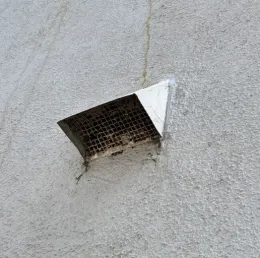 |
|
|
Foundation Vents 
|
|
|
Gable Vents 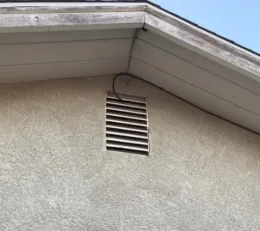 |
|
|
Ridge Vents  |
|
|
Roof Vents  |
|
|
Soffit Vents  |
|
|
How Can You Protect Your Vents?
The first step is to locate all vents on your property and determine whether they need immediate attention. There are a number of retrofitting recommendations to protect your vents, including:
- Replacing your vents with fire-resistant vents approved by the California Office of the State Fire Marshall. There are several California Office of the State Fire Marshal-approved flame- and ember-resistant vents. These vents meet the standards in the California Building Code. Some of these vents are shown below in alphabetical order:
Brandguard Vents

These vents use a baffle design to deviate the embers path.
Embers Out

These vents have multiple internal layers of louvers that block embers.
O'Hagin Vents

Low profile through-roof vents, approved for over eave applications.
Vulcan Vents

They use screenings on the front and back of a honeycomb matrix. This matrix is coated with an intumescent paint that swells when exposed to heat.
- Retrofit your existing vents with metal mesh (1/8-inch or 1/16-inch screening). For existing vents with 1/4-inch screens, you can add a second layer of screen of a smaller mesh size (1/8-inch or 1/16-inch) to cover the existing ¼-inch mesh.
- Install the finer mesh screens from the inside or outside (whichever is easier) to help keep embers out.
- Regardless of vent type or location on the home, all vents should be checked regularly. Vegetation and other combustible materials should be kept away from vents to reduce likelihood of exposure to embers and flames.
- If you were not able to replace or retrofit your vents before a fire approaches your area, you can use plywood or metal tape to temporarily cover the vents before evacuation if time permits.
California Regulations
According to Chapter 7A of the California Building Code;
- Screen mesh for roof vents should be made with corrosion-resistant and non-combustible materials, with openings between 1/16 and 1/8" (1.6 and 3.2 mm).
- Chapter 7A prohibits the use of vents in eaves unless they have proven to resist the intrusion of embers and flames.
Products and assemblies that have complied with Chapter 7A can be found in the WUI Product Handbook.
Additional Resources
Check out these vent-related wildfire preparedness resources from Fire Network Members and our colleagues!
These materials are not maintained by UC ANR and may not meet current accessibility standards. If you need assistance accessing this content or require an accessible format, please contact the Insurance Institute for Business and Home Safety.