

Decks can be ignited by wildfires via flame contact (usually from below) or ember attack (usually from above). Burning decks can expose the house to long-term flame impingement, which could ignite siding and eaves, and/or shatter windows. There are several factors that can contribute to deck ignition. Embers could ignite combustible materials stored or accumulated under the deck, exposing the rest of the deck to flame contact. Embers could also accumulate in gaps between deck boards and ignite debris. If the deck is in contact with vegetation or other combustible materials, they could provide a direct fire path causing deck ignition. A non-combustible surface or structural component is not always enough to prevent ignition.
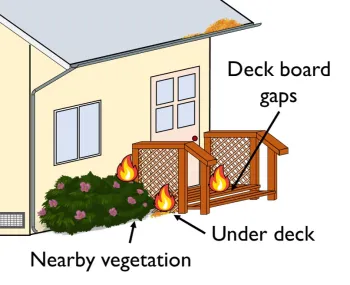
Diagram showing vulnerable areas of decks to wildfires.
There are many different types of decks, all with different vulnerabilities. Below is a list of common examples of decks.
Deck Type | Description and Vulnerabilities | Recommendations |
Vegetation on or close to the deck Image 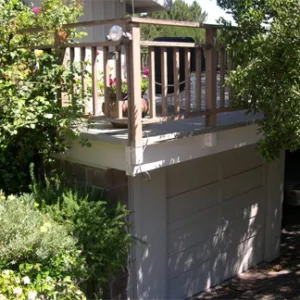 |
|
|
Deck with Membrane Image 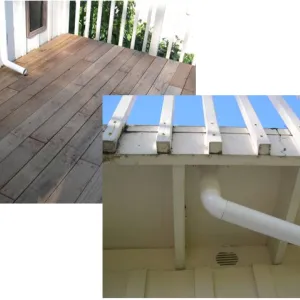 |
|
|
Deck enclosed with lattice fencing Image 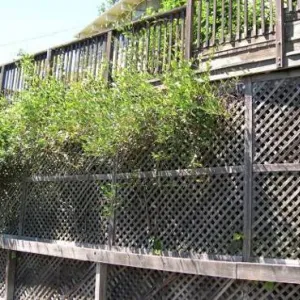 |
|
|
Deck with chain link fence Image 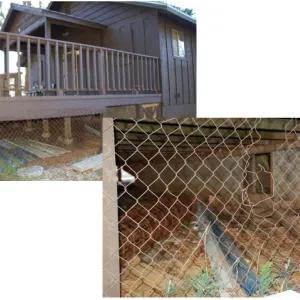 |
|
|
Deck with storage underneath Image 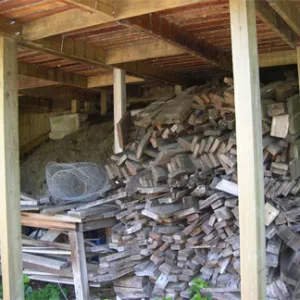 |
|
|
Deck with heavy timber structure Image 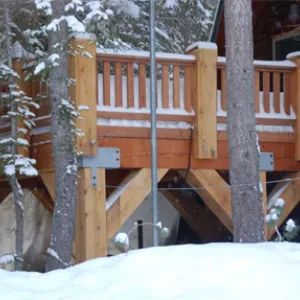 |
|
|
How Can You Protect Your Deck?
Deck enclosing is often recommended by wildfire guides, but it may not always be the best option. The benefits of enclosing your deck are minimal if you are not storing combustible materials under your deck, while moisture-related degradation can become problematic. The gaps between deck boards also play an important role in ignition.
A gapped-board deck will be less likely to have flames spread from its lower to upper surface if the deck boards are tightly installed. It would, however, be a bad detail due to the increased risk of water accumulating in the joints, causing fungal decay. The deck's distance from the ground also matters. Debris under decks that are close to the ground are generally more difficult to remove and could pose a fire safety risk.
Here are some general guidelines to make your deck more fire resistant:
- Keep your deck free of debris: dead vegetation and other debris can accumulate in between deck boards. When exposed to embers or direct flame contact, these accumulated debris can ignite.
- Minimize combustible materials on and around your deck: combustible materials can include patio furniture, door mats, wood piles, potted plants, etc. Create a vertical and horizontal clearance between deck and vegetation, and rearrange other combustible items away from vulnerable locations (in order to secure your deck surroundings, check recommendations about defensible space).
- Replace or repair damaged parts: inspect your deck regularly for damaged parts. Damaged sections can serve as an ignition point during a fire and should be replaced.
- For new installations with untreated wood, the deck's fire resistance can be improved by:
- Increasing the gap between deck boards from 1/8” to 1/4”.
- Increasing joist spacing from 16” to 24”.
- Applying a foil-faced self-adhering adhesive flashing tape (foil-faced bitumen tape) on the top of each joist. Foil tape should extend down each side of the joist 2-3”.
- Remove combustible materials before evacuation: if you have time, bring combustible door mats, brooms and furniture cushions inside. Move deck furniture off the deck and move barbecue propane tanks away from the house.
California Regulations
Chapter 7A predominately addresses the deck surface (deck boards, rails, treads, etc.), but not the underlying structural support members. It does not require enclosing the deck. Chapter 7A assumes that you have created an acceptable defensible space around your home or building. This includes the area under the deck.
When reviewing decking information in the WUI Products Handbook, note how the product complies with Chapter 7A. Generally, compliance with Chapter 7A can be achieved in three ways:
- Satisfy all the acceptance conditions of the SFM 12-7A-4 test (both Parts A and B). Part B uses type ‘A’ burning brands. Decking materials that comply with this option must also be ignition-resistant.
- The deck consists of (i) heavy timber construction (as specified in California Building Code Section 605.6), (ii) exterior-rated fire retardant treated lumber (this product qualifies as an ignition-resistant material) or (iii) approved noncombustible materials (such as metal deck boards or lightweight concrete surface)
- This is a variation of #1, but it is less restrictive. Decking only needs to meet the minimum heat release rate requirement of Part A. Three criteria for Part A don't apply (self-extinguishing, dropping flaming debris, and structural failure). Brand testing (Part B) is also not required. Products that comply with this option should also provide flame spread rating information (Class A, B, or C). Unless you can find it, assume Class C. In this case, the exterior siding within 10 feet of the deck must be either noncombustible or ignition-resistant (untreated wood siding, vinyl siding, and other combustible sidings cannot be used). For Class A and B flame spread ratings, siding that complies with Chapter 7A can be used. In most cases, deck boards are compliant with this option.
Products and assemblies that have complied with Chapter 7A can be found in the WUI Product Handbook.
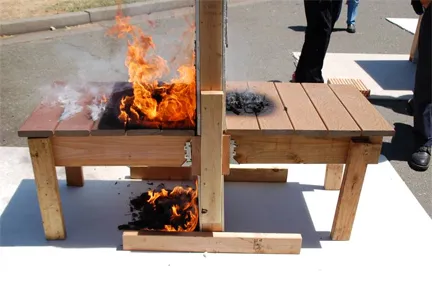
Testing the Combustibility of Decking Materials
As part of a fire demonstration, a burning 'B' brand was placed on both of these decks. The photograph was taken approximately 60 minutes after the burning brands were placed on the decks. The decking product on the left does not comply with the provisions of Chapter 7A. The decking product on the right does comply. Since Chapter 7A only applies to new construction (those buildings constructed since January 2008) and not to new decks built on older homes, both of these products are commercially available.
Additional Resources
Check out these deck-related wildfire preparedness resources from Fire Network Members and our colleagues!
These materials are not maintained by UC ANR and may not meet current accessibility standards. If you need assistance accessing this content or require an accessible format, please contact the Insurance Institute for Business & Home Safety.
- Peer-reviewed journal article in Fire, "Evaluating Deck Fire Performance - Limitations of the Test Methods Currently Used in California's Building Codes" (Hedayati et al. 2022).
- Peer-reviewed article Advances in Forest Fire Research, "Performance of Attached Decks Subjected to Ember Top-of-Deck and Flame Impingement Under-Deck Exposure (Hedayati and Quarles 2022).