
Program Overview
The UCCE Irrigation and Water Management Program addresses irrigation and water-resource challenges specific to low-desert agricultural regions of Southern California. The program focuses on improving water and nutrient use efficiency, crop productivity, and environmental sustainability under arid climates, saline soils, and limited water supplies. It conducts applied, field-based research and delivers science-based extension and education on irrigation practices, on-farm water management, and water conservation strategies tailored to low-desert vegetable, forage, and specialty crop production systems. A core emphasis of the program is the evaluation and deployment of emerging irrigation technologies, decision-support tools, and remote sensing approaches to support data-driven irrigation management.
Program Objectives
The objectives of the Irrigation and Water Management Program in low-desert regions are to:
- Improve water and nutrient use efficiency in desert cropping systems
- Support adoption of efficient irrigation technologies and scheduling approaches suited to arid environments
- Advance data-driven irrigation decision making using sensors, models, and remote sensing
- Address salinity, drainage, and soil–water management challenges common to low-desert agriculture
- Enhance the long-term sustainability and resilience of irrigated agricultural systems
Irrigation and Water Management Advisor
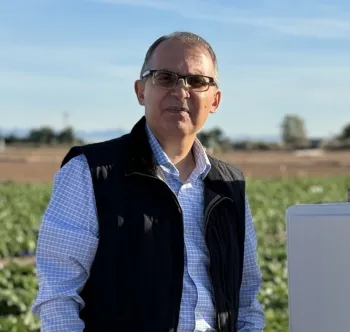
Dr. Ali Montazar is the Irrigation and Water Management Advisor serving Southern California. He holds a Ph.D. in Irrigation and Drainage and has more than 20 years of experience in agricultural water management research, extension, and teaching. He leads an applied research and extension program focused on low-desert production systems, with emphasis on irrigation efficiency, salinity management, and the integration of emerging technologies into practical on-farm decision making.
His key focus areas include:
- Sensor-based irrigation scheduling and real-time decision support
- Evaluation and application of remote sensing–based evapotranspiration (ET) for irrigation management
- Development and validation of decision-support tools for irrigation and nutrient management
- Irrigation management for vegetable crops (carrots, onion, lettuce, and other low-desert vegetables)
- Irrigation management for alfalfa, forage crops, and date palms
- Agricultural water conservation under arid and saline conditions
- Drainage and salinity management
- Best irrigation and nutrient management practices for low-desert systems
Current Research Projects
The Irrigation and Water Management Program maintains an active portfolio of applied research and extension projects addressing irrigation and water-management challenges unique to low-desert agricultural regions. Projects emphasize field validation, scalability, and usability to ensure technologies and tools are practical for grower adoption.
Current research and extension efforts include:
- Field evaluation of sensor-based irrigation scheduling tools, including soil moisture, plant-based, and weather-based approaches
- Application of satellite- and remote sensing–based ET products to support irrigation planning, performance assessment, and water accounting
- Development of decision-support frameworks that integrate field data, remote sensing, and crop coefficients to guide irrigation and nutrient management
- Development and evaluation of water-saving irrigation strategies for alfalfa and forage crops, and vegetable crops grown in low-desert environments
- Improvement of irrigation management for date palm production, with emphasis on crop water use and fruit quality in arid systems
- Determination of crop nitrogen removal coefficients for low-desert vegetable and forage cropping systems
- Research on drainage, salinity, and soil health management, including cover cropping and compost applications in desert vegetable systems
These projects are conducted in collaboration with growers, industry partners, and state and federal agencies to ensure outcomes are technically sound, regionally relevant, and directly applicable to on-farm decision making.