
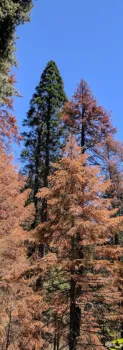
The drought of 2012 to 2016 resulted in unprecedented tree mortality across California, with the most severe impacts occurring in the southern Sierra Nevada. Prolonged drought stress weakened trees, reducing their ability to defend against native bark beetles. This led to widespread bark beetle outbreaks, during which beetles burrowed under the bark, laid eggs, and ultimately girdled and killed millions of trees. A CalEco video, Ponderosa Pine Mortality, the Western Pine Beetle and Drought provides a succinct explanation of this event.
The consequences of this mass die-off event will persist for decades. As dead trees fall, surface fuels will increase, vastly outpacing the resources of local, state and federal jurisdictions to remove it. Additionally, tree regeneration and species composition is significantly disrupted. In response, University of California scientists, forest managers, and public agencies developed a data collection network to monitor, identify and project future trajectory of affected stands. This work supported improved management of impacted forests to increase their resiliency to future droughts.
Additional information may be found in this published summary of the Tree Mortality Data Network, California Agriculture.
The California Tree Mortality Data Collection Network, led by UC Berkeley and UC ANR academics, and supported by CAL FIRE, brought bring together scientists from various agencies conducting field and remote-sensing studies across the Sierra Nevada. Additionally, researchers collected data at eight Drought Mortality (DX) sites throughout the Sierra Nevada in 2017, 2018, 2019 and 2021 to address the following questions:
- What is the future course of the bark beetle outbreak?
- What is the impact of tree mortality on forest carbon storage?
- What are the likely successional trajectories in impacted stands? Is forest regeneration occurring and what are the implications for future forest composition?
- How does the increase in standing, and eventual downed, dead trees affect the timing and magnitude of wildfire hazard?
Network Meetings
A key outcome of the Tree Mortality Data Collection Network was to quickly collect and present results to a diverse audience of resource decision makers, policy makers, practitioners, and private landowners. Annual meetings were held from 2018-2021 to share key information about tree mortality and its effects on wildfire risks, carbon, and more broadly on ecosystem services across this region.
2021 Network meeting (Summary) - Held in March 10-11, 2021, this workshop 1) Shared latest results on live and dead trees, tree fall rates, fuels, regeneration, and post-mortality management and 2) Discussed frameworks for incorporating data into forest management planning and identify management challenges and opportunities.
- Tree Mortality Data Collection Network 2021 Day 1 Workshop Introduction Dr. Jodi Axelson, UC Berkeley
- Listening to the trees: what global tree mortality observations tell us about the fates of earth’s historical forests under hotter drought Dr. Craig Allen, USGS New Mexico and Dr. Bill Hammond, Oklahoma State University Video recording
- Characterizing ground and surface fuels in Sierra Nevada forests shortly after the 2012–2016 drought Dr. Emilio Vilanova Torre, UC Berkeley Video recording
- Bark-beetle killed ponderosa pine snag demography & initial changes in fuel loads Dr. Leif A. Mortenson, US Forest Service Pacific Southwest Research Station Video recording
- Tracking tree mortality and fire risk in giant sequoia Ecosystems: New actions to address new threats Dr. Christy Brigham, Sequoia /Kings Canyon National Parks Video recording
- The 2020 fire season in context: Disaster or opportunity? Dr. Crystal A. Kolden. UC Merced Video recording
- Panel discussion: Moderator John Battles, Panelists William Hammond (Univ. of Oklahoma), Craig Allen (USGS), Crystal Kolden (UC Merced)
Joe Restaino (CAL FIRE) Video Recording - Tree Mortality Data Collection Network 2021 Day 2 workshop introduction Dr. Emilio Vilanova Torre, UC Berkeley
- The collective pipeline to climate-smart reforestation Britta Dyer, California State Director, American Forests Video recording
- Using assisted gene flow to establish climate-adapted forests Dr. Derek Young, UC Davis Video recording
- Dr. Jessica Wright, US Forest Service PSW Research Station Video recording
- Climate-wise reforestation toolkit Amarina Wuenschel, US Forest Service Region 5, Video recording
- Replanting strategies under changing wildfire, climate and budget conditions Dr. Malcolm North, US Forest Service PSW Research Station Video recording
- Panel discussion: Moderator John Battles, Panelists Britta Dyer (American Forests), Eric Sprague (American Forests), Jessica Wright (US Forest Service), Stewart McMorrow (CAL FIRE) Video Recording
2019 Network Meeting (Summary) - Held in March 14th, 2019, Wildfire Training Center in McClellan, CA, this workshop 1) Shared results of the field season on live and dead trees, bark beetle attacks, regeneration, and fuels 2) Solicited input from partners and managers on useful data summary products 3) Discussed on-going collaboration on field data collection, interpretation and use
- Local reactions and responses to tree mortality - a flash back - Brittany Dyer, American Forests
- California Forest Management Task Force - Coordinating the state's investments in forest management wood utilization and workforce development - Kevin Conway, CAL FIRE
- Tree Mortality and Dead Biomass 2018 Update - John Battles, University of California Berkeley
- 2018 field season update - Leif Mortenson, Christopher Fettig & Beverly Bulaon - US Forest Service
- Effects of bark beetle and drought induced tree mortality on wildfire severity in the Sierra - Rebecca Wayman and Hugh Safford, UC Davis
- Mortality and recovery following extreme drought in California - Derek Young, Becky Estes, Amarina Wuenschel, Shana Gross, Marc Meyer, Christina Restaino, Hugh Safford - UC Davis, US Forest Service, Tahoe Regional Planning Agency
- Structure and composition of natural regeneration across a latitudinal and tree mortality gradient - Jodi Axelson, John Battles, Lauren Cox, Susie Kocher & Elliot Kuskulis, UC Berkeley and UC Cooperative Extension
- Predicting the spatial patterns of postfire conifer regeneration - Kristen Shive - Save the Redwoods League, Kevin Welch & Hugh Safford - UC Davis and Scott Stephens - UC Berkeley
- Mortality in the context of long-term stand dynamics - Rob York, UC Berkeley
- Sierra Nevada Adaptive Management Experiments - Treatments to promote resistance resilience and adaptation - Sarah Bisbing, University of Nevada Reno
- Biomass Utilization in the Southern Sierra Nevada - Larry Swan, US Forest Service
2018 Network Meeting (Summary) - Held on March 12th, 2018, Wildfire Training Center in McClellan, CA, this workshop 1) Shared results of the field season on live and dead trees, bark beetle attacks, regeneration, and fuels 2) Solicited input from partners and managers on useful data summary products 3) Discussed on-going collaboration on field data collection, interpretation and use
- Tree mortality and bark beetles in the Sierra Nevada - Elliot Kuskulis, University of California, Berkeley
- How forest treatments influence tree mortality and recovery in the Sierra Nevada - Dr. Christina Restaino, University of California, Davis
- Tree Injections - Splat Verb Treatments - Western Pine Beetle biology - Sheri Smith, US Forest Service, Region 5 Forest Health Protection
- Drought mortality - Implications for carbon and fuels - Dr. John Battles and Lauren Cox, University of California, Berkeley
- Inventory-based mortality estimates for California forests 2001-2015 - Dr. Stella Cousins, University of California, Berkeley
- Mapping dead tree biomass from the recent California mortality event - Carmen Tubbesing, University of California, Berkeley
- Remote Sensing of Forest Health - Ecosystem Disturbance and Recovery Tracker (eDaRT) - Michèle Slaton, US Forest Service, Region 5 Remote Sensing Lab
Other Resources:
- 2017 Drought Mortality Data Summaries and Site Profiles
- Summary of group discussion on tree mortality information needs
Collaborators: CAL FIRE, National Park Service, US Forest Service (Forest Health Protection, Pacific Northwest Research Station, Pacific Southwest Research Station, Rocky Mountain Research Station, Region 5), US Geological Service, University of California (Berkeley, Davis, and Cooperative Extension), University of Washington.