
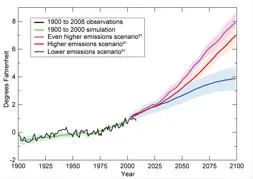
The future is going to be warmer but how much warmer is a question for which we have no definitive answer. California’s diversity of temperature and precipitation provide many examples of how forests may adapt to projected climate changes. Warmer temperatures generally improve growing conditions for all trees as long as sufficient water is available. It is also certain that some trees, shrubs and grasses will do better than others and thereby change the mix of trees and plants in different forests. All of these patterns could be significantly altered by changes in disturbances such as wildfire, insects, and disease infestations. Some of the potential changes are summarized in the climate change chapter of the 2010 Forest and Rangeland Assessment as well as the USDA Forest Service publication, California Forest Resources, 2001-2005 listed in the reference section. The most up to date map based information for California is accessible at www.cal-adapt.org.
Temperate forests have a unique role with respect to projected climate change in terms of the potential to provide additional mitigation through the combined benefits of greater net in-forest carbon storage, carbon storage in wood products, and direct and indirect substitution benefits from reduced fossil fuel use ( Managing Forests because Carbon Matters JOF Supplement , Stewart_Nakamura_FPJ2012_FullGHG_Accounting ) . California’s forests have been adding carbon inventory for decades but future trends can be altered by natural disturbances as well as proactive management decisions. Choosing to plant seedlings for future rather than historic climates as well as managing forests to address changing social demands (e.g. - water runoff for hydroelectric power and downstream users may become more important) are examples of possible mitigation strategies.
Resources:
The 25th UCCE publication in the Forest Stewardship Series was published in 2017 and is on Adapting forests to climate change .
CalFire's FRAP 2010 assessment has a chapter on climate change threats and opportunities .
The 2009 report of the US Global Change Research Program has data and projections at the regional level. Look at both the Southwest and Northwest regions for information relevant to California forests.
The Climate, Forests and Woodlands site on the extension.org web site contains a large number of short articles with references on forest ecosystems, climate change, climate-forest interactions, and adaptation strategies.
The Society of American Foresters has released a supplemental issue titled Managing Forests because Managing Forests because Carbon Matters-Integrating Energy, Products and Land Management Policy in October 2011.
Carbon and Fuel Management
Interactions of fuel treatments, wildfire severity, and carbon dynamics in dry conifer forests. Larissa L. Yocom Kent, Kristen L. Shive, Barbara A. Strom, Carolyn H. Sieg, Molly E. Hunter, Camille S. Stevens-Rumann, Peter Z. Fulé. Forest Ecology and Management 348 (2015) 68–77 (here)
Aboveground live carbon stock changes of California wildland ecosystems, 2001–2010. Patrick Gonzalez, John J. Battles, Brandon M. Collins, Timothy Robards, David S. Saah. Forest Ecology and Management 348 (2015) 68–77. (here)
Climate Change Impacts in Washington’s Forests A roadmap for adaptation and mitigation responses. Elaine Oneil, Larry Mason, Bruce Lippke. RTI/CORRIM Joint Working Paper No 6, Seattle WA, 36 pp. (here)
Biomass for Energy
The Burning Question: Does Forest Bioenergy Reduce Carbon Emissions? A Review of Common Misconceptions about Forest Carbon Accounting. Michael T. Ter-Mikaelian, Stephen J. Colombo, and Jiaxin Chen. Journal of Forestry 113(1):57–68. Jan. 2015. (here)
Biomass Waste for Energy Greenhouse Gas Offset Credit Project Report (here)
Greenhouse Gas Biomass Waste to Energy protocol_verion 6_3 (here)
Biomass Waste for Energy Greenhouse Gas Offset Credit Project Calculations (here)
Conifer Greenhouse Gas Tools
Growth Models for Ponderosa Pine: Yield of unthinned plantations in northern California; Oliver, William W. and Robert F. Powers; Research Paper PSW-133 here
Forest Carbon Estimation Using the Forest Vegetation Simulator: Seven Things You Need to Know; Hoover, Coeli M., and Stephanie A. Rebain; GTR NRS-77 here
PRESTO: Online Calculation of Carbon in Harvested Wood Products; Hoover, Coeli M., Sarah J. Beukema, Donald C.E. Robinson, Katherine M. Kellock, and Diana A. Abraha; General Technical Report NRS-141 here
Photo Series for Quantifying Forest Residues in the: Sierra Mixed conifer type, Sierra true fir type; Maxwell, Wayne G., Franklin R. Ward; GTR PNW-95 October 1979. here
Standard Fire Behavior Fuel Models: A Comprehensive Set for Use with Rothermel’s Surface Fire Spread Model; Scott, Joe H. and Robert E. Burgan; General Technical Report RMRS-GTR-153; June 2005 here
California Forest and Rangeland Greenhouse Gas Inventory Development: FINAL REPORT; California Air Resources Board Agreement 10-778; STATE OF CALIFORNIA AIR RESOURCES BOARD Battles, John J. et al; January 2014 here
Oak Resources
Standiford, R.B. and N.K. McDougald. 2015. Thinning interior live oak in California’s Southern Sierra. In: Proceedings of the Seventh California Oak Symposium: Managing Oak Woodlands in a Dynamic World, November 3-6, 2014, Visalia, CA. USDA Forest Service General Technical Report PSW-XXX, pp. XXX. here
Standiford, R.B., R.L. Phillips, and N.K. McDougald. 2015. Thinning – a tool for restoration of California’s Southern Sierra Nevada blue oak woodlands. In: Proceedings of the Seventh California Oak Symposium: Managing Oak Woodlands in a Dynamic World, November 3-6, 2014, Visalia, CA. USDA Forest Service General Technical Report PSW-XXX, pp. XXX. here
Single tree, distance independent model for blue oak:
Standiford, R.B. 1997. Growth of blue oak on California’s hardwood rangelands. In: Proceedings of a Symposium on Oak Woodlands: Ecology, Management, and Urban Interface Issues, March 19-22, 1996, San Luis Obispo, CA. USDA Forest Service Research Paper PSW-GTR-160, pp. 169-176. here
Pillsbury, Norman H. and Michael De Lasaux. 1985. Site Index, Height and Yield Prediction Equations for Blue Oak and Coast Live Oak in Monterey and San Luis Obispo Counties, California. Natural Resources Management Department, Cal Poly. here