
Garden Help > Fruits & Nuts > Watermelon
This watermelon trial was conducted in the summer of 2006 at our (no longer in use) Nine Palms project location.
Taste Test Summary
Seventeen varieties of watermelons were grown to compare taste and production. The taste test winners were:
- Sweet Siberian
- Osh Kirgizia
- Orangeglo
- The three varieties of Moon & Stars battled for 4th place (Van Doren Strain, Cherokee Strain, Yellow Fleshed)
Overview
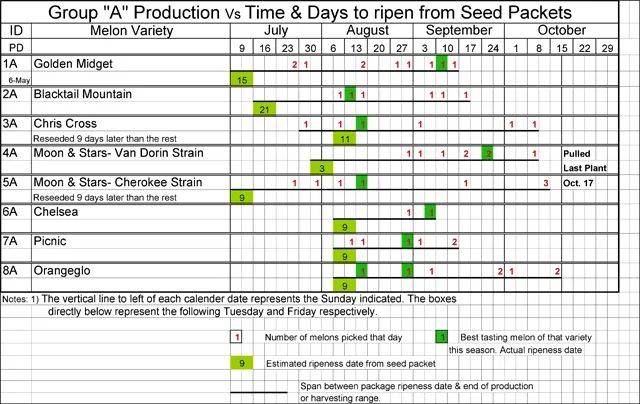
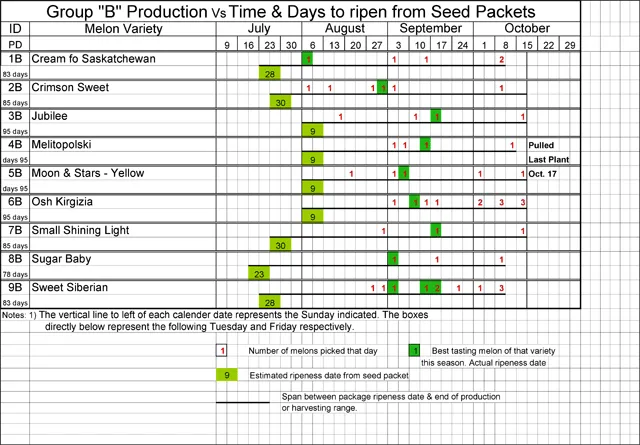
Seventeen varieties of watermelons (Citrullus lanatus) were grown to determine if satisfactory conditions could be created in Santa Clara County at reasonable cost and effort. Seed germination information was captured and tasting tests were conducted twice weekly. Harvest data—to determine number, size, and harvest period and harvest date deviations from seed packet ripening information—was tracked and graphed. Seed packet and web information were compared with experimental findings. The seeds for most varieties was procured from Seed Savers Exchange.
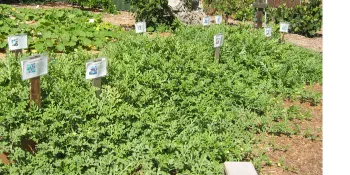
Varieties were divided into two categories based on packet planting recommendations. Eight varieties were planted with one foot spacing in rows two feet apart were placed in group “A” and planted on two-foot centers in such a manner to separate the second group. Nine varieties in Group “B” recommended to be planted on six-foot centers were spaced between the “A” group plants. The thinking was that the expected small compact “A” Group would also serve as markers to separate the larger more robust “B” Group plants. In actuality the “A” Group, although having thinner, more delicate vines, closely mimicked the “B” Group growth rather than being small bush types.
Moderate temperature raising techniques such as raised beds, row cover, and thermal mass, allowed almost all varieties to produce nice tasting melons. The difficulty was primarily determining optimum ripeness. Most varieties produced some melons that were quite sweet and tasty even somewhat past their optimum ripeness, although at some point flesh texture breakdown overcame increased sweetness to make melons undesirable. The earliest really tasty melon was picked in July and the last in October. As the temperatures decreased into October some melons of picking size failed to ripen.
Long, cold winter rains, a very short spring, and a hot summer provided somewhat unusual circumstances for this project which should be replicated again for weather effects.
Germination to Transplant
Seeds were planted on May 6 in four-inch pots containing Supersoil and Osmocote, two seeds per pot. Two pots of each variety were seeded. Most plants broke the surface six to nine days later. A few varieties failed and were reseeded May 15, putting their development nine days behind the others.
Germination Rates, Dates & Time to Melon Maturity
| ID | Melon Variety | 11-May | 12-May | 13-May | 14-May | 15-May | Germ. % | Packet | Actual |
|---|---|---|---|---|---|---|---|---|---|
| 1A | Golden Midget | X | X | X | 75 | 70 | 130 | ||
| 2A | Blacktail Mountain | X | XX | X | 100 | 76 | 102 | ||
| 3A | Chris Cross | 0 | 88 | 107 | |||||
| 4A | Moon & Stars- Van Dorin Strain | XX | 50 | 89 | 137 | ||||
| 5A | Moon & Stars- Cherokee Strain | 0 | 95 | 107 | |||||
| 6A | Chelsea | X | X | XX | 100 | 95 | 126 | ||
| 7A | Picnic | XX | XX | 100 | 95 | 120 | |||
| 8A | Orangeglo | X | XX | X | 100 | 95 | 107 | ||
| 1B | Cream from Saskatchewan | X | X | 50 | 83 | 95 | |||
| 2B | Crimson Sweet | X | X | X | 75 | 85 | 120 | ||
| 3B | Jubilee | X | X | X | 75 | 95 | 137 | ||
| 4B | Melitopolski | X | XX | X | 100 | 95 | 133 | ||
| 5B | Moon & Stars - Yellow | X | XX | X | 100 | 95 | 126 | ||
| 6B | Oh Skirziga | XXX | X | 100 | 95 | 130 | |||
| 7B | Small Shining Light | XX | XX | X | 100 | 88 | 137 | ||
| 8B | Sugar Baby | X | XX | 75 | 78 | 123 | |||
| 9B | Sweet Siberian | XXXX | 100 | 83 | 123 |
Wet Date: May 6, 2006
Average Germination: 76.5%
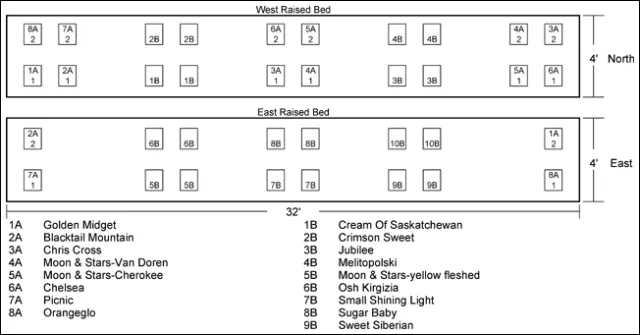
The plants were left in full sun inside a partially covered glass aquarium during the day and moved inside most nights. The best two plants of each variety were then transplanted into two raised beds at Nine Palms Ranch research facility the last week of May. The beds were 4-foot by 32-foot long and 8-inch tall. See Figure B for planting patterns, spacing and variety names.
Soil preparation
To each raised bed 12 cubic feet of compost horse manure, one cubic ft succulent planter mix, four lb of alfalfa pellets, four lb soybean meal and three lb of Biostarter+ from Live Earth were added and tilled. The beds were watered deeply by hand three days prior to planting and the automatic irrigation established. The West bed was watered using quarter-inch soaker hose while the North bed was watered with half or five-eighths soaker.
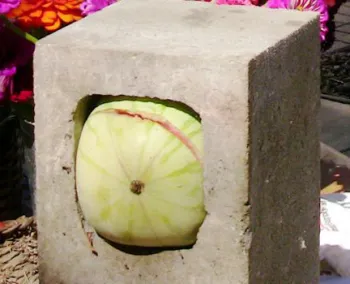
Upon completion of transplanting and verification irrigation worked properly, 68 8-inch x 16-inch cinder blocks were added to the raised beds to support the row cover and add thermal mass. Row cover provides heat by decreasing air movement. At blossom set, the row cover was removed for pollination. Cinder blocks were left until the plants were pulled. A few melons grew inside the cinder blocks forming bread loaf shaped melons. One melon broke its cinder block container.
Transplanting
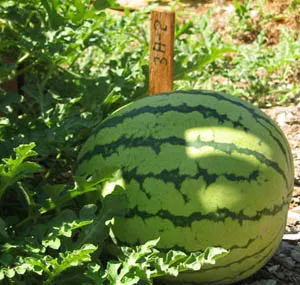
Each pair of “A” Group plants were split and planted down each side of both beds in reverse order such that 1A1 was opposite 8A2, where the first digit is the plant variety number, the second the group, and the third the first or second plant of a variety. This separated the two plants of each “A” group which helped in discerning soil fertility and disease problems from a variety of characteristics. Remember, these were supposed to be small plants.
Each of the “B” Group varieties was planted as a pair with plants 12 inches apart. It was felt that if they were not planted together it would become too difficult to assure which plant variety a melon came from due to limited growing space. Even so, marker sticks were required to identify each melon with its plant.
Watering
Watering was via timed soaker hose, three days per week for 30 minutes.
Fertilization/pesticides
The soil was conditioned as indicated in the Soil Preparation Section prior to planting. No additional fertilizers were added and no pesticides used. All plants went into the ground looking healthy and stayed that way until harvest.
Harvesting
The harvest season began in July and went into October. Ninety-eight melons were harvested and counted in the trial, comprising a total weight of 1,329 pounds. Sixteen “A” Group plants produced 51 melons weighing 766 pounds; while eighteen “B” Group plants produced 47 melons weighing 563 pounds. The “A” Group produced 8% more fruit and 36% more weight than the “B” Group; however, the “B” Group contained the two top taste winners. The average harvest seed packets “time to maturity” was almost identical for both groups at 89 days. The average days to maturity for each group, taking the date of each variety’s highest rating in the taste tests as the maturity date, was about 30 days longer, or 119 days. This reflects our cooler than typical melon growing temperatures.
Sweet Siberian (11) and Golden Midget (10) produced the most fruits. They also were the best and poorest in the taste testings in the same order. Small Shining Light (2), Jubilee (3) and Sugar Baby (3) had the lowest production.
Sweet Siberian 1st, Osh Kirgizia 2nd, and Orangeglo 3rd were the taste winners with the three varieties of Moon & Stars battling for 4th place. The heaviest melon prizes go to Chris Cross, Moon & Stars Cherokee, and Jubilee all about 30 pounds and Moon & Stars Van Doren at 27 pounds. The greatest girth goes to Moon & Stars Van Doren 34.5 inches, Chelsea 32 inches, and Orangeglo 30 inches. The longest was Moon & Stars Cherokee at 28 inches.
A summation of harvesting data on volume, weights, and sizes for each variety is shown in the first two tables below. Actual time to maturity compared to supplier seed packet and Web maturity dates for Group (A) types and Group (B) types are shown in the next two tables.
Combined Harvest Data For A Group Melons
| Plant ID | Variety Name | Number Picked | Weight Lbs (Totals) | Weight Lbs (Averages) | Length Inches | Circum. Inches |
|---|---|---|---|---|---|---|
| 1A | Golden Midget | 10 | 61.6 | 6.2 | 7.5 | 22.3 |
| 2A | Blacktail Mountain | 6 | 33.0 | 5.5 | 8.8 | 26.4 |
| 3A | Chris Cross | 6 | 119.5 | 19.9 | 10.8 | 32.8 |
| 4A | Moon & Stars- Van Doren | 8 | 180.5 | 22.6 | 11.4 | 32.9 |
| 5A | Moon & Stars- Cherokee | 5 | 123.0 | 24.6 | 18.2 | 27.2 |
| 6A | Celsea | 3 | 44.0 | 14.7 | 9.0 | 31.2 |
| 7A | Picnic | 8 | 116.7 | 14.6 | 11.5 | 24.9 |
| 8A | Orangeglo | 5 | 87.7 | 17.5 | 15.7 | 26.8 |
| Total A Type | 51 | 766.0 | 125.6 | 92.9 | 224.5 | |
| Average A Type | 6.4 | 96.0 | 15.6 | 11.6 | 24.1 |
Combined Harvest Data For B Group Melons
| Plant ID | Variety Name | Number Picked | Weight Lbs (Totals) | Weight Lbs (Averages) | Length Inches | Circum. Inches |
|---|---|---|---|---|---|---|
| 1B | Cream of Saskatchewan | 5 | 39.7 | 6.6 | 7.3 | 23.3 |
| 2B | Crimson Sweet | 6 | 109.0 | 18.2 | 11.3 | 34.3 |
| 3B | Jubilee | 3 | 78.0 | 26.9 | 19.0 | 27.3 |
| 4B | Meltipolski | 4 | 41.8 | 10.5 | 8.1 | 23.9 |
| 5B | Moon & Stars- Yellow Fleshed | 4 | 61.3 | 15.3 | 13.6 | 24.9 |
| 6B | Osh Kirgizia | 9 | 74.8 | 8.3 | 7.4 | 24.6 |
| 7B | Small Shining Light | 2 | 16.4 | 8.2 | 7.4 | 24.8 |
| 8B | Sugar Baby | 3 | 20.5 | 6.8 | 7.5 | 22.7 |
| 9B | Sweet Siberian | 11 | 121.3 | 11.0 | 11.4 | 23.5 |
| Total B Type | 47 | 562.8 | 111.8 | 93.0 | 229.3 | |
| Average B Type | 5.2 | 62.5 | 11.3 | 10.4 | 23.2 |
Tasting
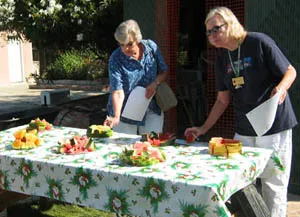
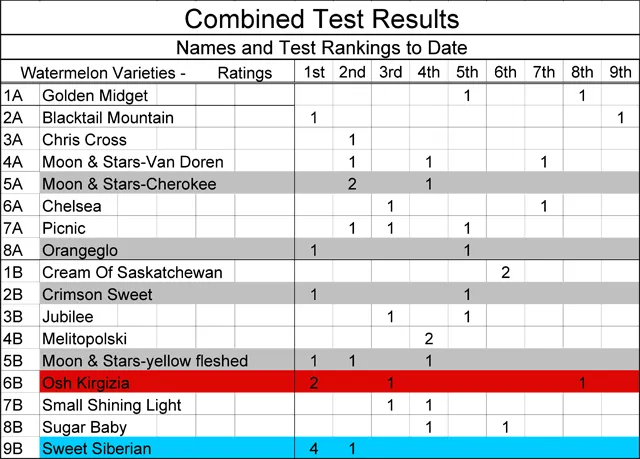
Taste tests were held nearly every Tuesday and Friday throughout the harvest season, July into October, with from two to ten melons being compared during each test. Two testing techniques were devised and results compared.The combined tasting results are shown in table that follows
Taste test winners were:
- Sweet Siberian
- Osh Kirgizia
- Orangeglo
- The three varieties of Moon & Stars battled for 4th place (Van Doren Strain, Cherokee Strain, Yellow Fleshed)
Pests & Diseases
During harvest, the two Golden Midget plants began to yellow and wither. Since they were located at opposite ends of different beds it was assumed to be a characteristic of that variety. Late in the harvest, a four-foot diameter sooty mold developed in the North raised bed but it was late enough it had little effect on production although it coated the surface of some melons with a sticky coating.
Photographs of the melons
A photograph of a whole melon of each variety was taken. The melon was then halved, and another picture was taken with a digital camera. The two photos of each were then merged using software to make the pictures shown below. Cracks in the flesh indicate the melon has past perfect ripeness. Usually, melons past perfect ripeness taste sweeter than at perfect ripeness,but also display a loss of flesh texture we have referred to as crunchiness.
Comments on “A” Group Melons
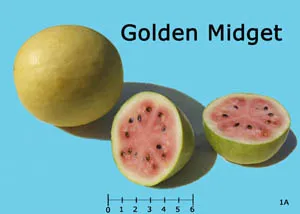
1A) Golden Midget
Packet Comments - Bred by Elwyn Meader and Albert Yeager, and introduced in 1959. It is the product of a cross between New Hampshire Midget and Pumpkin Rind. Melons are 6 to 8 inches in diameter, weighing 3 to 5 lb. The entire fruit turns golden yellow when ripe. The salmon pink flesh is pleasantly sweet. It ripens extremely early and is great for northern gardeners, ripening in 70 days.
Experimenter Comments - This is the only variety that failed to produce satisfactory tasting fruit. Fruits were 6 to 8 lb and 7 to 8 inch diameter with large black seeds. Flesh turned from salmon pink to salmon orange with expressed veining. Fruits were harvested from 83 to 175 days after seeding. Seed source was Seed Savers Exchange.
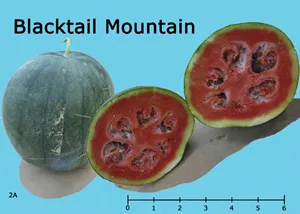
2A) Blacktail Mountain
Packet comments - Developed by Seed Savers Exchange (SSE) member Glenn Downs in northern Idaho where summer nights average 43 degrees F. Round 9 inch dark green fruits weigh 6 to 12 lb. Sweet, juicy, crunchy, scarlet flesh. This variety does well in hot humid climates also. It produces a very reliable crop, year after year at Heritage Farm in northeast Iowa on the Minnesota border. It ripens extra early, in 76 days.
Experimenter Comments—It was difficult to tell ripeness prior to picking. Most fruit was picked past optimum ripeness where an unattractive spider web looking growth in the area around the seeds began forming. Melon stayed sweet a long time, weighed 8 to 14 lb with an 8 to 10 inch diameter. Melons were harvested 99 to 136 days after seeding.
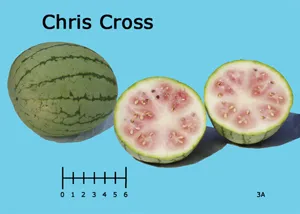
3A) Chris Cross
Packet Comments - The result of a cross between Hawksbury and Dixie Queen made by Chris Christensen in 1950 in Montrose Iowa. Good yields of 15 to 20 pound fruits. Good drought tolerance. 8 to 90 days.
Experimenter Comments - This variety never achieved the sweetness of a typical melon. Perhaps it needed higher temperatures. It had a wonderful, delicate, whitish-pinkish flesh color, lots of juice, and a nice crunchiness. Melons were harvested 89 to 149 days after seeding, weighed 15 to 30 lbs, and were 10 to 11 inches in diameter.
4A) Moon & Stars (Van Doren Strain) [no picture]
Packet Comments - Members of SSE searched for nearly a decade before Kent Whealy rediscovered this legendary watermelon on Merle Van Doren’s farm near Macon Missouri. Offered by Henry Fields during the 1930’s, these medium size oval dark green fruits are covered with pea size yellow stars and usually one larger yellow moon. Foliage is also spotted. The flesh is sweet and pink with brown seeds. Harvest 88 to 90 days, 25 to 40 lbs.
Experimenter Comments - Large almost round, 10 to 13 inches long. Dark green skin with yellow spots separates it easily from other varieties. Melon is 14 to 27 lbs and 9 to 11 inch diameter. Not quite as high on the tasting scale as the other Moon & Stars tested. Melons were harvested 117 to 58 days after seeding.
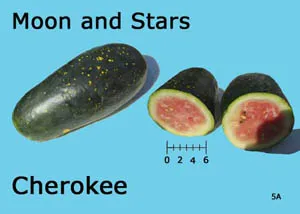
5A) Moon & Stars (Cherokee Strain)
Packet Comments - Foliage and fruit are spotted just like other Moon & Stars strains. Fruits are 20 to 24 inches long and 10 to 25 lbs. Bright pink, sweet flesh, black seeds. Keep plants continually watered to achieve uniform elongated fruit. 95 days.
Experimenter Comments - This is the better tasting of the two pink varieties. Most tasters placed the Yellow variety higher than either pink. Melons were 20 to 30 lbs, 16 to 20 inches long and 8 to 10 inch diameter. Harvested 90 to 153 days after seeding.
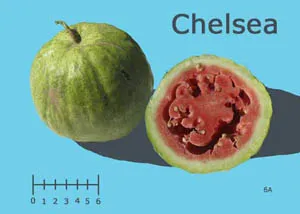
6A) Chelsea
Packet Comments - In the early 1900’s Chelsea, Iowa was famous for melons grown on the sandy hills north of town. Farmers filled their horse-drawn “triple box” wagons in the field, hauled them to town and sold melons from the wagons. Fruits weigh 15 to 20 lbs, are sweet with pink flesh. Will keep for several weeks once picked. 90 to 100 days.
Experimenter Comments - Only one of the two plants produced tested melons. They weighed 12 to 17 lbs, 8 to 9 inches long and 10 to 11 inch diameter which means they were wider than tall. Harvest period 117 to 136 days after seeding.
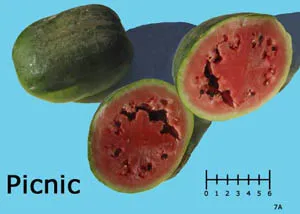
7A) Picnic
Packet Comments - Nice 8 to 12 lb fruits with sweet red flesh and small black seeds. Variety was bred by Asgrow Seed Company in 1972. Although a recent introduction, no commercial sources exist except SSE offers. Peacock type with more uniform flesh quality. Resistant to Fusarium wilt. 90 to 100 days.
Experimenter Comments - Fruits 9 to 20 lbs, 9 to 13 inches long, 7 to 9 inch diameter. Harvest period 102 to 146 days after seeding.
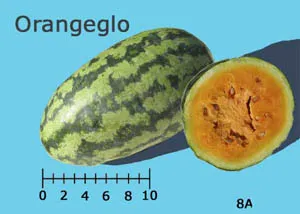
8A) Orangeglo
Packet Comments — Large 20 to 30 lb oblong fruit, very sweet crisp and flavorful with deep orange flesh. The rind is light-green with jagged dark green strips. It is an excellent producer at Heritage Farms and a favorite with the garden crew. Large seeds are cream colored with dark rings and tips, very distinct seed. The only orange-fleshed variety SSE offers, very nice in combination with yellow, white, pink and red watermelon varieties. 90 to 100 days.
Experimenter Comments — This is the finest, most impressive melon in the A Group. It is hard to imagine the vividness of this orange color, the same look an apricot shows as it comes out of the sulfur process before being dried. Wonderful orange color & Polynesian flavor, great melon ball contrast with other varieties. This is a great taste experience. The melon has large cream colored seeds with black eyes that look like little bugs! Fruits 13 to 23 lbs, 14 to 17 inches long, 8 to 10 inch diameter. The harvest period was 105 to 150 days from seeding.
Comments on “B” Group Melons from Web and the experimenters
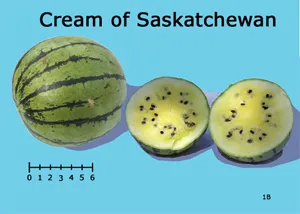
1B) Cream of Saskatchewan
Web Comments—Brought to Saskatchewan by Russian Immigrants. The rind is only one-fourth inch thick. The melon has sweet white flesh of exceptional flavor. It does well in cool northern climates. Handle with care due to the thin rind. Fruit is 4 to 10 lbs, round, 8 to 10 inch diameter. Skin is pale green with dark strips and cuts easily. 83 days.
Experimenter Comments—This melon was always a little light on sweetness but with excellent crunch and delicate flavor. The flesh was white to very pale yellow reminding one of a frosty Christmas. Seeds from the package were a blackish brown but at the tastings they were black. Fruit weighed 4 to 13 lbs, 6 to 9 inches long and 5 to 9 inch diameter. Harvest period was 95 to 157 days after seeding.
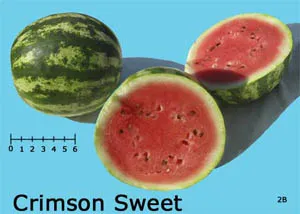
2B) Crimson Sweet
Web Comments—This is a main-season favorite with resistance to Fusarium Wilt and Anthracnose. It is very popular, an AAS/Winner-1964. Flesh is very crisp and exceptionally sweet. The plant allegedly promotes beneficial fungi that inhibit Fusarium Wilt. Weight is 15 to 25 lbs, 10 to 12 inches round with green skin with dark stripes, Flesh is a deep red. 85 days. Seed is from Ferry Morse.
Experimenter Comments—Has excellent sweetness, 14 to 19 lbs, 9 to 10 inches round melon, good producer of consistent size melons. Harvest period 95 to 157 days from seeding.
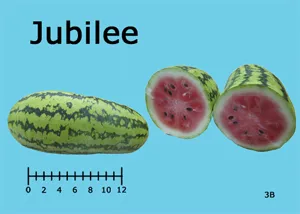
3B) Jubilee
Web Comments—Is one of the most popular varieties grown in the United States. The variety is resistant to Fusarium and Anthracnose. Crisp and very tasty, is widely distributed and grows vigorously in warm weather. Fruit is 25 to 40 lbs, with bright red color; rind is light green with dark green strips. 95 days. Seed is from Ferry Morse.
Experimenter Comments—Is very sweet with good watermelon taste, fruit weighs 24 to 30 lbs, 18 to 21 inches long, 8 to 10 inch diameter. The fruit was harvested 105 to 136 days after seeding.
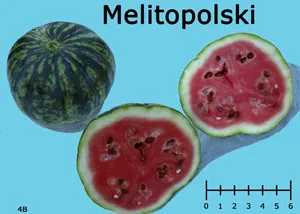
4B) Melitopolski
Web Comments—Is an early ripening variety with sweet red flesh from the Volga region of Russia, an area long famous for melons. They are piled high by Moscow street-venders in the summer. Fruits average 12 lbs, 10 to 12 inch diameter and are red fleshed, skin is light and dark striped, with large brown seeds. 95 days.
Experimenter Comments—This variety never scored high on taste tests. Produced 4 round 8 to 10 inch diameter fruits weighing 8 to 16 lbs. Flesh color was pink, not red as stated on the packet. Harvested wet seeds were beautiful polished cherry wood color. The fruit was harvested 114 to 160 days after seeding.
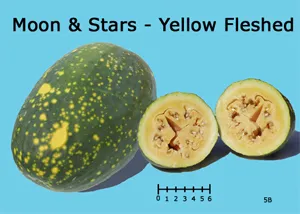
5B) Moon & Stars Yellow Fleshed
Web Comments—Yellow fleshed with rind and leaves spotted yellow like red fleshed Moon & Stars strains. Flavor is good but not as sweet red fleshed Moon & Stars. Fruits are 20 to 25 lbs, 18 to 24 inches long, oblong-shaped, with yellow flesh. 95 days.
Experimenter Comments—The yellow Moon & Stars strain placed slightly higher in taste tests than the two pink strains grown in this project, contrary to web-based information; plus the yellow flesh color was a big hit. Plants produced four melons weighing 12 to 18 lbs, 13 to 14 inches long and 8 to 9 inch diameter. The vine was a large robust plant with small yellow spots or stars on the leaves. The rind shows this same spotting pattern along with one yellow circle, usually one or more inches in diameter, called a moon. These are typical Moon & Stars characteristics. The fruit was harvested 100 to 150 days after seeding.
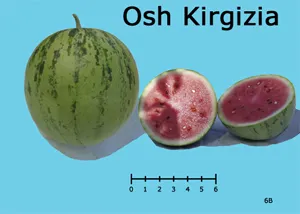
6B) Osh Kirgizia
Web Comments—This is a Russian variety introduced to U.S. gardeners by Seed Savers Exchange in 1992, a productive variety with sweet pink-red flesh. Weight from 10 to 15 lbs, round shape, pink flesh, small brown seeds, some reddish. 95 days.
Experimenter Comments—Osh Kirgizia is named after a city in southern Russia just above Afghanistan. The plants wielded nine fruit 6 to 12 lbs, 6 to 8 inches in length and 8 to 9 inch diameters. Rind color is light green with jagged thin dark strips. The seeds are an attractive redwood color. This variety placed second overall in taste testing and was very prolific. The fruit was harvested 122 to 157 days after seeding.
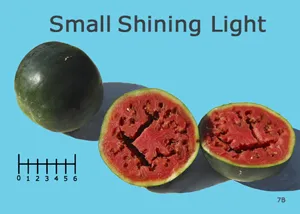
7B) Small Shining Light
Web Comments—This is a Russian variety with sweet red flesh introduced to U.S. by Seed Savers Exchange in 1991. This is a great Ice Box melon holding its flavor for weeks after picking. This variety is suitable for high altitudes and Northern climates. Fruit weighs 8 lbs and is 10 to 12 inch round with red flesh. The rind is very dark green without strips. Seeds are small brown. 88 days.
Experimenter Comments—Plants produced two round, red-fleshed melons 7 to 9 lbs that placed well in tastings. The rind is very dark solid green. Plants were not prolific. The fruit was harvested 117 to 136 days after seeding.
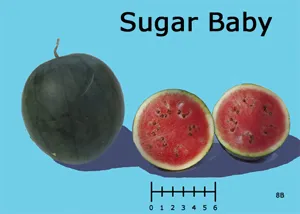
8) Sugar Baby
Web Comments—A small early season ice-box variety, very sweet. It was introduced in 1955. High in vitamins A, B and C, the melon is ripe when the underside is yellow and knuckle thumps produce a hollow sound. Vines are shorter than larger varieties. Fruits were 8 to 12 lbs, round, and 6 to 8 inch diameter. Seeds are small brownish black, from Ferry Morse. 78 days.
Experimenter Comments—Plants produced three 6 to 8 lbs melons, 7 to 8 inch diameter, round, dark bright red fleshed fruits. Plants not as prolific as expected. Melons appeared overripe before testing began. The fruit was harvested 122 to 157 days after seeding.
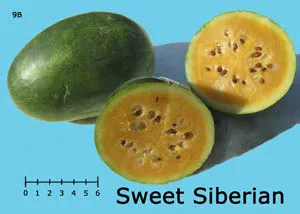
9B) Sweet Siberian
Web Comments—Was first introduced into U.S. in 1901, reintroduced by Seed Savors Exchange several years ago from USDA seeds. Weight is 6 to 8 lbs, red flesh, and dark green seeds. 83 days.
Experimenter Comments—Plants were very prolific, bearing 11 mature melons of 8 to 14 lbs, 7 to 13 inches long and 7 to 9 inch diameter, oblong fruit. The flesh of this melon is yellow with nearly black rind. Fruit weight 11 to 14 lbs, 11 to 14 inches long and 7 to 8 inch diameter, oblong shape. Planted tan seed and harvested small black seed. The fruit was harvested 95 to 157 days after seeding. Top ranking in taste tests.
Summary
Quality watermelons can be grown in the bay area using raised beds and low-cost passive heating techniques described in this document. Planting against south facing fences has been successful in previous years with Charleston Grey and Crimson Sweet varieties which are popular in retail stores in the area.
The taste test winners were Sweet Siberian first, Osh Kirgizia second, and Orangeglo third, with the three varieties of Moon & Stars battling for fourth place. The prizes for the heaviest melons go to Chris Cross, Moon & Stars-Cherokee and Jubilee, all about 30 pounds and Moon & Stars Van Doren at 27 pounds. The greatest girth goes to Moon & Stars Van Doren 34.5 inches, Chelsea 32 inches and Orangeglo 30 inches. The longest was Moon & Stars Cherokee at 28 inches.
Leads: Mike Kent & Sally Pyle
Camera Operators: Fred Schulenburg, Sally Pyle
Chief Editor: Karen Schaffer
Research and Signage: Lise Varner
Digital Magic: Fred Schulenburg
Plant Foster Mother: Sally Pyle
Slicing Professor: Bader Kudsi
Master Melon Pickers: Ed Luksus, Sandy Moisenco
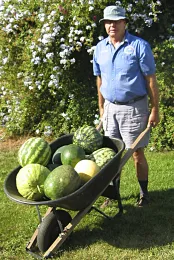
1st Grip & Wheelbarrow Operator: Mike Kent