
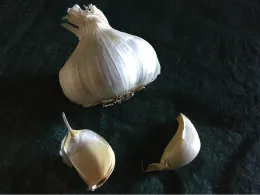
There are two main types of garlic: softneck, which produces numerous smaller cloves, and hardneck, which has fewer, larger cloves surrounding a stalk or “scape”. Elephant garlic is not a true garlic (more closely related to leeks), but its cultivation is similar to that of true garlics. It has very large, mild-flavored cloves.
Cultural Tips for Growing Onions and Garlic, UC IPM
Soil preparation
- Garlic tolerates a wide variety of soils, but does best in loose, loamy soil with high organic matter (i.e. compost) that provides good drainage. Boggy or wet soil can cause cloves to rot or develop poorly.
- If it hasn’t rained yet, water the bed a few days before planting so that the soil is damp.
Planting
- Garlic is best planted in late fall, at least two weeks before the first frost (mid-October through the end of November).
- Select a sunny spot that gets at least 8 hours of direct sun.
- When ready to plant, break the bulb into individual cloves, taking care not to damage the very bottom of the head. Do not remove the papery skin from the individual cloves (the skin protects the cloves from rotting).
- Choose the largest cloves for planting since the size of the clove typically determines the size of the bulb it develops.
- Small cloves can be planted 2 inches apart and grown for spring green garlic, which can be harvested before bulbs develop. Alternatively, simply use the small cloves for cooking.
- Plant cloves 4 to 6 inches apart and 1 to 2 inches deep, with the root end (flat part) down and the pointy tip up.
- If a scape appears (a central stalk), remove it to preserve the bulb size. Scapes are edible when young and tender.
Watering and fertilizing
- In a typical winter, garlic does not need additional watering, but occasionally watering might be needed during a dry winter.
- When the weather begins to warm, typically early March, fertilize garlic by side-dressing (digging fertilizer into a trench 4 inches away from the plants) or by watering with a liquid fertilizer such as dilute fish emulsion.
- Stop watering in May when the garlic tops begin to turn yellow. That is the cue for the garlic to develop its cloves. The bulbs need to remain in the ground for several more weeks.
Harvesting, curing, and storage
- After the tops turn brown, around mid-June, dig them up. Be careful not to nick the bulbs when digging.
- Cure the bulbs for about two weeks after harvest by placing them in a warm place with good air circulation and no direct sun.
- After curing, cut off the stalks, leaving about an inch at the top, and trim the beard (roots). Gently brush off the outer coating and store in mesh or paper bags, or hang together in a dark place with good air circulation.
- Alternatively, the tops may be braided into a rope for hanging.
- The ideal storage temperature is 60 to 65 degrees F.
Final tips
Here is a handy mnemonic for remembering all of these tasks: Plant by Thanksgiving (November), fertilize around St. Patrick’s Day (March), stop watering by Mother’s Day (May), and harvest around Father’s Day (June).
Be sure to keep some of your garlic for replanting. Save the best and eat the rest!
Pest management
Onion and garlic pests and disorders, UC IPM
More links
- Garlic: Safe Methods to Store, Preserve, and Enjoy, UC ANR publication 8568
- Video: How to Grow Garlic [2:17]
- Video: How to Grow and Harvest Elephant Garlic [5:12]
- Video: When to Fertilize Garlic [0:56], with Fertilizing Garlic Demonstration [0:54]
Recommended varieties for Santa Clara County*
California Early White — A subtle, mild-tasting garlic variety developed for the California garlic industry, known as Gilroy garlic
California Late White — One of the two Gilroy cultivars
Chesnok Red — A true medium hardneck garlic with purple stripes
Inchelium Red — A soft neck garlic that is mild at harvest but increases in flavor during storage, with just a touch of spicy heat
Music — Full-flavored, rich aromatic flavor. It is a go-to for many first-time growers
Spanish Benitee — Mild pungency with long storability
Susanville — Considered an improved selection of California Early
Other recommended varieties: Burgundy, Georgia Crystal, Rosewood
* Many other varieties may also do well here in Santa Clara County. This list is based on UC Master Gardener trials, taste tests, and feedback from local growers.