
Garden Help > Fruits & Nuts > Citrus
Sections
Site selection
Citrus are attractive, long-lived evergreen plants that require sun and warmth to produce flavorful fruits. Choose the sunniest, warmest location available. A southwestern exposure or a location that receives reflective warmth (from a surface such as a driveway, patio, wall, or pool) would be excellent.
Avoid planting citrus trees in the lawn if possible, since lawns and citrus have different water and fertilizer needs. If it’s necessary, maintain a mulched, grass-free area beneath the tree.
Plant selection
Select appropriate varieties for your climate.
- Oranges, grapefruit, and blood oranges need sufficient heat for pigmentation and sweetness.
- Limes and most lemons do not need full sun or long periods of heat to ripen fruit.
Choose rootstock to control the mature size and impart cold hardiness.
- Large, full-size trees will need at least a 12-by-12-foot space
- Semi-dwarf trees will need an 8-by-8-foot space.
- The only true dwarfing rootstock is Flying Dragon, which will yield a 4 to 8-foot-tall tree.
- Some types are naturally small: Improved Meyer lemon, Satsuma mandarin, and some kumquats.
See discussion of citrus types and varieties below.
Planting citrus
Choose young trees in small containers. Look for healthy leaves and roots.
- The planting hole should be twice as wide as the root ball, but only as deep as the root ball.
- Do not add amendments or fertilizer to the planting hole; trees grow best when their roots grow into the native soil.
- To ensure good drainage, position the top of the root ball one inch above the surrounding soil level.
- Make a watering basin around newly planted citrus, but keep water away from the trunk.
- Protect the trunk from sunburn by painting it with white interior latex paint diluted 1 to 1 with water.
Irrigation
It’s important to keep the rootball of newly planted trees moist, but not soggy. Newly planted citrus need frequent watering, possibly 2 or 3 times a week in hot weather.
For established trees, allow the top 3 to 6 inches of soil to dry before watering. Mature trees need deep watering 1 to 2 times per month in warm weather (4 to 6 inches of water/month in mid-summer), less frequent watering in cool weather, and none during rains.
Water under the canopy and slightly beyond the drip line for established trees. Do not allow water to contact the tree’s trunk. Hand watering, drip emitters, microsprayers, sprinklers, or soaker hose can all be used.
Maintain a 3 to 4 inch layer of mulch under the tree to conserve moisture and suppress weeds. Keep mulch 6 to 12 inches away from the trunk.
Fertilizing and nutrient deficiencies
For new trees, use small amounts of nitrogen fertilizer (1 tablespoon each month from May to August). Double the total amount of fertilizer used each year until the tree is 4 to 5 years old.
For full-size mature trees (5+ years), apply up to 1 pound of actual nitrogen per year. Smaller trees need less, ⅓ to ½ lb. Divide the application to two or three times a year: February or March before bloom, early May, and maybe a third application in June. Read the directions on the package carefully, and do not over fertilize, which can lead to other problems.
Yellowing of older leaves may indicate a nitrogen deficiency, but it is also common in the winter. Citrus roots do not absorb nitrogen efficiently from cold, wet soils. If adequate nitrogen is present, the leaves will green up in the spring as the soil warms up and dries out. Identify the issues first, before applying fertilizer.
Common micronutrient deficiencies in California citrus are iron, zinc, and manganese:
- Symptom: yellowing between veins on new growth
- Treat with a complete citrus fertilizer containing micronutrients.
Pruning
Citrus can be productive without pruning, but opening the center of the tree to light increases production.
During the first 2 to 3 years of growth, prune only to remove suckers that appear below the graft and any highly vigorous, vertical shoots (watersprouts) that are too close to other branches (common on lemons).
As the tree reaches fruiting age ( about 5 years old), prune to establish good tree form:
- Remove any dead, crossing, or too closely spaced wood that forms in the center.
- Prune off branches that touch the ground (the “skirt” of the tree) to help control snails, rats, ants, and disease.
- Prune for ornamental reasons or to control size. Citrus tolerates pruning well.
March is the best time for pruning in Santa Clara County. If ripe fruit is on the tree at this time (Valencia oranges, lemons), you can prune later, up to late summer.
Freeze protection and frost hardiness
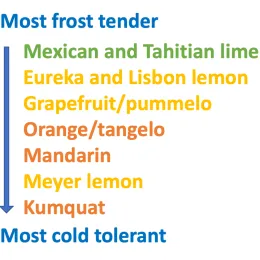
Citrus vary in cold tolerance, but most suffer when the temperature drops below 28 degrees for more than a few hours. When below-freezing temperatures are predicted:
- Pick ripe fruit to prevent freezing.
- Make sure the tree is well watered.
- Cover trunks of young trees with insulating material such as burlap or newspaper.
- Cover the foliage of small trees with a light sheet, row cover, or frost blanket.
- Strings of outdoor lights can be hung in the tree to provide some localized heat. Not LEDs, because they don’t provide enough heat.
If a tree is damaged by frost, remove damaged fruit, but wait several months before pruning damaged leaves or branches.
Fruit development and harvesting
During the first 3 or 4 years after planting a citrus tree, fruit production is light; this period is known as the nonbearing years. Major root growth occurs during this period, and the framework of the tree is developing for fruit production.
It is normal for a tree to drop many, if not most, young fruit, so don’t be alarmed. Many varieties alternate bear, i.e., have a heavy crop one year, then a light crop the next year.
Allow fruit to ripen fully on the tree because the fruit does not continue to ripen once picked. Taste fruit periodically and pick when it suits your taste. Color is not a reliable indicator of ripeness, since orange color is a response to cold nights. Fruit from older trees may vary in taste from year to year, especially depending on the warmth of any given year.
Container growing
Growing citrus in containers is an option for small spaces, borderline climates, or no access to in-ground planting.
- Use half-barrel size or at least 15-gallon containers for most varieties.
- Use potting soil and add slow-release fertilizer, or use liquid fertilizer once or twice a month. Use a complete fertilizer that includes micronutrients.
- Water regularly, when the top 2 to 3 inches of soil dry out. Applying water slowly is best.
- Mulch the soil surface in the container.
- Be ready to re-pot as roots fill the container and soil breaks down over time.
- For ease of maintenance, choose trees on fully dwarfing rootstock (Flying Dragon) or naturally smaller trees such as kumquats, mandarins, or Meyer lemon.
Common citrus pests
For additional citrus pests, see UC IPM Citrus.
Pests that suck juices from leaves and excrete honeydew
- Aphids are most noticeable in early spring. Found on the underside of leaves, particularly on new growth. Feeding can cause new leaves to curl. Populations decline when hot weather arrives.
- Whitefly feeds in groups on the undersides of leaves. Name derived from the mealy, white wax covering the wings and body of the adult insect. The nymph stage is wingless.
- Soft scale, such as brown soft scale, black, or citricola scale. Immature scales and adult females have a characteristic round or oval to elongate and flattened or humped appearance. Scales insert a tiny, straw-like mouthpart into plants and suck fluids. Scales can occur on bark, fruit, or leaves.
- Mealybugs are soft, oval, segmented insects that are usually covered with a white or gray mealy wax. This waxy covering is similar to that produced by cottony cushion scales. Colonies occur as white, sticky clusters among leaves and fruit.
A related pest is sooty mold, a fungus that grows on the honeydew excreted by sucking insects. It does not directly harm plants, but if it heavily covers the leaves, it may reduce photosynthesis. The presence of sooty mold is a clue that the tree has been infested by some kind of sucking insect.
To manage honeydew-excreting pests
- Control ants by putting a band of sticky material around the tree’s trunk to prevent ants from entering the tree. Ants consume honeydew excreted by aphids, soft scale, and mealybugs, so they protect these pests from natural enemies. Do not apply sticky material directly to the bark of young trees. Wrap the trunk with fabric, paper tree wrap, or duct tape, and apply sticky material to the wrap.
- Prune branches touching buildings, the ground, fences, or other trees to eliminate additional entry points into the tree.
- Encourage predatory and parasitic insects that control pests. Do not use insecticides. Plant flowering plants to provide pollen and nectar for these “natural enemies.”
- Do not overfertilize, as it encourages rapid, tender growth that attracts pests.
- Rinse the tree off with a strong stream of water to wash off some pests, honeydew, and sooty mold and to reduce dust, which favors a number of insect pests.
- Learn to tolerate some pests. Healthy citrus trees can tolerate low levels of pests.
- Insecticidal soap or summer horticultural oils, specifically recommended for summer spraying of citrus, are a last resort if all of the above methods have not provided adequate control. Follow label directions exactly. In deciding whether to use these materials, recognize that they will also kill natural enemies of the pests you are trying to control.
Other citrus pests
- California red scale, an armored scale. Armored scales do not produce honeydew. To control, encourage natural enemies such as parasitic wasps. Prune out severely infested branches, or consider one spray with summer oil, July to September, for severe infestations.
- Snails and slugs chew holes in leaves and fruit. To control, prune the tree’s skirt away from the ground to limit access. Trap snails and slugs under boards and/or handpick them at night. Wrap the trunk with strips of copper. If necessary, use an iron phosphate control.
- Citrus leafminer is a small, light-colored moth whose larva feeds between the tissues of tender young leaves and is most common after a flush of new growth. When the larva pupates, it curls the leaf’s edge around itself for protection. Damage is cosmetic, so spraying isn’t necessary. Avoid heavy pruning in summer or fall, as it stimulates new growth that attracts this pest. Encourage parasitic wasps that help with control.
- Asian citrus psyllid, a brown insect the size of an aphid, can vector a bacterium that causes a devastating, incurable citrus disease, Huanglongbing (HLB). Psyllid nymphs feed on young tissue and produce curly, waxy tubules that can be used to identify this invasive pest. The psyllid is established in southern California and has been found in many places in the Bay Area, which are now under quarantine. As of April 2026, over 10,500 trees in Southern California home gardens have been confirmed to have the disease and have been, or are slated to be, removed and destroyed (CDFA reference). At present, the best hope of controlling the spread of the disease is to control the insect. Visit the California Citrus Threat site to see how to inspect your citrus trees. If you suspect you have this pest, call the CDFA hotline 800-491-1899 or the Santa Clara County agricultural commissioner (408) 918-4600 immediately.
Varieties of citrus
Climate determines whether a particular type of citrus will produce quality fruit in your garden. Santa Clara County’s climate is best for navel and Valencia oranges, some mandarins, lemons, limes, Meyer lemons. kumquats, and oroblanco grapefruit. Extend your harvest by choosing varieties that ripen at different times. Pay attention to the tree size at maturity and choose citrus on rootstock that will work for the space available.
Oranges
- Navel — Standard tree 20 to 25 feet high, dwarf 8 feet tall. Cool nights and warm days are ideal for developing good flavor and a bright-colored rind. Taste to determine the time to harvest. Fruit holds well on the tree. Juice turns bitter soon after squeezing. Easy to peel, seedless.
- Washington Navel — Harvest December to May.
- Other varieties: Robertson, Lane Late, Trovita, Cara Cara (pink flesh)
- Valencia — Large tree, harvest April to October. Thin-skinned, very juicy, few seeds. Fruit stores well on the tree, improving in flavor, but may re-green with summer heat.
- Blood oranges — Medium-sized tree, slow to start bearing. The extent of color depends on climate, fruit maturity, and variety. Moro is recommended for Santa Clara County. Harvest from February to April. Has a tendency to alternate bear.
- Sour oranges — Often used for landscaping as well as marmalade or perfume. Fruit not palatable for most people. Varieties: Chinotto, Seville, Bouquet de Fleurs, Bergamot.
Mandarins and mandarin hybrids
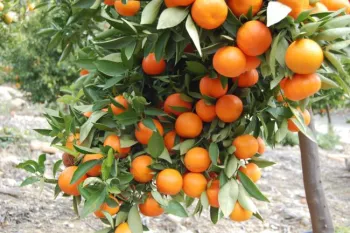
The largest, most varied group of edible citrus. Most varieties alternate bear. Good varieties for Santa Clara County include:
- Satsuma — A group of varieties including Owari. Early ripening and very cold-hardy. Harvest from December to April, depending on variety. Rind may still be green when the fruit is ready to eat. Seedless. Fruit does not hold well on the tree. Small, slower-growing tree.
- Mandarin — A group of varieties. Seedless if grown without a cross-pollinizer. Fruit holds well on the tree. Harvest January to April.
- Encore — Very late ripening (May to July).
- Nova — A cross between Orlando tangelo and clementine mandarin. Harvest from January to February.
- Page — Cross between Minneola tangelo and clementine mandarin. Small fruit holds well on medium to large trees. Harvest February to May.
- Shasta Gold — Harvest January to March.
- Tangelo — A cross between a tangerine and a grapefruit or pomelo
- Minneola, also called Honeybell. Large fruit with a prominent neck. Thin skin, easy to peel. Will produce better with a related pollinator variety. Harvest December to February.
Lemons
- Eureka — Vigorous tree requires pruning to keep under control. Fruit holds well. Some fruit year-round, but the main harvest is in late winter and spring. Frost tender.
- Pink variegated — Attractive variety with variegated leaves, striped rind, pink flesh. A sport of Eureka.
- Improved Meyer — Naturally occurring hybrid between a lemon and mandarin or orange. Improved Meyer is free of tristeza virus. Frost hardy into the low 20s. Small, ornamental tree, good container plant or hedge. Fruit holds well on the tree and is borne almost year-round; harvest is heaviest in late winter and spring.
Limes
Tahitian or Persian limes — Bearss variety is recommended for Santa Clara County. Hardier than Mexican/West Indian (Key) lime, not as hardy as lemon. Attractive small tree. Seedless, ripens to yellow; doesn’t hold well on the tree once ripe. Harvest August to March.
Kumquats
Fortunella genus. Eaten whole, including rind. Fruit is cold-sensitive, but the plant can withstand temperatures down to 20°F. Small, compact trees make excellent ornamental or container plants. Blooms late, in summer; harvest January to April. Fruit holds well on the tree. Varieties: Meiwa (round fruit), Nagami (oval fruit).
Other unusual citrus for Santa Clara County gardens
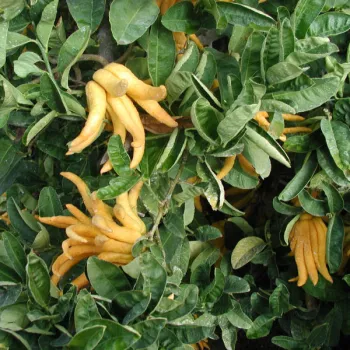
Buddha’s Hand citron — The fragrant and ornamental fruit is mostly rind. Thorny tree, very cold sensitive. Everbearing
- Oroblanco — A hybrid between grapefruit and pummelo, with lower heat requirement than grapefruit. Large attractive trees. Harvest January to April.
- Kumquat hybrids — Limequat, orangequat, and the highly ornamental calamondin
- Makrut lime — The leaves as well as the fruit are used in Thai food. Also known as Thai or Indonesian lime