
Since the first week of August 2024, the UC Cooperative Extension Entomology program in Imperial County has maintained a yellow sticky trap network across the Imperial Valley. This trap network aimed to facilitate landscape-level monitoring of the population dynamics of adult whiteflies, western flower thrips, flea beetles, and aphids throughout the year. The trap set up in the field consists of a 6 X 12 in (15.2 x 30.5 cm) yellow sticky trap (Olson Products, Medina, OH), shaped into a cylinder, attached to a wooden stake using a binder clip, and positioned about 60 cm above the ground (Fig. 1A and 1B).
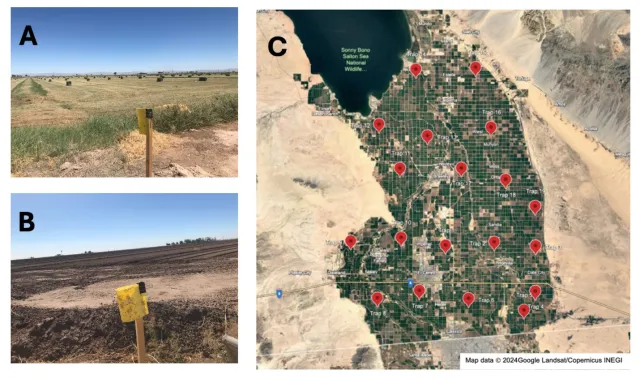
The traps are distributed throughout the Imperial Valley, covering the major agricultural locations (Fig. 1C). Insects that are attracted to the yellow color of the traps and those that land on the surface of the trap during the flight get trapped on its sticky surface. The traps are replaced weekly and are examined in the laboratory under a stereo microscope to count the pest population.
Insect count data from these traps identify the adult insect activity of targeted pests around the field. Since several biological and physical factors and farm operations (insecticide sprays, dust from the land preparation, crop harvest, etc.) can influence insect counts in the traps, the insect numbers in sticky traps do not always strongly correlate to the actual infestation levels in the grower’s field. Despite this, trap counts are a valuable indicator of adult insect movement across the landscape. Moreover, collecting trap data over multiple years will help establish a baseline of pest activity throughout the season. This historical pest data can then be compared with current trap captures to identify population trends. The traps are also screened for potential invasive insect pests, including Asian citrus psyllids, spotted lanternflies, and Mexican fruit flies.
Summarized trap-count data are published on this page approximately every 2 weeks. Additionally, this trap data can be accessed and visualized in the web app.
This project is supported by the Imperial County Agricultural Benefits Program grant (2024-2027).
Insect Count Updates: 01 June 2026
Whiteflies: The whitefly counts in the traps consisted mainly of sweetpotato whitefly (Bemisia tabaci MEAM1), but also a small fraction (< 5%) of bandedwinged whiteflies, Trialeurodes abutilonia, and other minor whitefly species. Currently, the trap counts indicate very high adult whitefly activity, above average for the time of the year.
Aphids. The trap-count data for aphids do not focus on any single species and represent the aphid complex in the Valley. Currently, we are observing near-zero alate (winged) aphid population pressure in the traps, which is typical of the seasonal average.
Flea beetles. The flea beetle counts on the traps comprised the pale-striped flea beetle, Systena blanda, the desert corn flea beetle, Chaetocnema ectypa, and other minor species. Currently, we are observing low adult population pressure across the Imperial Valley.
Western flower thrips. Several thrip species were captured in the traps, but only western flower thrips (Frankliniella occidentalis), the major thrip species of concern for several crops in the Imperial Valley, were counted. Currently, we are observing relatively low population pressure in our traps.
Bermudagrass stem maggot. Bermudagrass stem maggot (BSM; Atherigona reversura Villeneuve) is a relatively new invasive pest species in the Imperial Valley. We had higher-than-normal pest pressure in late summer and fall of 2025. Anticipating that a larger residual pest population from 2025 will serve as the base for the 2026 season, we are expanding the monitoring program to include this pest in future pest population updates. Current adult counts in the traps are relatively low, comparable to the 2025 average during the time of the season
If you are interested in additional data from this project or have questions or comments, please contact Arun Babu at (442) 265-7700 or arbabu@ucanr.edu.
Acknowledgements
This project is being supported by the Imperial County Agricultural Benefit Program grant (2024-2027).