
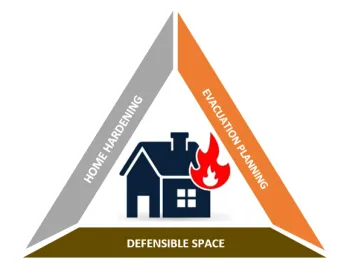
Living in the Lost Sierra means living with wildfire. Although it can feel overwhelming at times, there are proven steps you can take to prepare yourself, your property, and your neighborhood for the next wildfire. Home hardening, defensible space, and evacuation planning are all essential to help reduce your wildfire risk.
Cal Fire's Ready for Wildfire site and the UC ANR Fire Network's Wildfire Preparedness page are great resources to get started.
On this page:
Home Hardening
Visit the UC ANR Fire Network home hardening page to identify vulnerabilities in different aspects of your home and what you can do to address them.
View some low-cost retrofitting options (PDF, 5 MB) to help harden your home.
Explore an in-depth wildfire home retrofit guide (PDF, 4 MB) with specific recommendations on how to improve different aspects of your home.
Watch this series of short videos from UC ANR that covers the fundamental principles of home hardening by identifying the vulnerabilities of different structure components.
Defensible Space
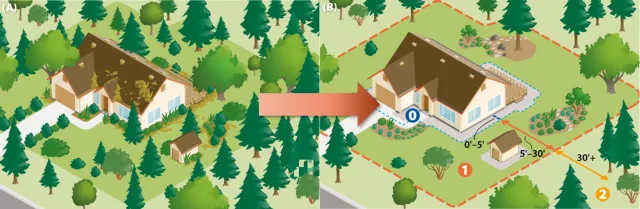
Learn how to manage vegetation and landscaping (PDF, 4 MB) around your home to reduce vulnerability to wildfire.
Make sure you acquire the proper permits (PDF, 1 MB) if needed before implementing forest fuel reduction projects on private lands.
Develop a thinning prescription (PDF, 0.3 MB) when considering which trees to remove for defensible space.
Evacuation Planning
Develop a wildfire action plan to ensure everyone in your household is well-prepared in the event of a wildfire evacuation.
Assemble your go-bag with emergency supplies and important valuables before an emergency evacuation occurs.
Review steps for emergency evacuation to help ensure a safe and efficient evacuation process.
Sign up for local emergency alerts to be notified by phone or email when an emergency situation arises. Do not rely solely on emergency services since damaged infrastructure can stop alert messages from getting to you. If you feel unsafe, evacuate.
Visit your county's Office of Emergency Services site to find local resources for emergency planning and preparedness.
Complete and print out this Resident Identification Card and place it in your front window before evacuating to assist first responders during evacuation orders.
- Printable Resident Identification Card - English (PDF, 12 KB)
- Imprimible información del residente - Español (PDF, 28 KB)
Smoke Readiness
View the AirNow Fire and Smoke Map to monitor air quality in your area.
Read the UC ANR Fire Network's resource guide to learn about smoke health effects, strategies to reduce smoke exposure, and more.
Learn more about how to protect yourself from wildfire smoke, including how to build your own cost-effective air filter.
Ranches and Farms
View the UC ANR Fire Network's guidelines on wildfire preparedness for farms and ranches.
Sign up for your local AgPass program so commercial livestock operators can access restricted areas following a natural disaster in order to provide care for livestock. To sign up in Plumas or Sierra Counties, contact Tracy Schohr, UCCE Livestock and Natural Resources Advisor (tkschohr@ucanr.edu, 916-716-2643) or Willo Vieira, Plumas-Sierra County Agricultural Commissioner (willovieira@countyofplumas.com, 530-283-6365).

Other Resources
The Firewise USA Program provides a structured way for communities to increase their wildfire resilience. View this map to find your local Firewise community.
The Plumas County Fire Safe Council offers a variety of programs, including:
- Hazardous Fuel Reduction
- Defensible Space Assistance for Senior and Disabled Residents
- Community Chipping Program
- Community-Led Prescribed Burning
- Fire Safe Home Visits
- HEPA Air Purifier Loan Program
Check out these ten steps the California Department of Insurance recommends you take to help qualify for a home insurance discount.
Visit this site for next steps if you have recently been dropped by your home insurer.
Reach out to your local forest advisor Kane Russell if you can't find what you're looking for or want to know more.