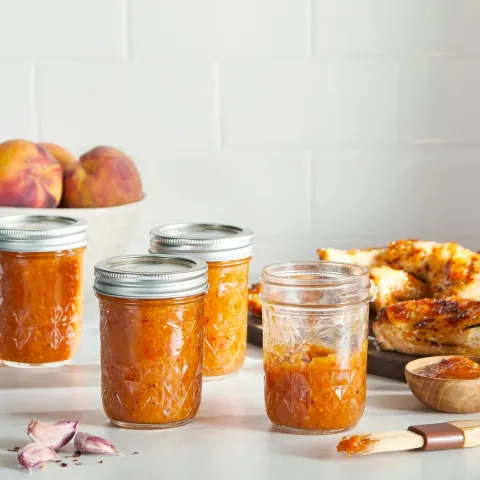
Food Preservation


Central Sierra: Extending Apple & Pear Season in El Dorado County
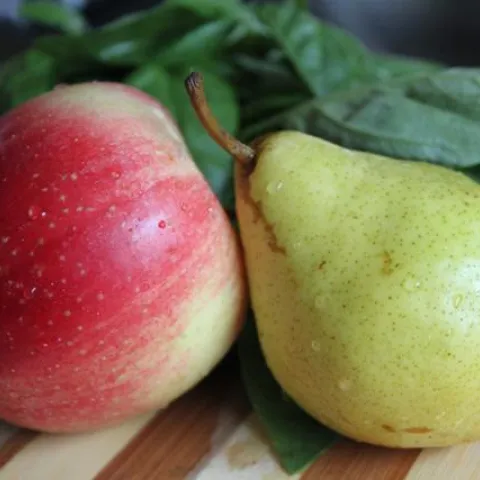
Don't say goodbye to apples and pears yet
Apples and pears have a long and distinguished history in El Dorado County agriculture. Locals and tourists alike appreciate our fine mountain autumn fruit. Right now, it's late in apple and pear season here in Camino, and most of the fruits will be gone once the main attraction becomes Christmas trees. While apples store well, fresh mountain pears will no longer be available.
Enjoy the autumn harvest all year long
The following recipe is a mixed-fruit jam that will provide you with reminders of the autumn season all year long. Make sure to use liquid pectin for this recipe.
Pear-Apple Jam
Yield: About 7 to 8 half-pints
2 cups peeled, cored, and finely chopped pears (about 2 lbs)
1 cup peeled, cored, and finely chopped apples
61⁄2 cups sugar
1⁄4 tsp ground cinnamon
1⁄3 cup bottled lemon juice
6 oz liquid pectin (2 pouches)
- Prepare boiling-water canner or atmospheric steam canner. Heat jars in canner until ready to use, do not boil. Wash lids in warm soapy water and set aside with bands.
- Wash apples and pears under cold running water, drain.
- Peel and core pears. Crush well and measure 2 cups into a large saucepan. Peel and core apples. Finely chop 1 cup of apples. Add apples to pears and stir in cinnamon.
- Thoroughly mix sugar and lemon juice into fruits and bring to a boil over high heat, stirring constantly.
- Immediately stir in pectin.
- Bring to a full, rolling boil and boil for 1 minute, stirring constantly.
- Remove from heat and quickly skim off foam.
- Fill a hot half-pint jar, leaving ¼-inch headspace. Remove air bubbles. Clean jar rim. Center lid on jar and adjust band to fingertip tight. Place jar in canner with simmering water (180 degrees F). Repeat until all jars are filled.
- Water must cover jars by one inch in boiling water canner or come to the base of the rack in a steam canner. Adjust heat to medium-high, cover canner, and bring water to a rolling boil in a boiling-water canner or until there’s a steady stream of steam coming from the steam canner for 1 minute. Start timing and process pint jars: 10 minutes at 0 – 1,000 feet elevation, 15 minutes at 1,001 – 6,000 feet, and 20 minutes at 6,001 – 8,000 feet.
- Turn off heat. For boiling water canner, remove lid and let jars stand 5 minutes. For atmospheric steam canner, let canner sit undisturbed for 5 minutes, then remove lid. Remove jars and cool 12-24 hours. Check seals (they should not flex when center is pressed). Label, date, and store in a cool dark place.
This delicious jam can be used on toast, of course, but also in yogurt, on pancakes, or as a glaze on roast poultry. Put it out on a charcuterie board with a soft cheese and crackers for a tasty treat during the holidays.
The UC Master Food Preservers of El Dorado County are a great resource for answers to your food safety and preserving questions. Please find our Ask a Master Food Preserver survey in the link below.
This article, written by UC Master Food Preserver of El Dorado County Monique Wilber, originally appeared in the Mountain Democrat in 2014. It was updated by Laurie Lewis in October 2025. The source of the recipe is PennState Extension (2023).
Central Sierra: Saving the Last of the Zucchini (Until you can appreciate it again)

Preserve It! Oh Dear, the Zucchini!
Pickling is one of the oldest methods of food preservation. Queen Cleopatra attributed her legendary beauty as well as her health to the pickles in her diet. Roman troops were given pickles in their diet believing it would make them strong.
What if you don’t have many pickling cucumbers? No problem. Make some sweet, tangy pickles with all those zucchinis you can’t give away this time of year. These pickles make a wonderful addition to your charcuterie board for the holidays.
This recipe hails from National Center for Home Food Preservation (NCHFP), University of Georgia.
Bread and Butter Zucchini Pickles
Yield: About 8-to-9-pint jars
16 cups sliced zucchini squash (or other summer squash or cucumbers)
4 cups thinly sliced onions (about 1 ½ pounds medium onions)
½ cup pickling or canning salt
4 cups white vinegar, 5% acidity
2 cups sugar
2 teaspoons ground turmeric
2 Tablespoons celery seed
4 Tablespoons mustard seed
Slice zucchini into rounds, one-quarter-inch thick. Slice onions into one-quarter-inch thick slices. Place sliced vegetables in a large flat glass or plastic container. Cover sliced vegetables with one inch of water and the salt. Let stand for two hours. Add ice cubes over the top, if desired.
Meanwhile, prepare boiling-water canner or atmospheric steam canner. Heat cleaned jars in canner until ready to use, do not boil (simmering water at 180 degrees F). Wash lids in warm soapy water and set aside with bands.
Drain vegetables thoroughly after the two hours. Rinse vegetables in cool water if you desire a less salty product.
Bring spices, sugar, and vinegar to a boil in a large stainless-steel saucepan. Add the sliced vegetables to the spice/vinegar mixture. Bring the mixture to a boil. Simmer for five minutes.
Pack zucchini and onions into a hot jar, leaving half-inch headspace. Remove air bubbles and adjust headspace, if necessary. Clean jar rim. Center lid on jar. Screw band down until resistance is met, then increase to fingertip tight. Place jar in canner. Repeat until all jars are filled.
Water must cover jars by at least one inch in boiling water canner or come to the base of the rack in a steam canner. Adjust heat to medium-high, cover canner, and bring water to a rolling boil in a boiling-water canner or until there’s a steady stream of steam coming from the steam canner for 1 minute. Start timing and process half-pint jars: 10 minutes at 0 – 1,000 feet elevation, 15 minutes at 1,001 – 6,000 feet, 20 minutes at 6,001feet and above.
Turn off heat. For boiling water canner, remove lid and let jars stand five minutes. For atmospheric steam canner, let canner sit undisturbed for 5 minutes, then remove lid. Remove jars and cool on a toweled surface 12-24 hours. Check lids for seal (they should not flex when center is pressed). Label, date, and store in a cool dark place.
The UC Master Food Preservers of El Dorado County are a great resource for answers to your food safety and preserving questions. Use our "Ask a Master Food Preserver" tool to submit your question and a volunteer will get in touch with you ASAP.
This article by UC Master Food Preserver Laurie Lewis originally appeared in the Mountain Democrat.
Central Sierra: Think Georgia Produces the Most Peaches? Think again!

Preserve It! Peaches!
Don't Hesitate to Buy Loads of Fuzzy Peaches (in season!)
Have you noticed that fresh peaches have more fuzz than peaches in grocery stores? Before peaches are sold in grocery stores, some of the fuzz is removed to make it more appealing. It is thought that too much fuzz on a peach might look like mold to consumers. Why do peaches have fuzz? It is believed that the fuzz repels extra moisture outside of the fruit and helps trap moisture inside the fruit, keeping it from drying out.
While one might think of the state of Georgia as the peach state, California is the largest producer of peaches in the country. Living so close to peach orchards in the Placerville area, it’s easy to over-purchase, coming home with more fresh fruit than can be eaten right away. Don’t fight the urge. Just can up some peaches in syrup, freeze some for pies this winter, or make the recipe below. This recipe comes from The All New Ball Book of Canning and Preserving, 2023. This would be delicious as a glaze over a grilled or roasted meat or on some fresh out-of-the-oven English muffins.
Peach-Ginger Butter
Makes about six half-pint jars
10 cups coarsely chopped fresh peaches (about 12 medium)*
½ cup water
½ cup finely chopped crystallized ginger
2 tsp lemon zest
2 Tbsp bottled lemon juice
3 cups sugar
Combine first five ingredients in a six-quart stainless steel pot. Bring to a boil over medium-high heat, stirring often. Reduce heat, and simmer, uncovered, 15 minutes or until peaches are tender, stirring occasionally. Remove from heat and let cool slightly.
Pulse peach mixture, in batches, in a food processor until almost smooth. Pour each batch into a large bowl.
Return peach puree to stainless steel pot; stir in sugar. Bring to a boil over medium heat, stirring until sugar dissolves. Cook stirring constantly, 25-30 minutes or until mixture thickens and holds its shape on a spoon.
Meanwhile, prepare a boiling-water canner or atmospheric steam canner. Heat cleaned jars in canner until ready to use, do not boil (simmering water at 180 degrees F). Wash lids in warm soapy water and set aside with bands.
Ladle peach puree into a hot jar, leaving one quarter-inch headspace. Remove air bubbles and adjust headspace, if necessary. Clean jar rim. Center lid on jar. Screw band down until resistance is met, then increase to fingertip tight. Place jar in canner. Repeat until all jars are filled.
Water must cover jars by one inch in boiling water canner or come to the base of the rack in a steam canner. Adjust heat to medium-high, cover canner, and bring water to a rolling boil in a boiling-water canner or until there’s a steady stream of steam coming from the steam canner. Start timing and process half-pint jars: 10 minutes at 0 – 1,000 feet elevation, 15 minutes at 1,001 – 3,000 feet, 20 minutes 3,001 – 6,000 feet, 25 minutes 6,001 – 8,000 feet.
Turn off heat. For boiling water canner, remove lid and let jars stand five minutes. For atmospheric steam canner, let canner sit undisturbed for three to five minutes, then remove lid. Remove jars and cool on a toweled surface 12-24 hours. Check lids for seal. Label, date, and store in a cool dark place.
*Note: Should not use white-flesh peaches, as the pH of these are not acidic enough for safe canning.
The UC Master Food Preservers of El Dorado County are a great resource for answers to your food safety and preserving questions. Email us at edmfp@ucanr.edu. For more information about our program, events, and recipes, visit our website at ucanr.edu/sites/mfp_of_cs/. Find us on Facebook, too (UCCE Master Food Preservers of El Dorado County)!
This article originally appeared in the August 06, 2025 Mountain Democrat and was written by UC Master Food Preserver Laurie Lewis.