
Monica Gross, Los Angeles Co., Online Delivery Program Volunteer
Dehydration is one of the earliest preservation methods developed by humankind. There is evidence from Middle Eastern and Asian cultures that dehydration was used as a method of preservation as far back as 12,000 BCE. The hot sun was harnessed to dehydrate and preserve available foods. In colder climates, where sunlight was not as intense, “still houses” were created that incorporated a fire to produce the heat needed to dry foods. Dehydration is still widely used and valued as a food preservation method. This article highlights the dehydration of adobo peppers to make a specialized chili powder that I used to make the most popular food for a Super Bowl party—chili with all the toppings!
What's the best way to make chili powder from scratch?
My chili recipe called for adobo chili powder. I was not familiar with any specific type of chili powder. As far as I knew, the red chili powder that I was familiar with just came from the store. I could not find this specific chili powder in my favorite markets or in the nearby specialty ethnic store. The ethnic store, however, did have a package of dried, whole adobo peppers, which I purchased. I planned to make my own chili powder.
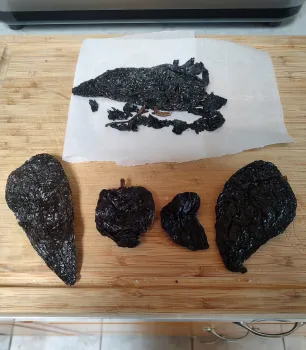
The process to make powder out of a dehydrated pepper entailed drying the peppers to the point that they would snap in half when bent, then they could be ground into a powder. In culinary terms, this state is called “brittle dry” or “bone dry.” As purchased, the adobo peppers were dried but still pliable and could be folded almost in half. This meant that there was a fair amount of water present in the peppers. They were in what is called a “leathery dry” state. Because I needed to make powder out of these peppers, they needed additional drying. My experiment entailed testing three ways of further dehydrating the dehydrated adobo peppers into the brittle-dry or bone-dry state. I experimented with three different methods: I used my oven, my dehydrator, and the traditional method of using an open flame to dry the peppers.
Testing three dehydration methods
I divided the package, which contained seven peppers, into three groups. The first group was destined for my oven. I placed three peppers onto parchment paper and set my oven to its lowest setting, which is 200°F. These peppers took seven hours to dehydrate to the point that they cracked under the pressure of being bent. They were then easily pulverized into powder in my food processor. It took about one minute in the food processor.
The second group of three peppers went into the dehydrator, where it took a total of nine hours for the peppers to become bone dry. I checked them after seven hours and using my fingers, I was able to sense the amount of moisture present and compare it to the oven-dried group. I determined that they were not quite as dry as those from the oven, so I left them in the dehydrator for a total of nine hours. At that point, they had also become brittle dry, and they ground into a nice powder.
The last group had only one pepper in it. I thought that the open flame method would be time consuming and would require a lot of hands-on work, so I intentionally put fewer peppers into this group. The process entailed holding the pepper with tongs over a medium flame. Directions warned that care should be taken not to light the pepper on fire! I must confess that more than once my little pepper did catch fire! It reminded me of roasting marshmallows! I was amazed that the pepper puffed up as I heard a sizzling sound and to my surprise the pepper was brittle dry in about 90 seconds! This pepper ground perfectly into a nice powder, perhaps with a little charcoal flavor added!
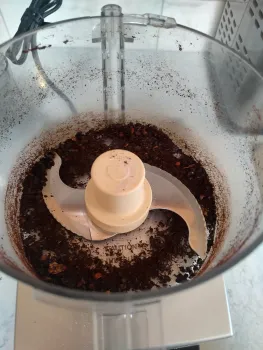
I have come to appreciate the usefulness of dehydration to obtain the hard-to-find ingredient of adobo powder, and I got to conduct a fun experiment! All three methods yielded a powder that I used in my special Super Bowl Sunday chili recipe. As it turns out, the open flame method was the most fun and the fastest to achieve the necessary level of dryness. It also used the fewest number of resources. Next time I need to make a powder out of chili peppers, I will choose the old method of drying over an open flame!
References
Hot Peppers—Preserving the Heat! Penn State Extension