
Tim Long, UC Master Food Preserver Online Program Volunteer
Dehydration preserves food by removing 80–95% of its moisture, which inhibits the growth of bacteria, yeasts, and molds that require water to grow. It is one of the oldest preservation methods, dating back to 12,000 BCE. This ancient, simple method uses heat (140° F), dry air, and air movement to create lightweight, nutrient-dense food ideal for long-term storage, backpacking, or preserving seasonal harvests.
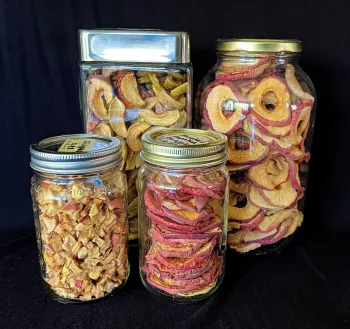
Jars of dried apples (photo credit Marina Hsieh)
Core Dehydration Methods
- Electric Dehydrators: Considered the most efficient and reliable method. These machines use an electric element for heat and a fan for air circulation to dry food uniformly at controlled temperatures (typically 95°F–165°F).
- Oven Drying: A convenient option for those without a dedicated dehydrator. It requires setting the oven to its lowest temperature—usually 140°F—and propping the door open to allow moisture to escape. It is less energy-efficient and can take 2–3 times longer than a dehydrator.
- Sun Drying: A traditional outdoor method requiring at least 85°F, low humidity (under 60%), and several days of direct sunlight. It is primarily recommended for fruits due to their high sugar and acid content.
- Air/Room Drying: Best for herbs, hot peppers, and mushrooms. Food is hung in a well-ventilated, low-light indoor area until it is brittle.
- Solar Drying: Uses a "solar dehydrator" (often a tabletop greenhouse structure) to capture and magnify the sun's heat without electricity.
- Freeze-Drying (Lyophilization): A more advanced process in which food is frozen and then placed in a vacuum, causing water to sublimate directly from ice to vapor. This preserves the food's original structure, flavor, and nutrients better than heat-based methods.
- Microwave Drying: Suitable only for small quantities of herbs or leafy greens. It is not recommended for most other foods as it can cause an overcooked taste.
Essential Preparation Steps
- Pretreatment: Many vegetables require blanching (briefly boiling or steaming) to stop enzymatic reactions that cause spoilage. Light-colored fruits are often dipped in antioxidant solutions (like lemon juice or ascorbic acid) to prevent browning.
- Slicing: For even drying, food should be sliced into uniform pieces, typically 1/8 to 1/2 inch thick.
- Conditioning: After drying, fruit should be placed in an airtight container for 7–10 days and shaken daily to redistribute any remaining moisture.
- Pasteurization: Any food dried outdoors should be pasteurized by heating (160°F for 30 minutes) or freezing (0°F for 48 hours) to kill potential insect eggs.
Recommended Drying Temperatures
| Food Category | Recommended Temperature |
| Herbs | 95°F – 105°F |
| Vegetables | 125°F – 135°F |
| Fruits | 135°F – 145°F |
| Meat/Jerky | 145°F – 160°F |
For long-term storage, keep dehydrated foods in airtight glass jars or vacuum-sealed pouches in a cool, dark, and dry place. Keeping properly sealed dehydrated foods in the freezer will extend their shelf-life almost indefinitely.
Learn more! Attend an online training
For a deeper dive on the above topics, please join the Master Food Preserver Online Delivery Team presentation on Zoom on Tuesday April 14 at 7pm. https://www.eventbrite.com/e/how-to-dehydrate-food-safely-at-home-without-a-dehydrator-tickets-1983578480632?aff=ebdsoporgprofile
There will be an additional class on Freese Drying specifically on May 19 at 7pm.
References
https://extension.missouri.edu/publications/gh1562
https://www.ballmasonjars.com/step-step-dehydrating.html
https://ucanr.edu/site/uc-master-food-preserver-program-orange-county/dehydration