
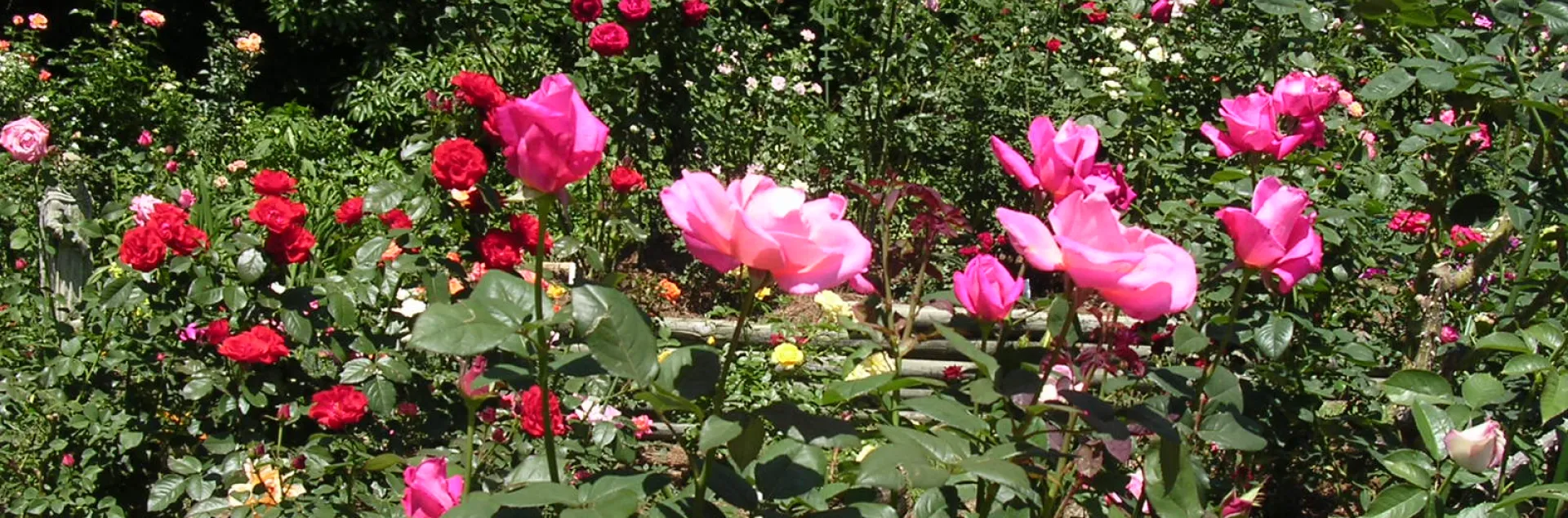
Caring for Roses on the East Side
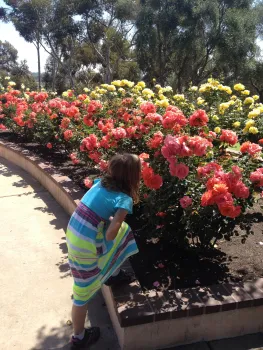
Photo credit: D. Blakey
Roses can be intimidating but are actually more forgiving than you might expect. The following tips have been compiled by Farm Advisors Rick Delmas and Dustin Blakey.
Fundamental Pruning Practices
The following practices apply to all garden roses regardless of type:
Always make pruning cuts at an angle about ¼ inch above a bud that points toward the outside of the plant. The angle should slope away from the bud. A cut made at this point will heal rapidly, and water will drain away from the bud (Figure 1).
Remove dead canes to the crown. Dead canes will be brown and shriveled both inside and out. Also remove all broken or damaged canes caused by insects or disease. Removing dead and damaged canes is the first operation when pruning any rose (Figure 2).
Remove portions of canes damaged by frost. When you cut through a cane, the wood should be white all the way through. If there is any brown discoloration, remove more of the cane.
Remove spindly canes, or those smaller in diameter than the size of a lead pencil. These tend to crowd the center of the rose bush.
Remove any suckers. These are extra-vigorous shoots arising from rootstock below the bud union. Suckers should be removed completely, not just clipped off at the soil surface. Move the soil away from the trunk until you can see where the sucker is connected. Grasp the sucker close to the trunk and pull downward to break it off. This removes adjacent buds and helps prevent regrowth.
General Pruning Techniques for Various Types of Roses
Hybrid Tea, Grandiflora, and Floribunda Roses
Cut back between one-third and one-half of the previous year’s growth on all canes you plan to keep (typically 4 to 7 canes).
The average pruning height for Floribundas and Hybrid Teas is between 12 and 18 inches. Taller-growing Hybrids and most Grandifloras may be left at 2 feet.
For most hybrids, this means leaving between 5 to 10 buds per cane.
Miniature Roses
Miniature roses are 6 to 12 inches high, with tiny blooms and foliage. They do not require special pruning. Remove dead growth and remove the hips.
Rambler Roses
Old-fashioned Rambler roses have clusters of flowers, usually less than 2 inches across. They often produce canes 10 to 15 feet long in one season.
Ramblers produce best on year-old wood, meaning this year’s blooms grow on last year’s growth. Prune immediately after flowering. Remove some of the large old canes. Tie new canes to a support for the next year.
Climbing Roses
Large-flowering climbing roses have flowers more than 2 inches across, borne on wood that is 2 or more years old. Canes are larger and sturdier than those of Ramblers.
Many flower once in June, but some, called ever-blooming climbers, flower more or less continuously.
These are often pruned in autumn, any time before cold weather sets in:
Remove dead and diseased canes first.
Remove 1 or 2 of the oldest canes each season to make room for new canes.
Shorten laterals (side shoots) to 3 to 6 inches after flowering.
If the plant is strong, keep 5 to 8 main canes and tie them to a trellis, fence, wall, or other support. If it is not strong, leave fewer canes.
Recommended Pruning Times
In Darwin, Antelope Valley (Mono County), and in Owens Valley north of Aberdeen, repeat-blooming roses should be pruned in February after Valentine's Day. Points south in Owens Valley should be pruned in late January. In Pearsonville, Haiwee, and Coso Jct. prune anytime in January. Deep Springs higher locations in Mono County should prune in March when buds swell.
If a very cold storm is in the forecast, wait until it passes and the weather returns to what passes as "normal" for us.
Pests
We have few pest problems on roses in our area. Our two most common pests are aphids and powdery mildew. More comprehensive information on rose pests is available at the UC IPM program site.
Rose Mosaic Viruses
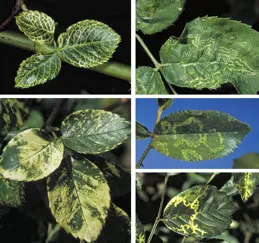
Photo: UC IPM program
Many roses in the Eastern Sierra are infected with one or more viruses that cause unusual, yellow foliage markings. These symptoms are most common in spring and tend to appear on leaves in the middle of the plant.
The exact pattern of the symptoms is highly variable, but not exactly random, either. Roses planted about 15 to 30 years ago seem to be most affected in Owens Valley.
The disease is not known to spread via insects. It is usually spread at a nursery through grafting.
Thankfully, at worst this disease may slow growth. Often there is no noticeable effect beyond leaf color anomalies. No control is needed.
For information on identifying and controlling rose diseases, see this resource.
More Tips
Because summer temperatures are high, most repeat-blooming roses like hybrid teas, will slow down their blooms during summer's heat. They will resume in later in the season. Removing spent blossoms will extend the spring flowering period.
UC ANR has a $10 publication on rose care in California called Healthy Roses that is very good. It is available at this link.
Dr. Huey Roses
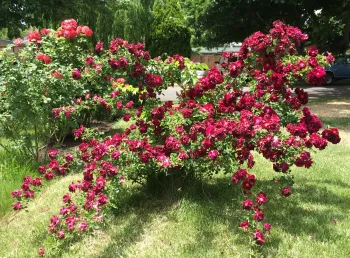
Photo credit: D. Blakey
Most roses for sale at the nursery are grafted onto an old rootstock called 'Dr. Huey.' It has long, spreading branches that seem to have a mind of their own. If you notice your rose has different looking, vigorous foliage coming from the roots, chances are it is this rose. You should prune off these suckers when they are seen.
'Dr. Huey' is a tough plant; tougher than many of the desirable roses we choose at the nursery. Because of this, when your rose bush has problems, it is not uncommon to see 'Dr. Huey' racing out of the roots ready to take over. What was once a beautiful white rose can suddenly turn into a rambling monster with semi-double, dark-red flowers having a yellow center.
'Dr. Huey' is often seen in abandoned or old landscapes where it has survived neglect.
While it certainly has its charm in some landscapes, it may not be what you have in mind. Your options are to graft it to a variety you like (usually it's budded) or dig it up and plant a new rose. Otherwise learn to live with its carefree nature. And buy some good gloves.
If you already are the owner of a 'Dr. Huey' rose and want to try to manage it, try cutting it back aggressively immediately after it finishes blooming. Feel free to trim back canes that get in the way as you see them. These roses do fine in our area with less water than hybrid teas and other common landscape roses. In fact, reducing water is a good way to keep their growth in check.
- What's that lurking in your roses? (OC Register)
- Rose Rootstocks (Santa Clarita Rose Society)
An interesting side note: Dr. Robert Huey was a dentist who invented a technique for whitening teeth as well as a being a rose breeder. His rose could actually the most commonly planted in America even if you don't notice it.