

Preliminary Findings Report • Download PDF (456 KB)
Authors: Yu Meng, Marisa Neelon, Yulia Lamoureaux, Nayoung Song, Danielle Lee, and Susana Matias
Background
The UC ANR Household Food Waste Reduction project has the overall aim to reduce household food waste among Californians, and it will be implemented in phases. The first phase involved creating a survey to conduct a needs assessment to better understand the current level of household food waste reduction awareness, attitudes, motivators, barriers, and practices of UC ANR staff and volunteers (VOL) in our statewide programs. These programs include the Expanded Food and Nutrition Education Program and CalFresh Healthy Living UC staff (CESNUT), 4-H staff (CESH4H) and 4-H volunteers (VOL4H), Master Gardeners volunteers (VOLMG), and Master Food Preservers volunteers (VOLMFP). The findings from this assessment will allow us to understand their readiness to educate consumers about reducing household food waste and, if needed, to develop appropriate training to prepare them to deliver food waste reduction messages, which will support consumer compliance with California’s short-lived climate pollutant reduction strategy (SB 1383).
Participants
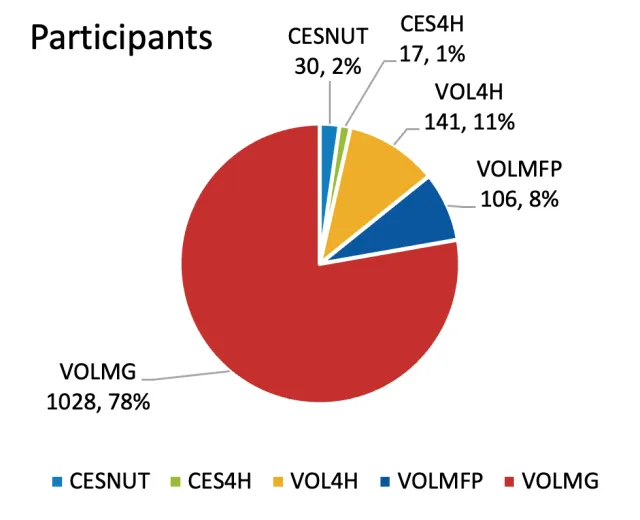
This report includes preliminary results from 1566 UC ANR staff/volunteers (CES NUT = 30; CES 4-H= 17, VOL4H= 141, VOLMPF=106, VOLMG=1028) who completed the online survey in September 2022 (Figure 1).
Awareness
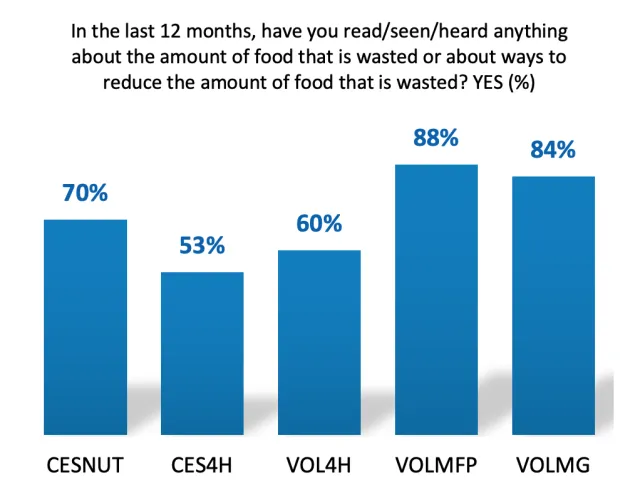
MFP volunteers (88%) and MG volunteers (84%) have heard/read/seen food waste information during the past 12 months (Figure 2).
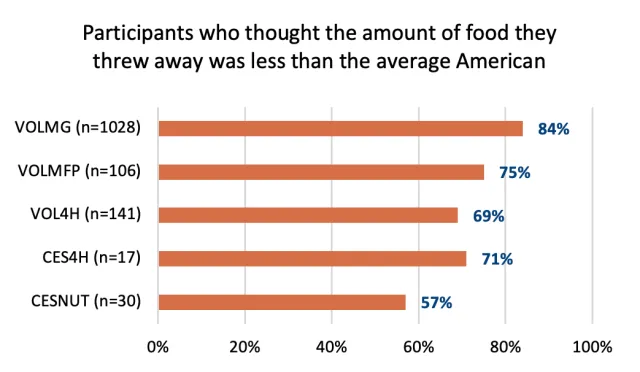
MG volunteers had the highest level of confidence (84%) that they threw away less food than the average American (Figure 3).
The average U.S. household wastes 31.9% of the food that its members obtain. (Yu 2020).
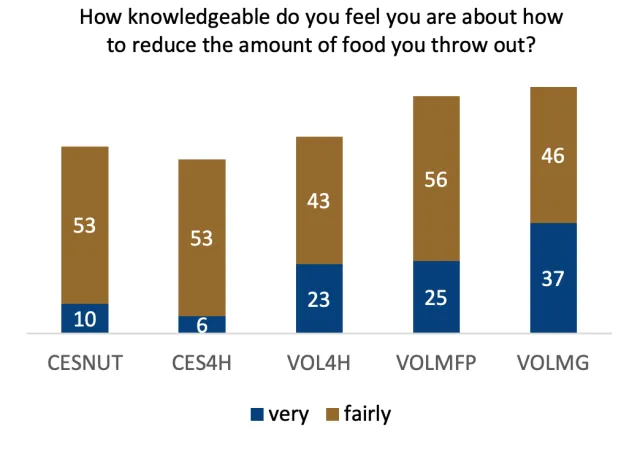
MG volunteers had the highest self-reported knowledge of reducing the amount of their household food waste. 4-H CES self-reported the lowest (6%) in the “very knowledgeable” category (Figure 4).
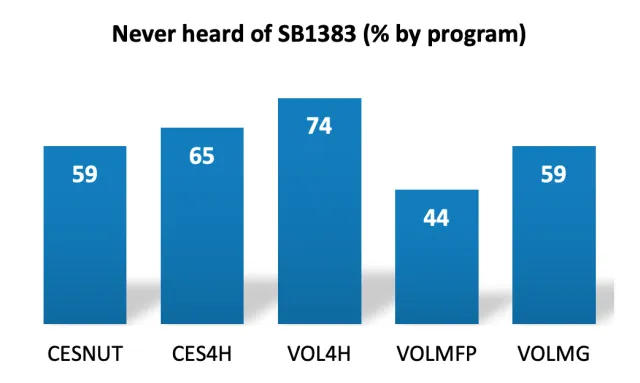
Awareness about the Short-Lived Climate Pollutant Strategy, SB 1383
Attitudes
Nutrition CES, 4-H, MFP, and MG volunteers agreed most on the top two statements explaining the reasons they throw away food: 1) “Sometimes I throw out food because I worry about food poisoning”, 2) “I want to eat only the freshest food”.
Only 4-H CES rated their second highest reason as “other people in my household don’t like when I try to use up older food (47%)."
Barriers
The top barrier across all programs is a perceived health risk (average 77% agree that they throw food because they are not sure if it is safe to eat). The second barrier for nutrition CES, 4-H CES, and 4-H volunteers is lack of information, while for MFP and MG volunteers is purchasing too much (“I usually buy more food than I need when I entertain because I worry about not having enough food for family/guests”).
Motivators
We asked participants about their top motivators for reducing the amount of wasted food by the household (Table 1).
| Program | Top 1 | Top 2 |
| CES Nutrition | Thinking about the possibility of saving money. | Wanting to manage my home efficiently. |
| CES 4-H | Thinking about the possibility of saving money. | Wanting to manage my home efficiently. |
| VOL 4-H | Want to set example for my children. | Thinking about the possibility of saving money. |
| VOL MFP | Wanting to manage my home efficiently. | Thinking about the possibility of saving money. |
| VOL MG | Think that I can make a difference. | Manage home efficiently and feel guilty about waste in general. |
Practices
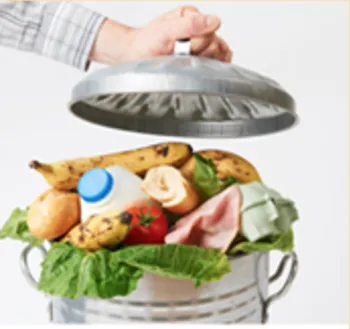
Fruits/vegetables and homemade meals were the most common types of food that went to waste in one given week per household.
Food Waste Disposal Practices
For nutrition CES, 4-H CES, 4-H volunteers, and MFP volunteers, the top way to dispose of food waste was trash bins. Those groups also used waste to put waste in a garbage disposal, feed livestock, or used home compost as the second highest choices.
For MG volunteers, the top two ways to dispose of food waste were home compost bins & organic pickup service.
Readiness to Change
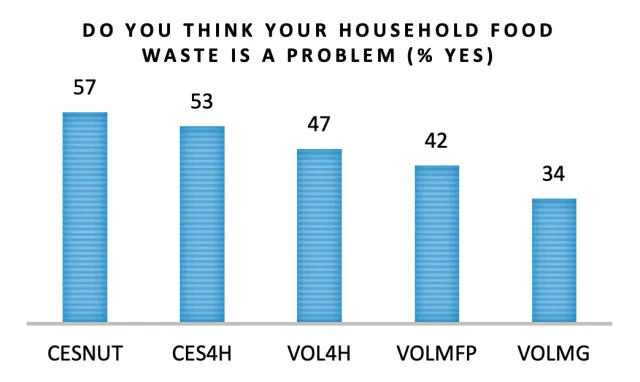
Over half of the nutrition CES (57%) and 4-H CES (53%) indicated concern about their household food waste (Figure 6).
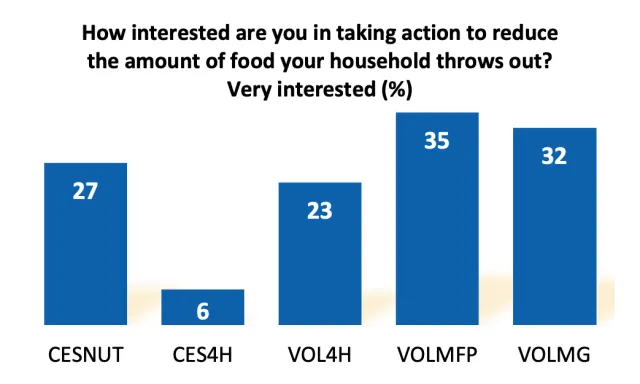
MFP and MG volunteers had a higher level of interest to take action to reduce food waste at the household level, 35% and 32% respectively (Figure 7).
Extension

The majority of survey respondents do not currently teach household food waste reduction strategies. The top two reasons are:
We asked our survey participants what they thought the most effective method to educate their clientele about reducing household food waste would be. The top two methods identified were in-person classes & print materials. Additional methods identified were online modules and a Food Waste Reduction Challenge.
We inquired what topics would be important for the survey participants’ clientele to help them reduce household food waste. The top two topics identified by our respondents were:
- Food practices to reduce food waste
- Understanding the meaning of food date labeling (use by, sell by, best by)
We asked what food practices our respondents would like their clientele to learn to reduce household food waste. The top two food practices identified were:
- Use of leftovers
- Food storage
Additional practices identified by the respondents were meal planning and food preservation.
Future Plans
- We plan to assess our nutrition program participants’ awareness, attitudes, motivators, barriers, and practices related to household food waste. There is limited research on understanding low-income household food waste practices and effective food waste reduction education and messaging.
- Based on this needs assessment, the research team will develop and field test household food waste reduction messaging and educational material for our nutrition program clientele.
- Next, we will develop training for the consumer-facing staff and volunteers to address household food waste reduction education that is culturally and linguistically appropriate for low-income households.
For questions about this report contact Yu Meng: ucmeng@ucanr.edu
Suggest citation: Meng Y, Neelon M, Lamoureaux Y, Song N, Lee DL, Matias S. Household Food Waste Survey Results by Program. University of California, Agriculture and Natural Resources. October 2024.
University of California Agriculture and Natural Resources is an equal opportunity employer. © 2024 UC Regents, Creative Commons 4.0 International License.
