


Policy Brief • May 2022
CACFP Delivers Healthy Food for Preschoolers
It is important to lay the foundation for healthy eating habits early in life.1
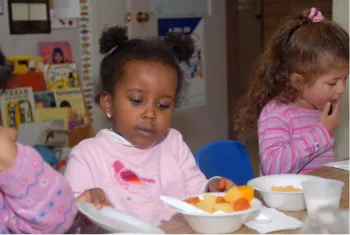
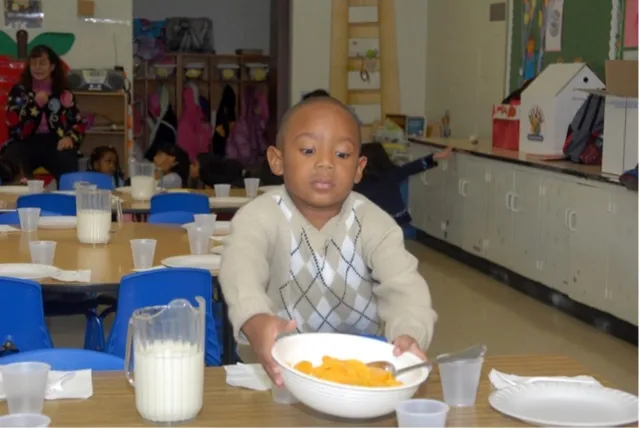
The federal Child and Adult Care Food Program (CACFP) provides balanced and nutritious meals to nearly 800,000 California preschoolers daily.2
Nutrition quality in childcare sites that participate in CACFP is better than in sites that do not.3 Further, participation in CACFP can reduce family food insecurity.4
California’s History of Leadership in Children’s Nutrition Policy
- SB 12 (2005) limited sale of non-nutritious competitive foods in K-12.
- AB 2084 (2010) set the nation’s highest standards for beverages in all licensed childcare.
- SB 1413 (2010) required K-12 access to drinking water at no charge.
All these concepts were then included in the federal Healthy, Hunger-Free Kids Act of 2010.
- AB 130 (2021) provides meals (breakfast and lunch) that meet federal nutrition standards, at no charge, to all K-12 students.
- SB 1481 (2022) would provide meals at no charge to all children in CACFP licensed childcare homes and centers.
Many Preschoolers Lack Healthy Food
- Diet quality in young children in the U.S. does not meet national nutrition guidelines. This can impact children’s growth and development and establish poor nutrition habits that persist into adulthood.5,6
- Children are not eating enough fruits and vegetables,7 particularly children in families with low-income.8
Lack of Healthy Food Has Severe and Long-Lasting Health Consequences
- Lack of healthy food has been consistently associated with children’s poorer overall health status, and acute and chronic health problems later in life.9
- For example, lack of healthy food increases risk of overweight and obesity.
- In 2010, 16% of California children aged 2-5 were overweight and another 17% were obese.10
- Children with obesity are at increased risk of prediabetes, type 2 diabetes, and other risk factors for heart disease, such as high blood pressure, high cholesterol, and fatty liver disease; as well as sleep apnea, early puberty, and psychological issues.11
- Modeling shows that if current trends continue, in California adults the prevalence of obesity will rise to 41.5% by 2030, while 18.3% will have severe obesity.12
Lack of Healthy Food Has Costly Financial Consequences
- Overweight and obesity-related health costs were estimated at almost $21B in California in 2006.13
- Type 2 diabetes direct medical costs were estimated at $7B for Medicare, $3B for Medi-Cal, and $10B to other payers,14 while indirect costs of diabetes-related morbidity and mortality were estimated at $30B in California in 2013.15
Food Insecurity and Diet-Related Chronic Conditions are Rife with Disparities: Three Examples
- Food insecurity varies by race and ethnicity. In California, 22% of Hispanic and 20% of non-Hispanic Black children lived in households that sometimes or often did not have enough to eat, compared with 9% of non-Hispanic White children in 2020.16
- Prevalence of overweight and obesity varies by income level. In California, child overweight or obesity is twice as common in families under 100% of the federal poverty level (FPL) as in families over 400% of FPL (44.3% vs. 21.2% children overweight or obese in 2007).17
- Prevalence of obesity also varies by race and ethnicity. In the U.S., 26% of Hispanic children and 22% of non-Hispanic Black children have obesity, compared with 14% of non-Hispanic White children and 11% of non-Hispanic Asian children, in 2016.18
References
- Mennella, JA. Ontogeny of taste preferences: basic biology and implications for health. Am J Clin Nutr 2014, 99, 704S–711S.
- USDA FNS. Child Nutrition Tables: National Level Annual Summary Tables. 2022.
- Gurzo K, Lee DL, Ritchie K, Yoshida S, Homel Vitale E, Hecht K, Ritchie LD. Child Care Sites Participating in the Federal Child and Adult Care Food Program Provide More Nutritious Foods and Beverages. J Nutr Edu Behav 2020, 52(7):607-704.
- Heflin C, Arteaga I, Gable S. The Child and Adult Care Food Program and Food Insecurity. Soc Serv Rev 2015, 89(1):77–98.
- Banfield EC, et al. Poor adherence to US Dietary Guidelines for children and adolescents in the National Health and Nutrition Examination Survey population. J Acad Nutr Diet 2016, 116:21-7.
- U.S. Department of Health and Human Services and U.S. Department of Agriculture. 2015–2020 Dietary Guidelines for Americans. 8th Edition.
- Kim SA, et al. Vital Signs: Fruit and vegetable intake among children – United States, 2003-2010. Morbidity and Mortality Weekly Report. Centers for Disease Control and Prevention. 2014, 63;671-6.
- Drewnowski A, Rehm CD. Socioeconomic gradient in consumption of whole fruit and 100% fruit juice among US children and adults. Nutr J 2015, 14:3.
- Thomas MMC, Miller DP, Morrissey TW. Food insecurity and child health. Peds 2019, 144(4):e20190397.
- Centers for Disease Control, Division of Nutrition, Physical Activity, and Obesity. 2012. Overweight and Obesity: California State Nutrition, Physical Activity, and Obesity Profile.
- Kansra AR, Lakkunarajah S, Jay MS. Childhood and Adolescent Obesity: A Review. Front Pediatr 2021, 8.
- Ward ZJ, et al. Projected U.S. State-Level Prevalence of Adult Obesity and Severe Obesity. N Engl J Med 2019, 381:2440-50.
- California Center for Public Health Advocacy. The Economic Costs of Overweight, Obesity, and Physical Inactivity Among California Adults—2006 (July 2009).
- Centers for Disease Control. Diabetes State Burden Toolkit.
- Centers for Disease Control. Diabetes State Burden Toolkit.
- Cal Budget and Policy Center. Not Enough to Eat: California Black and Latinx Children Need Policymakers to Act. 2020.
- Child and Adolescent Health Measurement Initiative, Data Resource Center. California State Fact Sheet. Data Source: 2007 National Survey of Children’s Health.
- Hales CM, Carroll MD, Fryar CD & Ogden CL. Prevalence of obesity among adults and youth, United States, 2015-2016 (Data Brief No. 288). 2017.
Suggested citation: Policy Brief: Research Shows that CACFP Helps Fill Nutrition Gaps for Preschoolers. University of California, Division of Agriculture, Nutrition Policy Institute. 12 May 2022.
University of California Agriculture and Natural Resources is an equal opportunity employer. © 2026 UC Regents, Creative Commons 4.0 International License.