

Research Brief • March 2025 • Download PDF (356 KB)
Background
California’s landmark investment in free school meals for all K-12 students, beginning in school year 2022-23 following federal universal school meals (USM) during the pandemic, has enormous potential to improve nutrition for millions of students. Evaluation of California’s USM can inform legislators and administrators as well as policy in other states and federally. The University of California Nutrition Policy Institute (NPI) has been engaged by the state, in collaboration with the California Department of Education, to assess USM in California beginning in school year 2021-22 and continuing through 2025-26. This brief summarizes the evaluation design as well as NPI’s published findings to date.
Aims and Methods
NPI used a longitudinal design to integrate data from multiple sources (administrative, meal observations, surveys and interviews with school staff, parents, and students) to address two aims:
- Assess stakeholder perspectives about the opportunities and challenges presented by federal USM to inform the initial implementation of state USM (formative evaluation) and compare to data collected over 4 subsequent years to optimize state USM (process evaluation).
- Assess the impacts of USM to inform continuation and/or expansion in California, other states and nationally (outcome evaluation). Data were collected primarily in California with the addition of comparative data from several other states both implementing and not implementing USM, with a focus on statewide samples, as well as from a select sample of California districts undertaking efforts to improve school foodservice. Measures include: 1) student school meal participation, food security, nutrition, school attendance, behavior and academic performance; 2) stakeholder perceptions of USM; 3) school meal quality and waste; and 4) school foodservice operations and costs.
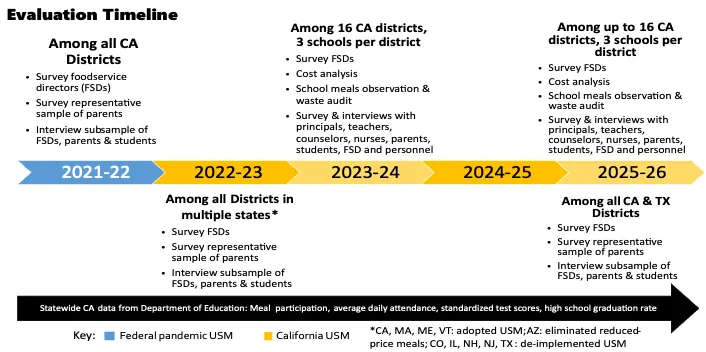
To date, NPI’s research includes interviews, surveys, and focus groups throughout California with over 580 school nutrition directors, 430 students, and 2,000 parents (school years 2021–22 and 2022–23). Additional in-depth information was collected from 16 California school districts during the 2023–24 school year that included surveys and interviews with approximately 86 school nutrition professionals, 3,800 students, 1,400 parents, 300 teachers, and 55 school administrators. This research is complemented by comparisons with other states across the country that have either continued School Meals for All or gone back to charging some students for meals — reaching a total of over 1,800 school nutrition directors, 1,300 students, and 5,000 parents nationwide.
Findings to Date
Overwhelming support for Universal School Meals
Support for USM is widespread across all income levels in California, with eight in ten parents (80%) and nearly nine in ten students (87%) supporting the program.6 Parents, school foodservice directors and teachers report that USM has a positive impact on students’ academic performance.11,14,19 In addition, the majority of parents value that USM save them time and money, while also reducing stress.11,14,23
Increased Meal Participation
More students are participating in school meals than before USM. Over two-thirds of California school foodservice directors report increased student participation in response to state USM policy21,27 Across the nation, meal participation has risen in states that adopted USM, compared to states that eliminated it after the federal policy ended.16
Reduction in Stigma and Embarrassment
Two-thirds of California students (66%) and parents (65%) report that USM have resulted in feeling less stigma or embarrassment associated with eating school meals.19,20,21 This shift reflects the program’s role in normalizing school meals for all students.
Reduction in Food Insecurity
USM has proven effective in improving students’ ability to access adequate food. Nearly two-thirds (61%) of parents who were nearly eligible for free or reduced-price meals worried about their financial situation without USM and half of all parents worried about providing enough food without USM.6 Food insecurity remains a common issue among California families with school-age children.20 USM are associated with lower food insecurity among households with school-aged children, particularly in families already eligible for free meals under means-tested programs and those near but above the income eligibility threshold, who earn too much to qualify for free or reduced-price meals by federal standards.15
Progress with School Meals
Among California’s school foodservice directors, 44% reported improved meal quality during the first year of California USM. In addition, 82% reported freshly preparing at least some meal offerings. Most districts (79%) have received supplemental state, federal or local funding, such as Kitchen Infrastructure and Training Funds and the Farm to School Incubator Grants, which has enabled them to offer more freshly prepared and locally sourced foods.5,10,22 When more meals are fresher, student participation increases.18,22
Better School Finances
California foodservice directors report that USM have resulted in positive financial outcomes, including increased revenues (65%), less meal debt due to unpaid meal charges (81%), and improvements in staff salaries and benefits (37%).8,14,22
Room for Improvement
Despite these successes, there were suggestions for improvement. Ongoing barriers to school meal participation include students’ desire for more freshly-prepared options and greater variety, as well as inadequate time to eat.12,17,22 Parents recommend that clearer communication about why school meal applications remain necessary under USM – and how the information collected is used by schools – would be beneficial.11 Furthermore, a majority of California foodservice directors (70%) advocate for higher meal reimbursement amounts, and 84% continue to need upgraded school kitchen facilities and equipment.13,14
Publications
Research Briefs
- The State of School Meals for All in California. Nutrition Policy Institute. February 2025.
- School Meals for All Supports Students and Families. Nutrition Policy Institute. December 2024. [Available in Spanish - Programa Universal de Comidas Escolares Beneficia a Estudiantes y Familias]
- Texas Food Service Director Survey Findings: Experiences transitioning from meals free of charge for all students. Nutrition Policy Institute. August 2024.
- Arizona Food Service Director Survey Findings: Experiences transitioning from meals free of charge for all students. Nutrition Policy Institute, University of California. August 2024.
- School Meals for All in California: Government investments are associated with better meal operations, labor practices, and local food sourcing. Nutrition Policy Institute. May 2024.
- School Meals for All in California: Strongly supported by parents of all income levels. Nutrition Policy Institute. March 2024.
- Impact of Massachusetts’ Healthy School Meals for All. Nourish Lab, Center for Health Inclusion, Research and Practice, Merrimack College. March 2024.
- Implementation of Universal School Meals during COVID-19 and Beyond: School Food Authority and Parent Perspectives in California and Maine. Share Our Strength. September 2023.
- The Many Benefits of School Meals for All. Nutrition Policy Institute, Arizona State University, University of Connecticut, Merrimack College. Boise State University. August 2023.
- School Meals for All: Farm Fresh Food. Nutrition Policy Institute. June 2023.
- School Meals for All in California: Parents Value School Meals for All and Offer Suggestions to Strengthen Meal Programs. Nutrition Policy Institute. May 2023.
- School Meals for All in California: Time to Eat Can Be a Barrier to Full Participation. Nutrition Policy Institute. April 2023.
- School Meals for All in California: Benefits and Challenges During COVID and Beyond as Reported by School Food Services. Nutrition Policy Institute. August 2022.
Reports
- Implementation of Universal School Meals during COVID-19 and Beyond: School Food Authority and Parent Perspectives. Cohen et al. Share Our Strength. September 2023.
Journal Publications
Statewide Universal School Meal Policies and Food Insecurity in Households with Children. Orta-Aleman et. al. Amer J Prev Med. 2025;(in review).
Universal free school meal policies increase participation in the U.S. National School Meal Programs. Ramponi et al. JAMA Pediatr. 2025;(in review).
- California Middle and High School Students Report Wanting Fresh and Healthy School Lunch in the Context of Universal School Meals. Chelius et al. J Nutr Ed Behav. 2025:Feb 7.
- Factors and Outcomes Associated With Using Scratch-Cooked, Organic, and Locally Grown Foods in School Meals in California. Zuercher et al. J School Health. 2025:Jan 6.
- Perceptions and experiences of Universal School Meals in California: Qualitative insights from school food service directors on participation, stigma, and operational benefits and challenges. Orta-Aleman et al. J Acad Nutr Diet. 2024; S2212-2672:00941-9.
- Household Food Insecurity Is Associated with Parental Perceptions of and Student Participation in School Meals. Zuercher et al. Nutrients. 2024;16:3375.
- Students’ Perspectives on the Benefits and Challenges of Universal School Meals Related to Food Accessibility, Stigma, Participation, and Waste. Orta-Aleman et al. J Nutr Educ Behav. 2014;56:599-610.
- The Benefits and Challenges of Providing School Meals during the First Year of California’s Universal School Meal Policy as Reported by School Foodservice Professionals. Zuercher et al. Nutrients. 2024;16:1812.
- Universal School Meals During the Pandemic: A Mixed Methods Analysis of Parent Perceptions from California and Maine. Chapman et al. J Acad Nutr Diet. 2024;S2212-2672.
- School Meals for All: A Qualitative Study Exploring Lessons in Successful Advocacy and Policymaking in Maine and California. Hecht et al. J Acad Nutr Diet. 2024;S2212-2672:00206-5.
- Parent Perceptions of School Meals Influence Student Participation in School Meal Programs. Zuercher et al. J Nutr Ed Behav. 2024;56:230-241.
- Parent perceptions of school meals and how perceptions differ by race and ethnicity. Zuercher et al. Health Aff Sch. 2024;2:qxad092.
- Implementation of Universal School Meals during COVID-19 and beyond: Challenges and Benefits for School Meals Programs in Maine. Cohen et al. Nutrients. 2022;14:4031.
- Providing School Meals to All Students Free of Charge During the COVID-19 Pandemic and Beyond: Challenges and Benefits Reported by School Foodservice Professionals in California. Zuercher et al. Nutrients. 2022:14L3855.
Acknowledgements
The Nutrition Policy Institute, University of California Agriculture and Natural Resources, is funded to conduct evaluation through CA SB 170 (2021), CA SB 154 (2022) and CA SB 101 (2023). Methods were designed in collaboration with Nourish Lab evaluating a similar program in Maine. We thank the California parents, students and school professionals who have taken time to participate in this study. For more information on NPI’s evaluation of California’s Universal School Meals, please visit https://ucanr.edu/statewide-program/nutrition-policy-institute/school-meals-all.
Suggested citation: Research Brief: Evaluation of Universal School Meals in California. Nutrition Policy Institute, University of California, Agriculture and Natural Resources. March 2025.
University of California Agriculture and Natural Resources is an equal opportunity employer.
© 2025 UC Regents, Creative Commons 4.0 International License.
