

Research Brief • November 2024 • Download PDF (171 KB)
Background
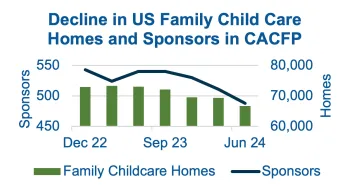
The federal Child and Adult Care Food Program, or CACFP, provides nutritious meals and snacks to over 4.7 million US children, predominantly from families with lower incomes, through reimbursements to their childcare providers.1 Family childcare homes must work with a sponsoring organization for CACFP participation. Sponsors oversee administration, compliance, training, financial management, and ensure nutritious meals are served. However, the number of CACFP sponsors in the US is declining in parallel to a decrease in the number of family childcare homes, raising concern for equitable access to this important child nutrition program (Figure 1).2
Our Study
We conducted semi-structured interviews with 15 of the 45 geographically diverse California CACFP family childcare home sponsors in 2023-2024 to understand their challenges. Interview transcripts were thematically analyzed using the framework method.3,4
Study Findings
Three major themes were identified related to challenges sponsors experience facilitating family childcare home CACFP participation.
Inadequate Administrative Reimbursement and Resources
Sponsors receive a $147/month administrative reimbursement per home, though rates decrease as the number of participating homes increase. Sponsors report that reimbursements are insufficient to fully operate CACFP, leading to resource shortages and hindering support for non-English-speaking childcare providers.
"We don't have enough [reimbursement] to sustain the basic operations of our program.”
“There is [not] much support or assistance in helping sponsors overcome barriers with providers who speak different languages.”
Inadequate Staff Funding and Staffing Shortages
With fewer family childcare homes participating in CACFP and many not claiming food reimbursement, administrative reimbursements are dropping, limiting funds for staffing. Sponsors are also struggling to hire and retain CACFP monitors.
“If they [providers] don't claim we don't get paid, and I can't keep my staff on.”
“We need to get more administrative funds per home that we sponsor so that we can hire more staff to help us do our end of the work too.”
“Reimbursement for sponsors kind of plateaus once you hit [a] certain number of providers. So, it makes it a lot more difficult for larger sponsors to continue to add [staff and providers].”
Challenges with In-Person Monitoring Visits
Sponsors are required to visit each FCCH at least three times per year, twice unannounced and once during a meal or snack. Sponsors reported that in-person monitoring visits, which resumed in June 2023 following the end of COVID-19 waivers, are time-consuming, costly, and stressful, with added staff safety concerns. They find it logistically challenging to visit during meals/snacks and ensure that providers and children are present.
“[In-person monitoring visits] takes up a lot of time administratively, and on the financial side of things, it's so expensive.”
“I get there at 3:00, and they're like, “Well, the kids were hungry so I fed them at 2:30 or 2:45.” So, we just missed it.”
“We have to expect we might be in traffic for 45 minutes to maybe an hour sometimes… And then what if the provider is not there? And then they have to go back and follow up in person again.”
“We also have dangerous areas. So we visit some areas that are very scary and so my staff doesn't want to go there anymore.”
Conclusion
Our study highlights several challenges facing CACFP sponsors. The administrative reimbursements provided to sponsors are insufficient, leading to staffing shortages and limited resources, especially for supporting non-English-speaking providers. The resumption of in-person monitoring visits has also introduced logistical, financial, and safety concerns, exacerbating the burden on sponsors. These issues underscore the need for policy changes to ensure that sponsors are adequately supported in their efforts to sustain and expand CACFP participation. Addressing funding shortfalls, improving resources for diverse providers, and exploring virtual alternatives to in-person monitoring could help strengthen the program and promote equitable access to nutritious food for children in family childcare homes. Further research is needed to explore additional sponsor challenges.
References:
- US Department of Agriculture. Child and Adult Care Food Program. Accessed 7 November 2024.
- National CACFP Association. One Year After Vital Supports Ended: Disheartening Drop in CACFP Participation. 30 September, 2024.
- Bacon KA, Lee DL, Vasicsek R, et al. Provider, sponsor and family perceptions of Child and Adult Care Food Program (CACFP) participation and COVID-19 reimbursement increases. Public Health Nutr. 2025;28(1):e195. Published 2025 Nov 3. doi: 10.1017/S1368980025101389
- Bacon KA, et al. 2026. In review.
Acknowledgements: This project was funded by the Robert Wood Johnson Foundation Healthy Eating Research Program Grant No. 269287 and by the California Collaborative for Pandemic Recovery and Readiness Research (CPR3) Program which was funded by the California Department of Public Health (CDPH). CDPH was not involved in study design, data collection, data analysis and interpretation, manuscript development, or the decision to publish.
Suggested citation: Lee DL, Fiedler K, Bacon K, Felix C, Vasicsek R, Matias SL, Marshall SK, Homel Vitale E, Ritchie LD. Research Brief: Challenges Experienced by Child and Adult Care Food Program Sponsors. Nutrition Policy Institute, University of California, Agriculture and Natural Resources. University of California, Berkeley. CACFP Roundtable. November 2024.
University of California Agriculture and Natural Resources is an equal opportunity employer.
© 2024 UC Regents, Creative Commons 4.0 International License.
