

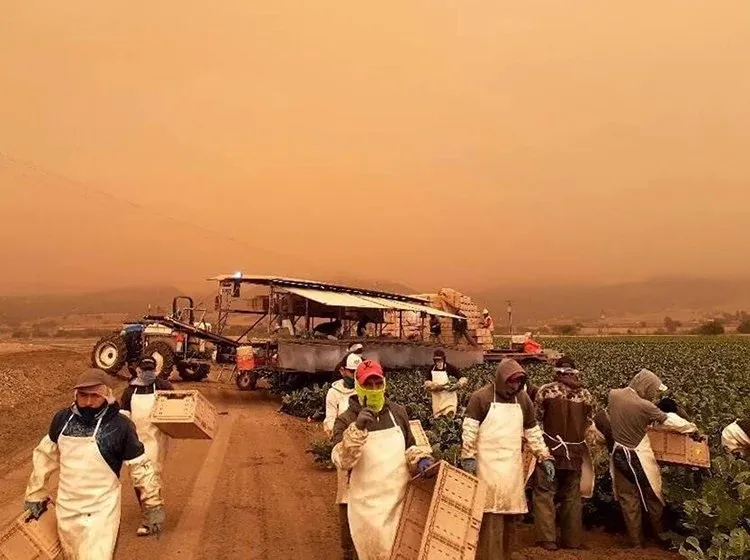
Most Sonoma County agricultural workers labored through wildfire smoke — even in a state with some of the strongest protections in the nation
SONOMA COUNTY, Calif. — Most farmworkers in Sonoma County have worked at least once under wildfire smoke and hazardous air conditions since 2017, according to research from UC Berkeley, revealing gaps between state protections and workers’ lived experiences.
California has some of the strongest regulations in the country for protecting outdoor workers from wildfire smoke. It is one of only three states, along with Oregon and Washington, that require employers to provide masks when air quality reaches unhealthy levels, according to NPR.
Yet survey participants reported receiving only surgical masks or inconsistent access to protective equipment during wildfire events.
Choosing between health and income
The survey, one of the largest conducted among agricultural workers in the region, found that nearly three out of four respondents reported working during wildfire conditions, even when smoke was dense, and the air was considered hazardous.
Carly Hyland, the study’s lead researcher and a Cooperative Extension specialist at Berkeley who also teaches at the School of Public Health, said the findings highlight a central tension: workers understand wildfire smoke is dangerous, but stopping work is not financially viable.
“Many agricultural workers are deeply concerned about the health impacts of wildfire smoke,” Hyland said. “But what we heard repeatedly is that they would continue working because it becomes nearly impossible to pay for rent or food when they lose work.”
Even workers who reported headaches, respiratory irritation or other symptoms said they would expect to keep working during future wildfire seasons, researchers noted.
Worker concerns extend beyond physical risk
Zeke Guzmán, president of Latinos Unidos del Condado de Sonoma, said workers repeatedly expressed feeling overlooked and unprotected.
“Farmworkers told us there was a lack of awareness or interest in the health risks of working during wildfires,” Guzmán said. “Many were only given a surgical mask, not an N95, and to them, that signaled that no one really cared.”
Community-led participation helped the research move forward
Hyland said the study’s collaboration with local organizations, community health workers and advocates was essential for reaching participants.
“Many workers can be hesitant to engage in research,” she said. “Our community engagement team was key to explaining the process and ensuring people felt comfortable participating.”
Researchers did not collect identifying information to protect participants’ confidentiality.
Study points to structural gaps
According to Hyland, the findings suggest that changes in policy, rather than just educational campaigns, may be necessary.
“The most urgent change is expanding unemployment insurance to all workers, regardless of immigration status,” she said. “Undocumented workers contribute nearly half a billion dollars to California’s unemployment system each year but cannot access benefits, forcing many to put their health at risk just to meet basic needs.”
The report also identified concerns regarding Sonoma County’s Agricultural Pass program, which grants access to evacuation zones to allow agricultural operations to continue.
Researchers found that few workers were aware of the program, mistrust was high, and information was not available in Spanish or Indigenous languages, limiting understanding and equitable access.
A growing challenge under climate change
Hyland said the study was timely because Sonoma County has one of the most expansive Ag Pass programs in California, and climate-driven disasters are on the rise.
“We identified gaps in protections for agricultural workers’ health and safety that will only worsen as wildfires become more frequent, intense and prolonged,” she said. “Local governments need to act before the next disaster arrives.”
Although focused on Sonoma County, researchers noted that similar conditions are reported in other agricultural regions of California, where outdoor work, wildfire smoke and economic insecurity overlap.
According to researchers, prioritizing economic security and culturally accessible communication could play a key role in keeping agricultural workers safer as wildfire risks grow.