UC ANR is committed to providing an accessible and inclusive web experience for all users. If you encounter an accessibility barrier on this or need content in an alternative or remediated accessible format, please contact anraccessibility@ucanr.edu.
The most recent group of scientists and educators hired by University of California Agriculture and Natural Resources includes several firsts, including a UC Cooperative Extension specialist in water equity at UCLA and a UC Cooperative Extension Black, Indigenous and People of Color (BIPOC) communit...
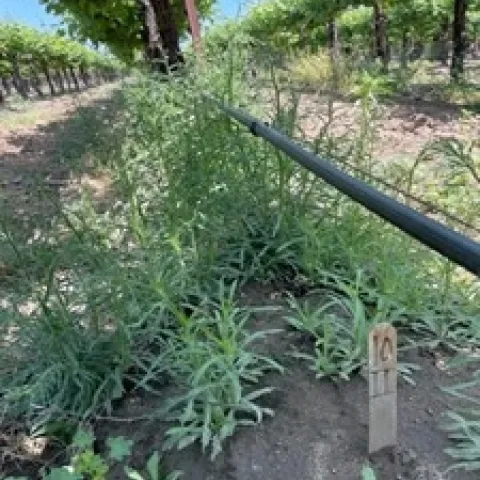
Summary Review Results from this year's Italian ryegrass (IR) herbicide trials helped quantify differences in herbicide resistance among IR populations within the southern Sacramento Valley. The trial took place in Bird's Landing, CA (near Rio Vista), and was replicated farther north in Esparto, CA.
The New York Times recently showcased the research of two UC Davis medical entomologists who are targeting malaria in the two-island African nation of So Tom and Prncipe by releasing genetically modified (GM) mosquitoes.
(This post is available in English) A principios de septiembre 2023, casi toda el rea de cultivo que bordea la ciudad de Brentwood, CA qued sujeto de una cuarentena por el Departamento de Alimentos y Agricultura de California (CDFA).
Visitors at the Bohart Museum of Entomology open house learned about such "household vampires" as mosquitoes, fleas, lice, ticks and bedbugs, and many also participated in the family arts-and-crafts activities.
Medical entomologist-geneticist Geoffrey Attardo, associate professor, UC Davis Department of Entomology and Nematology and chair of the Designated Emphasis in the Biology of Vector-Borne Diseases (DEBVBD), will speak on tsetse flies at the next department seminar, set for 4:10 p.m., Monday, Oct.
They saw mosquitoes, ticks, fleas, lice and bed bugs at the Bohart Museum of Entomology open house on "Household Vampires." They learned that "medical entomologist is the study of arthropods (such as insects and ticks) that spread pathogens that cause human disease.
The Orobanchaceae family comprises 270 holoparasitic species that cannot photosynthesize. Instead, they rely entirely on the host plant roots for nutrition, and can produce great numbers of minute, dust-like seeds that last for years in the soil.