
Cole Imperi, UC Master Food Preserver Online Program Volunteer
County of residence: Los Angeles
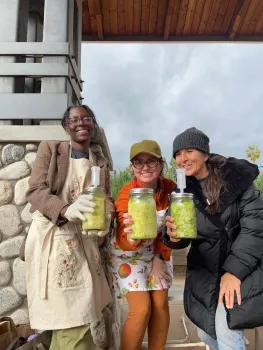
Cole Imperi and fellow trainees (Used with permission).
The first time I canned anything was the second summer after I bought my first house a few blocks from the Ohio River in Northern Kentucky. I had set up a big backyard garden comprised entirely of heirloom tomatoes, and discovered what happens at the end of a prolific growing season—pounds and pounds of tomatoes that need to be brought inside and dealt with before the first frost.
My husband and I learned to can out of necessity, and we started with tomato jam. If I remember correctly, we made 48 half pints that first season.
The second thing I ever canned was pickled peaches. My neighbor that lived caddywhompus to us had two peach trees. Exasperated, he showed up at my back fence and dropped two big black garbage bags full of peaches into my backyard and said DO SOMETHING WITH THESE. They became pickled peaches.
But I didn’t come to the Master Food Preserver (MFP) program because of canning, I came because of grief. But not in the way you might think!
In my career, I’m a thanatologist. Thanatology is the study of death, dying, grief, and loss. In all my years doing this work, I’ve noticed that grievers (and those who love them) tend to congregate around places where transformation happens. Gardens and kitchens are places of transformation. Gardeners turn soil and seeds into harvests, and cooks turn ingredients and spices into meals. The products of gardens and kitchens become tangible reminders that people love us, and that we love them. Casseroles dropped off on doorsteps, or a flat of tomatoes left by a neighbor at your back door, or a half pint of fig preserves left on your desk at work… just because. Food is often a container for things that are hard to say with words alone. And grievers? They use grief to turn their losses into healing, into discovering their ‘new normal’, into whatever comes next.
In early December of 2025, my husband and I packed up two big boxes to send to each of our parents who live across the country. Each box contained 7 different things I’d canned since finishing the Master Food Preserver training program in June of 2025. We were really packing up boxes of food that said, “I miss you” and “I miss sharing meals with you.”
The other draw for me is community. I’ve been a volunteer and an educator the bulk of my adult life. And part of why I value those things so much is absolutely informed by my work as a thanatologist—when loss shows up, you really see who you can count on, who shows up, and who doesn’t. For someone who’s a transplant to Los Angeles, it’s important to me to give back to a community that has embraced and welcomed me and helped me find a sense of ‘home’ here, too.
There’s also a part of food preservation that hits home for a lot of people, but in a legacy sort of way. When my fellow Master Food Preservers offer classes to the public, one of the most common questions we get are from attendees who say something like: “My Grandma used to can, can I use her recipes?” For a lot of people, canning and food preservation in general touch on memories, on growing up, on the relationship we still have to our loved ones, even if they’ve passed on. (And by the way, the answer to that common question is “probably not”. You can still can tomatoes (or whatever it was that Grandma did), it’s just that we know a lot more about food safety these days, so the recipe might be tweaked, but it will also probably taste better. Safe, tested recipes mean they are tested not only for safety, but also for flavor and texture.) A lot of people are discovering or reconnecting to their roots when they sign up to take one of our food preservation classes.
The MFP program was exceptionally rigorous, and it completely transformed my relationship to my kitchen. I’m a better cook just in general because of the program, and it made me a better gardener too. It’s rewarding to be able to contribute to my community in this way. I’d highly recommend this program to anyone who has even a tiny interest—we need more people from more backgrounds and experiences to join our crew. While I came to the program by way of thanatology, maybe you’ll find your way here because of your own unique background and experiences.