
2025 Trial Results and Management Recommendations
UC Cooperative Extension | Imperial, Riverside, and San Diego Counties
Powdery mildew, caused by the fungus Erysiphe necator, remains one of the most economically important diseases affecting vineyards worldwide. Under favorable environmental conditions and without adequate management, powdery mildew can result in substantial yield and quality losses. In California's diverse grape-growing regions, effective powdery mildew management is essential for maintaining both yield quality and quantity. This article presents results from our 2025 field trials in Valley Center, San Diego County, along with practical management recommendations based on current research.
Understanding the Disease
The Disease Triangle
Plant disease occurs when three essential components converge: a susceptible host plant, a viable pathogen, and favorable environmental conditions (Figure 1). Disease management strategies target one or more of these components. For powdery mildew in grapes, the host (Vitis species) is inherently susceptible, making pathogen suppression and environmental modification our primary control strategies.
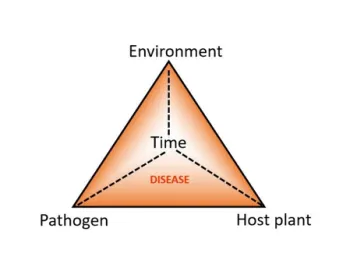
Figure 1. Disease Triangle Diagram
Host Specificity
While over 700 species of powdery mildew fungi affect more than 7,600 plant species globally, E. necator is highly specialized, infecting only grapevines. This strict host specificity means grape powdery mildew will not spread to other crops, and conversely, powdery mildew from cucurbits, roses, or other hosts poses no threat to vineyards.
Pathogen Biology
E. necator is an obligate parasitic fungus, meaning it can only survive and reproduce on living plant tissue. The fungus exhibits both asexual and sexual reproductive cycles. During the growing season, asexual reproduction produces abundant conidia (spores) on specialized structures called conidiophores, which appear as the characteristic white, powdery growth on infected plant surfaces. These conidia are easily dispersed by wind and can initiate new infections within hours under favorable conditions (Figure 2).
The sexual cycle produces chasmothecia—small, dark, overwintering structures containing ascospores. These survival structures form on infected tissues and persist through winter, releasing ascospores during spring rains when temperatures exceed 50°F (10°C). This primary inoculum initiates the disease cycle each season, making sanitation and early-season control critical components of effective management programs.
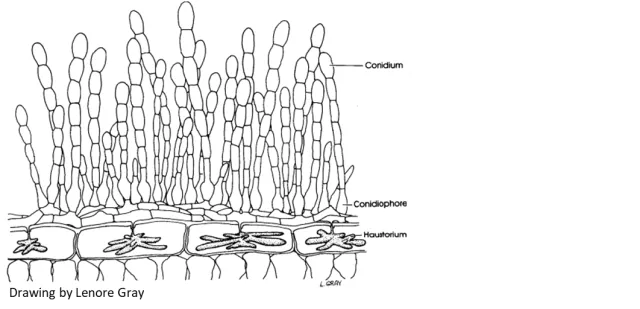
Figure 2. Fungal structures showing conidiophores and haustoria.
Disease Recognition and Impact
Symptoms on Foliage
Early foliar symptoms appear as chlorotic (yellowish) spots on the upper leaf surface, often most visible on young, expanding leaves (Figure 3). As infection progresses, white, web-like mycelial growth develops on both upper and lower leaf surfaces (Figure 3). Heavily infected leaves may become distorted, cease growth prematurely, and in severe cases, develop necrotic areas. Reduced photosynthetic capacity from infected foliage can significantly impact vine vigor and fruit maturation.
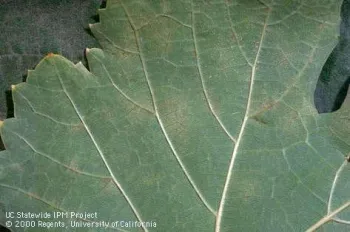
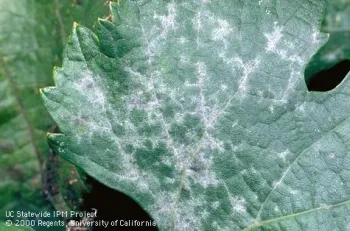
Figure 3. Figure 4: Leaf with chlorotic spots (left) and white mycelium (right).
Fruit Infections
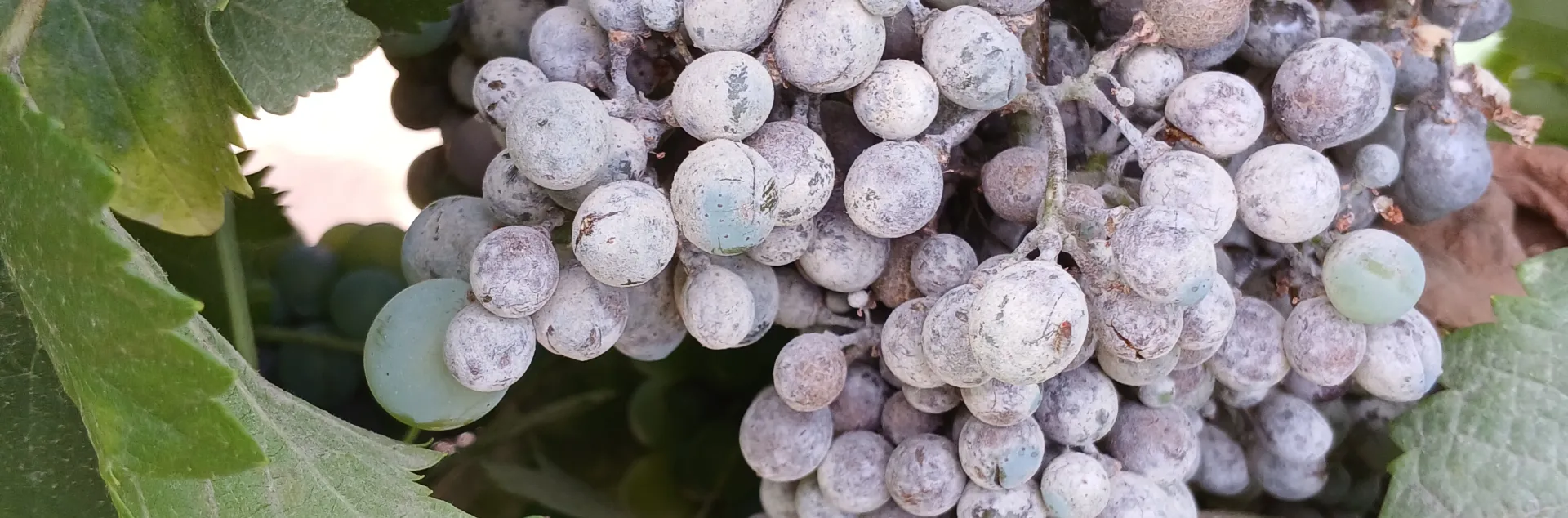
Berry susceptibility varies with the development stage. Young berries are highly susceptible, with infections appearing as white, powdery masses that can colonize the entire berry surface (Figure 4). As berries mature, their resistance increases, but early infections leave permanent damage. On mature fruit, previous infections manifest as distinctive black-to-brown, web-like scarring patterns (Figure 4). These scarred berries are unsuitable for the fresh market and may contribute off-flavors to wine, particularly musty or moldy characteristics that persist through fermentation.
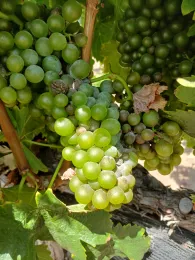
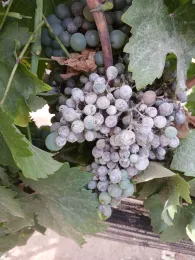
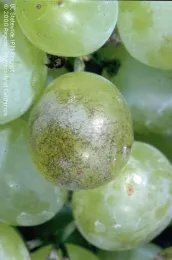
Figure 4. Clusters showing progressive infection stages (left and center) and web-like scarring patterns (right).
Cane and Shoot Symptoms
On dormant canes, powdery mildew appears as diffuse, red-to-brown blotchy areas where the fungus overwinters. These marks indicate the presence of chasmothecia and serve as important sources of primary inoculum for the following season. Identifying and removing heavily infected canes during dormant pruning can significantly reduce disease pressure in the subsequent growing season.
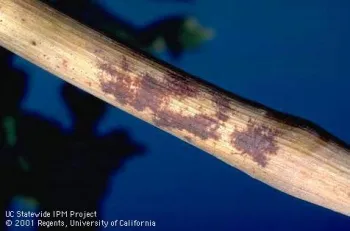
Figure 5. Red-to-brown blotchy areas on dormant canes.
Environmental Requirements and Cultural Control
Critical Environmental Factors
Powdery mildew development is influenced by several key environmental factors:
- Temperature: The disease cycle initiates when temperatures exceed 50°F (10°C), with optimal growth occurring between 68-77°F (20-25°C). High temperatures above 95°F (35°C) can suppress disease development.
- Moisture: While free water is not required for infection, the disease cycle begins with ascospore release triggered by rainfall exceeding 0.1 inch. Relative humidity above 40% favors conidial germination and mycelial growth.
- Light: Ultraviolet radiation is highly suppressive to powdery mildew. Shaded vine portions consistently exhibit higher disease pressure than well-exposed areas, underscoring the importance of canopy management as a critical cultural control strategy.
- Air circulation: Dense canopies with poor air movement create humid microclimates that favor disease development, while also hindering fungicide penetration and coverage.
Cultural Management Strategies
Effective cultural practices can significantly reduce powdery mildew pressure:
- Canopy Management: Maintain an open canopy architecture that allows sunlight penetration and air movement. Shoot positioning, leaf removal, and hedging should aim to minimize shaded areas within the fruiting zone.
- Basal Leaf Removal: Removing leaves in the cluster zone improves both UV exposure to fruit and fungicide coverage. Timing is critical; remove leaves shortly after fruit set to maximize benefits while avoiding sunburn.
- Sanitation: Remove and destroy heavily infected canes during dormant pruning to reduce overwintering inoculum. Early-season sulfur or oil applications can further suppress chasmothecia germination.
- Varietal Selection: While rarely practical for established vineyards, consider disease resistance when planning new plantings. Some cultivars show moderate resistance, though none are immune.
Critical Timing for Disease Management
The Six-Week Critical Window
The period from pre-bloom through approximately two weeks post-bloom represents the most critical window for powdery mildew management. During these six weeks, berries are at their most susceptible stage, and infections established during this period will persist throughout fruit development, regardless of subsequent control efforts.
Research consistently shows that effective early-season control simplifies late-season management. Conversely, poor control during the critical window is often irreversible, even with intensive later applications. This underscores the importance of:
- Beginning fungicide applications before bloom, especially in vineyards with historical disease pressure
- Maintaining consistent 7–14-day spray intervals during the critical period
- Using high-efficacy materials during peak susceptibility
- Ensuring thorough coverage, particularly of developing clusters
After fruit reaches approximately 12° Brix and remains clean, powdery mildew-specific applications can typically be discontinued, though monitoring should continue. At this stage, management priorities often shift toward bunch rot pathogens such as Botrytis cinerea.

Figure 6. Phenological timeline showing critical control period.
Fungicide Options and Resistance Management
Understanding Fungicide Categories
By Application Timing
- Protectant fungicides must be applied before disease appears. They prevent spore germination and infection but cannot cure existing infections. Sulfur and many contact fungicides fall into this category.
- Eradicant fungicides can halt disease progression after infection has occurred, though efficacy decreases as infection age increases. Some systemic fungicides possess eradicant activity.
By Mobility
- Contact fungicides remain on plant surfaces and require thorough coverage, including leaf undersides. They are susceptible to weathering but generally pose a lower risk of resistance failure.
- Systemic fungicides are absorbed and translocated within plant tissues, providing protection to new growth and better resistance to wash-off. However, their site-specific modes of action make them more prone to resistance development.
Sulfur: The Organic Mainstay
Sulfur has been used for powdery mildew control for over a century and remains the foundation of organic management programs. Three primary formulations are available:
- Wettable sulfur is mixed with water and applied as a spray. It provides good preventive protection but can cause phytotoxicity when applied above 85°F (29°C) or within two weeks of oil applications.
- Sulfur dust is applied directly as a powder. While inexpensive and effective, dust applications carry a higher risk of phytotoxicity (particularly at 85-90°F), can irritate applicators, and are prone to drift.
- Micronized or flowable sulfur features finer particles suspended in liquid, providing superior coverage and adhesion with reduced phytotoxicity risk compared to dust formulations, though at a higher cost.
Oils: Effective but Requiring Caution
Petroleum-based oils (such as JMS Stylet Oil) and plant-based oils (such as neem and jojoba) can help suppress powdery mildew. However, their use requires strict adherence to safety guidelines:
- Never apply oil sprays within two weeks of sulfur applications—this combination can cause severe phytotoxicity.
- Do not apply when temperatures exceed 90°F (32°C).
- Avoid applications when vines are water-stressed or drought-stressed.
Alternative Organic Materials
Several other Organic Materials Review Institute (OMRI)-listed materials are available, though generally with more limited efficacy:
- Bicarbonates (potassium bicarbonate, sodium bicarbonate) raise leaf surface pH, creating unfavorable conditions for fungal growth
- Biological fungicides contain beneficial microorganisms that compete with or parasitize the pathogen
- Plant extracts induce plant defense responses
- Silicon-based products strengthen cell walls, creating physical barriers to infection
Conventional Fungicides and Resistance Management
Synthetic fungicides offer excellent efficacy but require careful stewardship to preserve effectiveness. Erysiphe necator has demonstrated a remarkable capacity to develop resistance; many once-effective materials now provide little to no control. Critical resistance management practices include:
- Rotating fungicides with different FRAC (Fungicide Resistance Action Committee) codes
- Never applying the same fungicide (or fungicides with the same FRAC code) more than twice consecutively
- Tank-mixing or alternating with protectant fungicides (particularly sulfur) to reduce selection pressure
- Staying current with resistance monitoring and University recommendations, as the resistance landscape continues to evolve
2025 Valley Center Trial Results
Trial Design and Methods
During the 2025 growing season, we conducted field trials at a commercial vineyard in Valley Center, San Diego County, to evaluate the efficacy of nine treatments against powdery mildew. The trial utilized a randomized complete block design with four replications, encompassing both high-density (3'×8') and standard-density (6'×8') planting configurations.
Applications were made according to the following schedule:
- June 9: Luna Experience applied to the entire vineyard as a commercial standard
- June 24: Cevya (4 fl oz/acre) applied to trial plots only
- July 8: All trial treatments applied (except plasma-activated water)
- July 22: All trial treatments applied
- August 7: All trial treatments applied
Disease assessment was conducted in 25 randomly selected clusters per treatment, measuring both incidence (the percentage of clusters showing any symptoms) and severity (the percentage of cluster surface area affected).
Products Evaluated
The trial included both conventional and organic-approved materials representing diverse modes of action:
- Vivando (15.4 fl oz/ac, FRAC 50, metrafenone)
- Torino (3.4 fl oz/ac, FRAC U6, cyflufenamid)
- Quintec (4 fl oz/ac, FRAC 13, quinoxyfen)
- Cevya (4 fl oz/ac, FRAC 3, mefentrifluconazole)
- Kaligreen (5 lb/ac, FRAC M2, potassium bicarbonate, organic)
- Regalia (4 qt/ac, FRAC P5, Reynoutria extract, organic)
- JMS Stylet Oil (2 gal/ac, paraffinic mineral oil, organic)
- Erysichrona (27.4 + 12.8 fl oz/ac, RNA interference (RNAi) technology)
- Plasma-activated water (experimental technology, PAW)
Key Results
Statistical analysis revealed significant differences among treatments for both disease incidence and severity (Figure 7). Results are summarized below, with treatments grouped by similar performance levels:
Excellent Control: Vivando demonstrated superior performance, with 32% disease incidence (68% reduction compared to the untreated control) and only 6% severity. This product consistently provided the best control across all evaluation metrics.
Good Control: Torino and Quintec provided commercially acceptable control with 56% and 62% incidence, respectively, and both achieved approximately 12% severity. These materials represent viable alternatives for rotation programs, though with reduced efficacy compared to Vivando.
Good to Limited Control: The remaining treatments—Cevya, JMS Stylet Oil, Regalia, RNAi, plasma-activated water, and Kaligreen—showed moderate efficacy under the high disease pressure conditions of this trial. Disease incidence ranged from 76-84%, statistically similar to each other, though significantly better than the untreated control (100% incidence). Under lower disease pressure conditions, these products may prove more useful for disease management.
| Treatment | Disease Incidence (%) | Incidence Significance Group | Disease Severity (%) | Severity Significance Group |
|---|---|---|---|---|
| Control | 100 | A | 80 | A |
| Kaligreen | 85 | AB | 24 | B |
| RNAi | 79 | BC | 23 | B |
| Regalia | 75 | BC | 21 | BC |
| JMS Stylet Oil | 75 | BC | 20 | BCD |
| PAW | 79 | BC | 19 | BCD |
| Cevya | 79 | BC | 18 | BCD |
| Quintec | 62 | CD | 10 | CDE |
| Torino | 55 | D | 7 | DE |
| Vivando | 32 | E | 3 | E |
Table shows Powdery Mildew Disease Incidence (%) and Severity (%) across ten treatments including an untreated control.
Practical Recommendations for Growers
Integrated Management Program
Based on current research and trial results, an effective powdery mildew management program should integrate multiple tactics:
- Early-season sanitation: Apply sulfur or oil before bud breaks to suppress overwintering inoculum in vineyards with previous disease history.
- Critical period protection: Maintain 7–14-day spray intervals from pre-bloom through two weeks post-bloom using high-efficacy materials.
- Product rotation: Alternate FRAC codes, never applying the same mode of action more than twice consecutively.
- Canopy management: Maintain open canopy architecture and perform timely basal leaf removal.
- Regular monitoring: Scout weekly during the critical period, paying particular attention to shaded areas where disease typically appears first.
Looking Forward
Powdery mildew management continues to evolve as resistance develops and new technologies emerge. In all production systems, success ultimately depends on integrating multiple management tactics rather than relying solely on chemical control.
Growers should stay current with university recommendations, monitor their own vineyards carefully, and maintain detailed records of product efficacy. What works in one vineyard may not perform equally well in another due to differences in microclimate, variety, and pathogen populations. Adaptive management—adjusting programs based on observed results—remains essential for long-term success.
Acknowledgments
The author gratefully acknowledges the Eskalen Lab at UC Davis for providing guidelines and protocols for trial implementation, and the cooperating growers Alysha and Al Stehly for generously providing the trial site. Special thanks to Ubaldo and Juan for their excellent work in fungicide application and vineyard management throughout the growing season.