
By Penny Pawl, UC Master Gardener of Napa County.
My fellow Master Gardener Gayle Nelson is having a love affair with her new cloner. A tray of 20 gardenia cuttings produced roots in 4 weeks.
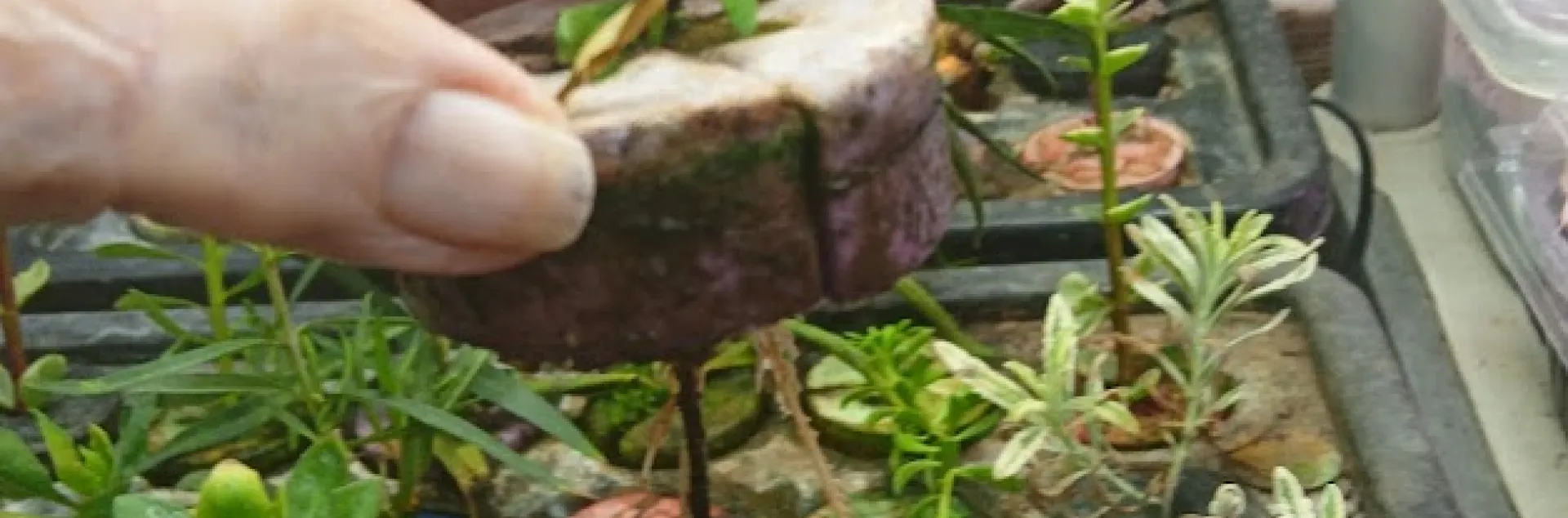
A cloner is a machine that uses hydroponic methods to encourage cuttings to produce roots. The top section has soft rubber plugs with a hole to hold the cuttings. There is water in the tank and a small pump that continually washes the stems of plants in the top section. I have had my cloners so long and use them so often that I have had to replace two of the pumps.
I enjoy propagating plants and either give them away or plant them in my garden.
I have been “slipping” or propagating plants for many years. As I walk around my garden, I see many of my propagation successes growing happily. These include lavenders, salvias (especially ‘Hot Lips’), boxwood, pomegranate, dogwood and figs.
One method that I use for plants that don’t like the cloner requires a mixture of sharp sand and pumice. It takes longer to root cuttings in this mixture than in a cloner, but it works well because the mixture is coarse and fast draining. The sharp sand also encourages rooting because when a root hits the sand it divides and forms more roots.
When using the sand/pumice method, select a young stem about 8 to 10 inches long. Cut it at an angle and strip off the lower leaves. Plant it deeply enough in the medium that some leaf nodes are buried. Roots usually appear first at the leaf nodes.
After a couple of months, check to see if the cutting is rooting by gently tugging on it. If you feel any resistance, you have roots and your cutting is ready to repot in soil mix.
Another of my favorite methods is air layering. This procedure takes a bit more effort, but it works well on maples and other deciduous trees. I use air layering when I want to reduce the height of a tree and would like to make a new tree from the top part because it is nicely shaped.
Let’s say I have an eight-foot maple that I would like to reduce to six feet. At the six-foot mark on the trunk, I cut into the bark down to the heartwood, gently scraping away the bark and cambium around the trunk to make a band as tall as the diameter of the trunk. Then I cover the exposed band with damp sphagnum moss, secure the moss with plastic and tie the bundle in place. I leave the bundle open on top so I can water it and keep the moss moist. You can find helpful videos of air layering online.
In a few months, roots should start to grow from the heartwood. You can feel them inside the bundle as they expand. When I know I have a good mass of roots, I cut across the trunk at the base of the band. Now I have a maple sapling that can be immediately planted.
The only issue with this method is that sometimes the initial wound will develop a callus. When this happens, I recut and rewrap the area.
Another propagation method is grafting, but I must be honest. I have never made a successful graft. What am I doing wrong? I have rather given up on it.
You can also propagate some plants by anchoring a low, flexible branch to the ground. If all goes well, the branch will eventually root and you can cut it away from the mother plant.
You prepare cuttings for the cloner the same way you prepare them for the sharp sand and pumice method. Monitor the cloner daily to make sure the pump is functioning properly and not blocked. It’s also important to keep adding water so plant stems stay wet. The tank is inviting to small toads; I’ve had some take up residence.
And now that you have roots, what do you do next? It is time to pot these plants in soil. Sometimes the roots are so long that I have to cut them back to fit into a 4- or 6-inch pot. I use a soil-less mixture that I have baked for a while in my hothouse to dry it and hopefully kill any weed seeds. My potting medium contains small red lava rock, compost, bark, pumice and perlite.
I make sure the roots are well-covered with potting medium, then I water it well and feed with homemade worm compost to give the plant a boost. I put newly potted plants in a protected place for a few weeks until they have adjusted.
If you decide you would like to buy a cloner, you will find several styles available online. Propagating plants you love is satisfying and economical, so I hope you will give it a try.
Workshop: Join UC Master Gardeners of Napa County for a workshop on “Winter Rose Care” on Saturday, January 10, from 10 am to noon, via Zoom. The workshop will highlight pruning techniques for all rose types, along with everything needed to make your roses a success. Reserve here to receive the Zoom link.
Workshop: Join UC Master Gardeners of Napa County for a workshop on “Starting Your Own Vegetable Seedlings” on Saturday, January 10, from 2 pm to 4 pm, at UC Cooperative Extension, 1710 Soscol Avenue, Napa. We’ll cover all the basics, including proper moisture, temperature and light for successful seed starting, and care of seedlings until they are ready for transplant. We provide some seeds, containers and soil; bring your own seeds if you like. Reserve here.
Help Desk: The Master Gardener Help Desk is available to answer your garden questions. Use our online Plant Problem Help Form or email us at mastergardeners@countyofnapa.org. Include your name, address, phone number and a brief description of the problem. You can also visit us in person on Mondays and Fridays from 10 am until 1 pm at the University of California Cooperative Extension Office, 1710 Soscol Avenue, Suite 4, Napa.