
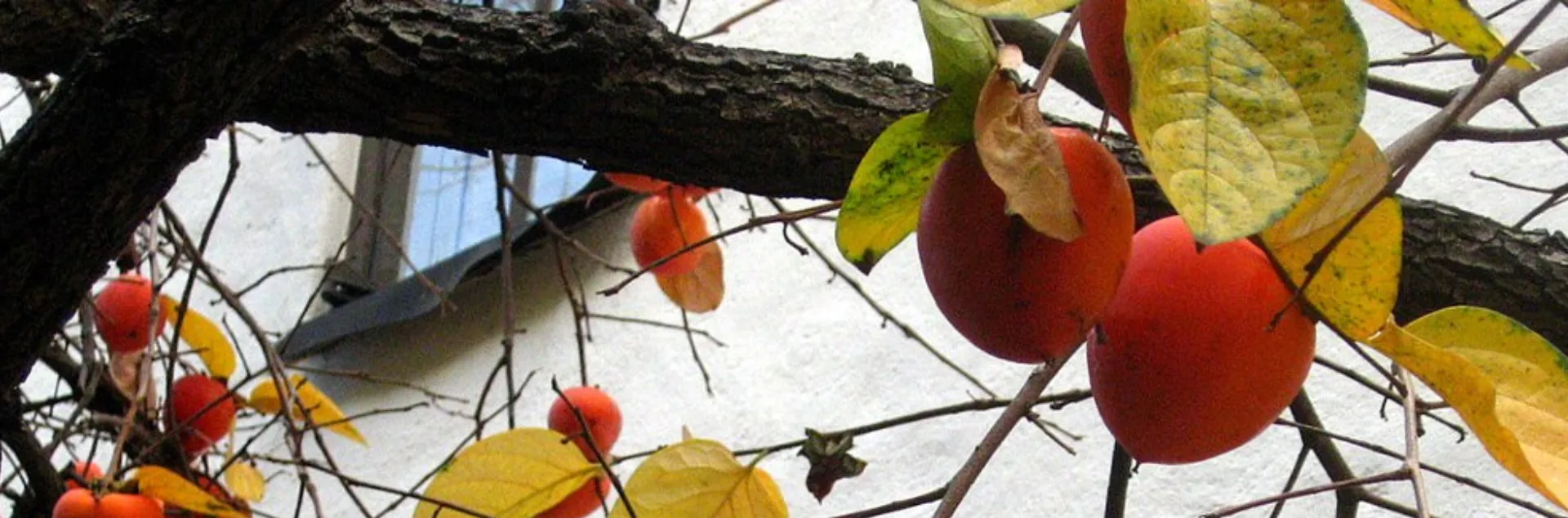

Are you tired of making persimmon cookies? Do you want to try something new with your hachiya persimmons? Try hoshigaki - the centuries-old Japanese art of air of drying hachiya persimmons.
Hachiya persimmons have an astringent taste when hard and are not edible in that state. In America, the softened fruit is used to make cookies. In many countries, hachiya persimmons are used for drying because their high tannins and sugar profile can transform into a sweet, jammy interior.
Air drying hachiya persimmons is an ancient practice that is widespread throughout Asia and the Mediterranean, including Japan, China, Korea, Armenia, Georgia and Iran. The traditions involve peeling whole hachiya persimmons and hanging them by the stem to dry. They turn into a sweet treat with the consistency of dates.
The tradition in most countries is simply to peel and dry persimmons. In Armenia, the persimmons are dipped in sugar water before they are dried. In Azerbaijan, the persimmons are pressed to form shapes. In Japan, the method involves repeatedly massaging the persimmons. Does it sound crazy to “massage your persimmons”? It’s done so their natural sugars concentrate and bloom on the surface, giving it the jammy interior and pliable consistency for shaping.
Below is a protocol for drying your hachiya persimmons, adapted from UCANR Master Food Preserver instructions and established hoshigaki techniques.
- Pick hachiya persimmons when orange but still firm. Leave the upper leaves and stem on the fruit.
- Rinse briefly under running water, pat dry and remove the skin. Leave about a quarter inch of skin on top of the fruit, as well as the upper leaves.
- Tie a length of cotton string securely to the stem.
- Dip the peeled fruit in boiling water for 15 seconds.
- Hang fruits so they don’t touch. Hang in a spot with good airflow. Ideal temperature is 70 degrees.
- After the first 7 to 10 days when the exterior skin begins to wrinkle, begin gentle daily massaging: squeeze and roll each fruit to redistribute sugars, break down the pulp, eliminate air pockets, and shape the fruit. Continue massaging (daily or every few days) for 3 to 6 weeks until the interior is soft, jelly-like and the outside develops a white sugar bloom.
- When the fruit is pliable and the surface has a sugary bloom, the hoshigaki are done. At this point you can gently shape the fruit and roll them to even thickness and remove remaining surface moisture. Remember, the white coating on the outside is sugar and is safe to eat.
- Store in airtight containers in the refrigerator for several months or freeze for longer storage. For short-term pantry storage, use cool, dry, low-humidity conditions.
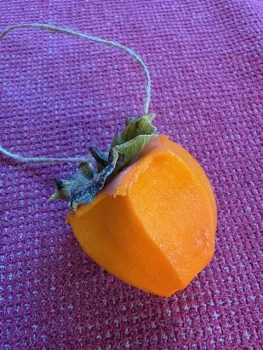 | 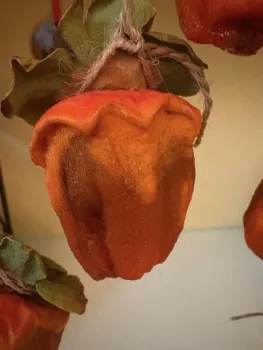 | 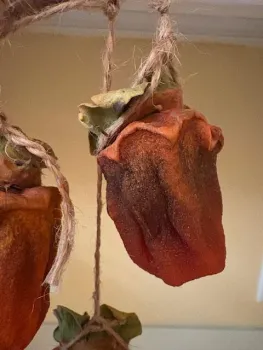 |
| Photos: Sue Bohigian |
My observations and missteps:
- Did it work? Yes, the air-dried hachiya persimmons were delicious. They were sweet and really did taste like dates.
- Do you have to massage the fruit? This step resulted in lots of giggles, but it is an important step. I noticed that massaging the fruit allowed it to dry evenly and distribute the softer center so that it dried faster.
- Does size matter? Yes, smaller persimmons dried much more easily. I did not have to do much while they dried. The very large persimmons did not dry by air alone. Several of them became mushy in the middle and fell on the ground.
If possible, select small- to medium-sized fruit. Make sure the fruit is hard. For very large fruits, consider cutting in half (lengthwise or crosswise). This reduces drying time and prevents the fruit from sagging. If the stem is weak or the fruit is heavy, insert a toothpick through the top to provide extra support.
As a last resort lay the peeled fruit on a mesh screen (instead of hanging) to dry. I had to cut my persimmons down before they were dry and put them in the oven at 200 degrees to help dry the center of the fruit.
- Additional tip - Check your fruit daily. I was out of town for a few days and I came home to persimmons on the floor. By checking daily, you can remove any fruit that is too soft and put it in the open to help it dry.
- Can you air dry fuju persimmons? All the literature states that fuju persimmons will not dry in the same way and should not be used for this process, but I tried anyway. I hung the fuju persimmons to dry in the same way I hung the hachiya persimmons. I had to put them in the oven at day 6 for an hour to speed up the drying and then I hung them again to air dry. They were delicious and had a softer consistency than the more common dehydrated fuju persimmons. I highly recommend it.
- Was it worth it? It was so much fun drying the fruit and experimenting with all the different ways to get a yummy product. The successful dried fruit was delicious, so definitely worth the effort and I will do it again next year.
References and further reading:
- Persimmon time, UC Cooperative Extension, San Joaquin County
- Preserving persimmons by Susan Mosbacher, UC Food Blog
- Preserving persimmons 1, Freezing and Drying, UC Master Food Preserver Program
_____________________________
Written by UC Master Gardener/Master Food Preserver Sue Bohigian