
By Penny Pawl, UC Master Gardener of Napa County
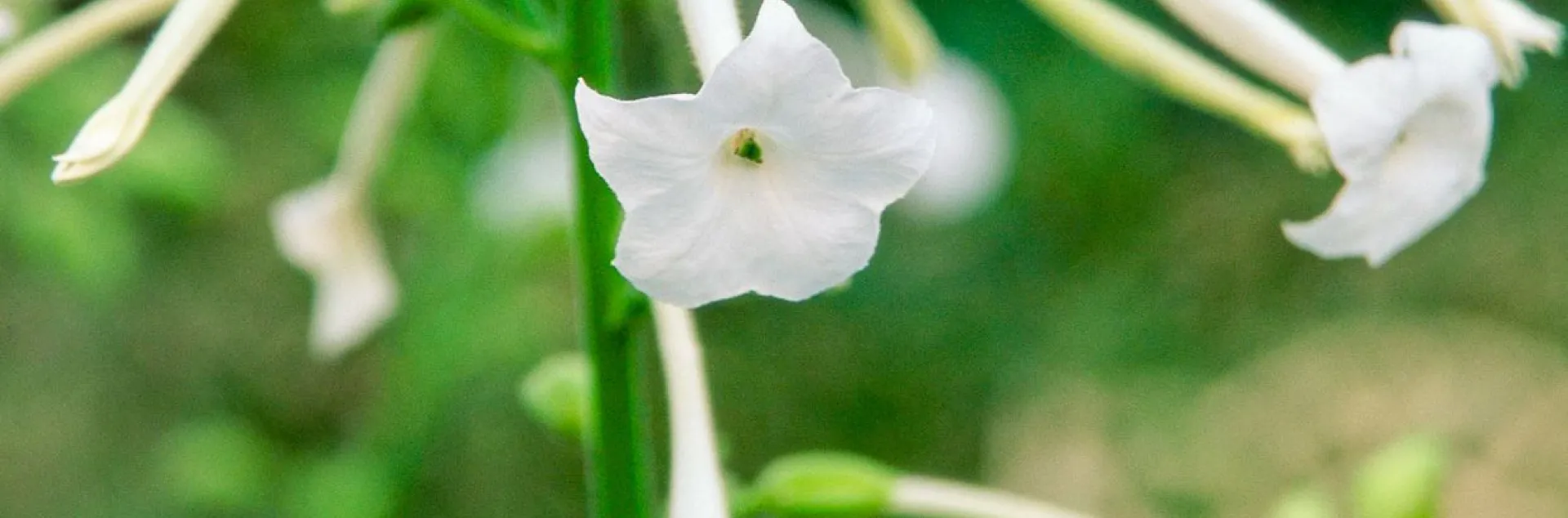
One of my favorite plants in my garden is nicotiana (Nicotiana sylvestris), also known as flowering tobacco. The plants need almost no care and bloom most of the spring, summer and autumn. The flowers are fading just now in October.
Nicotiana also does double duty by feeding nighttime garden visitors such as moths and bats. Although I don’t see these creatures when they dine because I am asleep, the plants create a lot of seed. That indicates to me that something has been feeding on them and moving nectar around. Hummingbirds also like to feed on nicotiana flowers.
If I am in the mood, I may water the plants, but mostly they are dry. Still, baby nicotiana is coming up in a
lot of places in my yard so the seeds are moving around. I once was pruning near a large nicotiana, and
when I came inside, I felt small bumps on my scalp. It took me a few minutes to figure out I was a seed
spreader. The seeds are sticky, and I had to wash my hair to get them out.
Nicotiana is native to South America. It was introduced to Europe by John Nicot, a 16 th -century French
diplomat. People admired its flowers. Coincidentally, smoking tobacco became common during that
period; however, flowering tobacco is not used for smoking so grow it for its beauty alone.
There are many species of ornamental nicotiana, but N. sylvestris, the one I grow, has downward-facing
tubular flowers. I see the blossoms on both full-grown plants and those that have recently reseeded. My
plants have white blossoms but nicotiana bloom in a variety of colors. I have recently purchased an
orange-flowering nicotiana and plan to keep it this winter in my greenhouse. In spring, I’ll add it to the
garden bed with the white variety. Online you can find sources for nicotiana that bloom in red, pink,
yellow and green.
A mature nicotiana grows three to five feet tall. When its seeds are mature, a flowering stalk will die back.
Recently I was looking at a dying flower stalk with seed pods and saw a new stalk coming up at the base.
I will cut the old stalk back to the new growth, where next spring’s blooms are getting ready.
The plants do not appear to be fussy about soil, but my best plants are in my vegetable beds, where the
soil has been improved over the years. My soil contains a mixture of loam, compost, wood chips and
worm compost.
The ripe nicotiana seeds are about the size of coarsely ground black pepper. You can scatter them on top
of good soil and with winter rains they will sprout.
Nicotiana grows well in partial to full sunlight in our area. In the tropics, where they are native, they will
even grow in the shade.
While researching this article, I noticed that many sources mention nicotiana’s jasmine-like fragrance. The
alluring scent attracts moths for pollination. I must admit I have never smelled the flowers. Maybe I
should go out in the moonlight and take a sniff. Several articles also mentioned nicotiana as an excellent
filler flower in floral arrangements.
As its name suggests, the plant does contain nicotine, a natural pesticide. No wonder nicotiana has very
few pests.
Keep pets and young children away from nicotiana. Every part of the plant is toxic if ingested.
Fall Clean-Up: Join UC Master Gardeners for the annual fall clean-up at the Las Flores Learning Garden
on Saturday, October 25, from 10 am to noon. The garden is at 4300 Linda Vista Avenue in Napa. We’ll
be putting gardens to bed for the winter. Learn healthy gardening practices by working alongside Master
Gardeners in the low-water, native, pollinator and succulent gardens. Register here.
Library Talk: Join UC Master Gardeners for a free talk on “Growing Garlic, Onions, and Other Alliums”
on Thursday, November 6, from 7 pm to 8 pm via Zoom. Garlic can be planted as we enter the darkest
time of year; other alliums get planted throughout the seasons. Register here to get the Zoom link.
Help Desk: The Master Gardener Help Desk is available to answer your garden questions on Mondays
and Fridays from 10 am until 1 pm at the University of California Cooperative Extension Office, 1710
Soscol Avenue, Suite 4, Napa. Or send your questions to mastergardeners@countyofnapa.org. Include
your name, address, phone number and a brief description of the problem.