
Blog by Jenni Dodini
I have noticed on recent blogs that the author has shared that a friend/neighbor/ relative came to them with a "bug" or plant problem.
Well, I knew that I was in trouble when my friend said, "Come here. I need you to look at my tree." She was quite distressed that her 30+
year year-old crape myrtle tree was quite distressed.
Needless to say that it was VERY DRY. "When was it last watered?" I asked. "Last rainfall" was her answer. Then the "bug" inspection
was done. The bugs looked like aphids, but there was no honeydew, and the leaves were all spotted. Also, very dry. There were dead
leaves piled under the tree. The tree is between the fence and a little playhouse with a cement patio about 2 feet away from the fence line.
So, we determined that the dead leaves needed to go away as they could be harboring more insects. Then I advised water, lots of water.
At that point, I took off a little of the wood and some leaves and bugs, and that went into a ziplock bag. I said that even with my glasses on,
I couldn't be really sure about what I was looking at, and I would take it into the office, where I could use the loupe and consult with
Jennifer.
Well, into the office I went. Jennifer and I looked with the loupe. Then she got out the good microscope. Boy oh boy, one cannot say enough
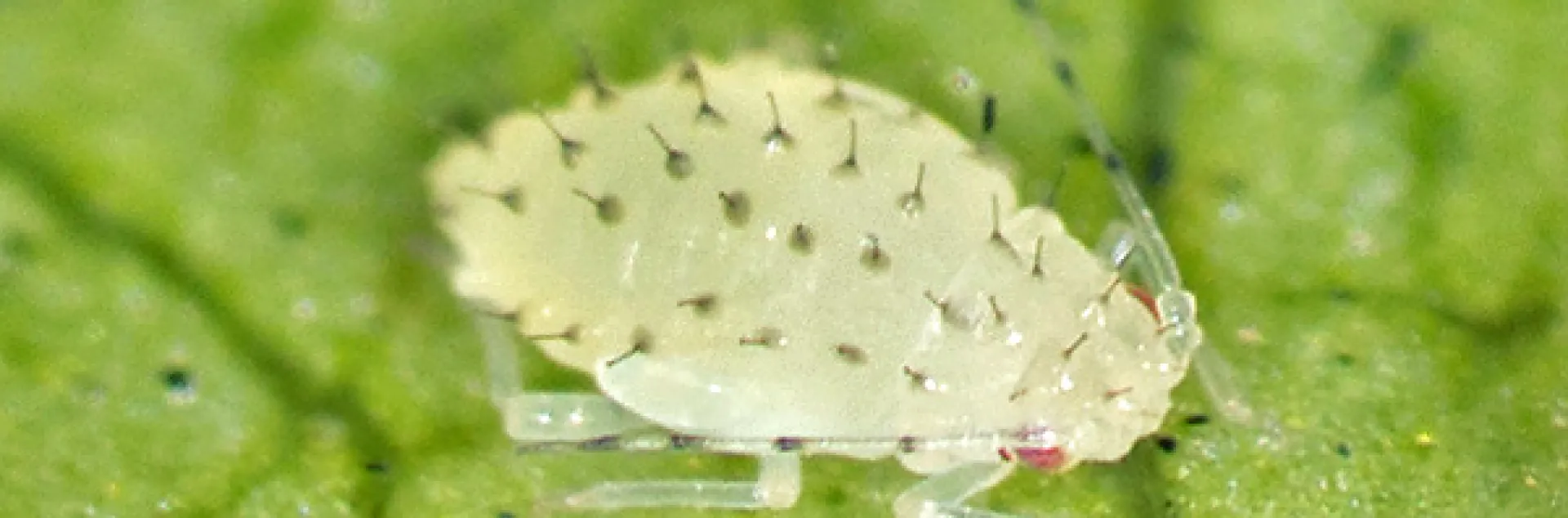
about what magic comes from at least 500x magnification! (OK, you caught me exaggerating again.) This little guy had a pale greenish body
with 2 rows of black prongs along its back and pink to red colored eyes! Seriously. Jennifer said she had never seen it before. Too bad that the magic
microscope doesn't take pictures. Anyway, she found it pretty quickly on the computer. Click here to see a photo from the Oklahoma State University Extension.
As it turns out, there are four nymph stages, and the ones with the black spikes are the older ones. The nymphs are wingless, while the adults have
wings and dark-tipped antennae. The eyes are pink to red in color. Now, here's the interesting part. These little pests overwinter as eggs in the cracks
in the bark of the tree and in the twig flanges and begin to hatch in about April. They mature in 7 to 10 days! They give birth to living young without
mating, and those little pests mature in about 7 to 10 DAYS. That gives rise to many generations in a single growing season. As we know, the nymphs
are hungry little buggers and feed by sucking and injecting saliva into the leaf, causing yellowing. There are both winged and wingless adults.
Only the winged adults leave the plant and migrate to another crape myrtle to start new colonies. The last females of the season lay eggs for overwintering.
These are the only sexually reproducing females and males, and they are born around the fall equinox. They all produce honeydew.
The scientific name of this aphid is Sarucallis ( or tinocallis) kahawaluokalani. It was first described in Hawaii in 1907 and then named after the queen,
Queen Kahawaluokalani. It is native to Southeast Asia. It is one of the most common pests on crape myrtle. The natural enemies are lady beetles and
their larvae, lacewings and their larvae, hoverfly maggots, and parasitic wasps. One should begin monitoring the plants in late May, focusing on the
underside of the leaves. Prune away susceptible branches during the winter. Making sure that the canopy has full sun helps decrease the infestation
as well as maintaining a greater plant diversity around your crape myrtle to attract the natural enemies.
So, what was the outcome of this story? Well, a very deep watering a couple of times made a huge difference for her tree. She also sprayed the
honeydew off as much of the canopy as her hose would reach. She did identify some lady beetles in an upper branch, so I advised patience so that
more would join the party. The honeydew that had dripped onto the plants below was also sprayed, and the ants were none too happy about it.
Then I went about my place and inspected the crape myrtle that Steve's mom had planted. She loved them, so there are quite a few. Good news...
They are all OK.
photo credit: https://www.inaturalist.org/people/5283