
UC Master Food Preserver Newsletter

In November of 2024, the UC Master Food Preserver Program launched a monthly newsletter that delivers recipes, how-tos, and food preservation inspiration straight to a subscriber's inbox. Subscribe to the newsletter here.
Do you have a correction, suggestion, or story to share with the newsletter team? Share corrections, suggestions, or stories here.
Past Newsletter Full Emails
2026
2025
2024
Monthly Articles To-date
All About Apples: Which are Best for Your Recipe? (November 2025)
Tim Long, UC Master Food Preserver Online Program Volunteer
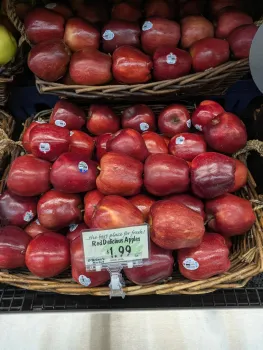
Red Delicious apples at the market (Photo caption: Tim Long, used with permission).
If you’re looking for a native apple tree, you’ll to be disappointed. Apples, other than three varieties of crabapples, aren’t native to the Americas. They originated in Kazakhstan in central Asia and eastern Europe about 6,500 years ago.
Apples came to America with the first colonists, who carried young trees and seeds from home. Unlike today’s apples, they were likely smaller and not so pleasant tasting. Even so, apples became a staple in the American diet with many being pressed to make cider. Hard cider was regularly consumed at meals—a safer alternative at a time when water supplies often carried disease due to poor sanitary practices.
Apples moved westward along with settlers, including the man many know as Johnny Appleseed. He was born Jonathan Chapman in 1774 in Leominster, Massachusetts, and apprenticed as an apple orchardist. Chapman collected seeds from cider presses, planting (and selling!) orchards as he traveled west.
Over 2,500 Varieties of Apples are Grown in the United States
Although the crabapple is the only variety native to North America, thousands of varieties of apples are grown in the United States. Red Delicious, Fuji, Golden Delicious, Braeburn, McIntosh, Rome, Granny Smith, and Gala are a few of the most popular varieties grown in the U.S.
Fun facts and useful information:
- The old saying, "An apple a day keeps the doctor away," comes from an old English adage, "To eat an apple before going to bed, will make the doctor beg his bread."
- A bushel of apples weighs about 42 pounds and will yield 20-24 quarts of apple sauce.
- Two pounds of apples make one 9-inch pie.
- It takes about 36 apples to create one gallon of apple cider.
- Don't peel your apple (but do wash it). Two-thirds of the fiber and lots of antioxidants are found in the peel.
- Red Delicious is the most widely grown apple variety in the United States.
- The five most popular apples in the United States are Red Delicious, Golden Delicious, Gala, Fuji, and Granny Smith.
Different apple varieties are best suited for particular applications:
Table of common apple varieties and suitability for different types of preservation methods. | ||||||
| Apple Variety | Canning | Dehydrating | Freezing | Juice & Cider | Pies & Baking | Sauce & Butter |
| Ambrosia | ✓ | ✓ | ✓ | ✓ | ||
| Braeburn | ✓ | ✓ | ✓ | |||
| Cameo | ✓ | ✓ | ✓ | |||
| Cortland | ✓ | ✓ | ✓ | |||
| Empire | ✓ | ✓ | ✓ | ✓ | ||
| Fuji | ✓ | ✓ | ✓ | ✓ | ||
| Gala | ✓ | ✓ | ✓ | ✓ | ||
| Golden Delicious | ✓ | ✓ | ✓ | ✓ | ✓ | |
| Granny Smith | ✓ | ✓ | ✓ | ✓ | ✓ | ✓ |
| Gravenstein | ✓ | ✓ | ✓ | |||
| Honeycrisp | ✓ | ✓ | ✓ | ✓ | ✓ | |
| Jazz | ✓ | ✓ | ✓ | |||
| Jonathan | ✓ | ✓ | ✓ | |||
| Jonagold | ✓ | ✓ | ✓ | |||
| McIntosh | ✓ | ✓ | ✓ | |||
| Pink Lady | ✓ | ✓ | ✓ | ✓ | ||
| Rome Beauty | ✓ | ✓ | ||||
| Stayman | ✓ | |||||
| Winesap | ✓ | |||||
Table provided by University of Illinois-Illinois Extension Food Preservation:
https://extension.illinois.edu/food-preservation/apples
Special Note on Acidity of Apples from: Ball Blue Book FAQs
“Why was lemon juice added to apple recipes in the Ball® Blue Book 38th edition?”
Over the past several years, recipe validation efforts with apples have noticed the pH increasing of certain species. The Ball® Home Canning Test Kitchen ran a screening study of a variety of species of apples under several conditions and found that some species have pH's higher than historical assumptions. We are unaware of any documented safety issues arising from current apple recipes, and the National Center for Home Food Preservation has not updated their guidance on apples requiring any acidification. Out of an abundance of caution and in the spirit of continuous improvement, we have added bottled lemon juice to all apple-based recipes where the apple was expected to be the lowest pH ingredient. The quantity of lemon juice was based on experimentation of different types of apple recipes using the highest pH apple species that was identified, and using pH modeling to understand the margin at different pH and temperature thresholds keeping existing processing time recommendations the same. These apple acidification guidelines have been incorporated into all Ball® home canning recipe publications for print year 2024. We are not currently recommending that consumers discard any apple recipes they have canned previously as prior publications are still within USDA recommendations. We are advising consumers using Ball® recipes to follow the acidification guidelines in publications starting in 2024. We believe this is a best practice given the current information, and we will reevaluate as additional data becomes available.”
Great resources for apple/apple related preservation are:
The Ball® Blue Book, https://www.ballmasonjars.com/products/products-to-get-you-started/ball%C2%AE-blue-book-guide-to-preserving/ and the Ball® website (https://www.ballmasonjars.com/recipes?fdid=recipes)
Selecting, Preparing, and Canning Fruit and Fruit Products, The National Center for Home Food Preservation (https://nchfp.uga.edu/papers/guide/GUIDE02_HomeCan_rev0715.pdf)
So Easy to Preserve, Cooperative Extension, The University of Georgia. https://www.fcs.uga.edu/extension/so-easy-to-preserve
UCANR Master Food Preservers: https://ucanr.edu/program/uc-master-food-preserver-program/uc-master-food-preservers-recipes
Applications Now Open for 2026 UC Master Food Preserver Training Program! (November 2025)
Henry Shaw, UC Master Food Preserver Online Program Volunteer
Your Name Here MFP Badge (Photo caption: Henry Shaw, used with permission).
Do you want to learn more about safe food-preservation techniques? Do you have a passion for sharing your knowledge with others? Are you willing to donate your time as a volunteer for a good cause? Would you like to help people in your community learn to preserve food safely in their homes, reduce food waste, increase food security, and provide engaging ways for Californians to explore healthy food? Are you a resident of California? If so, you should consider becoming a UC Master Food Preserver yourself!
Applications are now open for the 2026 UC Master Food Preserver training program. Complete details of the application process, what the training entails, and the training schedule are available on the UC Master Food Preserver website. If you reside in a county that has a local county-based program, you should apply to that county’s program. Note that not all counties are conducting training in 2026 (see the website). California residents living in counties that do not have a county-based program (i.e., Alameda, Alpine, Butte, Contra Costa, Glenn, Imperial, Kern, Kings, Lake, Los Angeles, Marin, Mendocino, Monterey, Napa, Nevada, Placer, San Benito, Santa Clara, Santa Cruz, Stanislaus, and Ventura) are invited to apply to the 2026 training for the Online Delivery Program.
Once trained, UC Master Food Preservers must volunteer a minimum of 50 hours in their first year, and 25 hours/year subsequently. To maintain their active status past the first year, volunteers are also required to complete 12 hours/year of continuing education and pass an annual recertification quiz.
Pasting and Saucing Chile Peppers: Exploring Flavors from New Mexico to Peru (November 2025)
Robyn Barker, UC Master Food Preserver Online Program Volunteer
If you have a sunny spot in your garden or on your patio, chili peppers are fun and easy to grow. The plants don’t get too large; they can even be grown in a container. They are relatively disease and pest free. With limited space and energy though, I prefer to grow varieties that I like to eat but can’t be easily found at the grocery store. This year, among others, I grew Hatch and Aji Amarillo varieties.
Hatch peppers are synonymous with New Mexico. I’ve heard said that, just as sparkling wine must be from the Champagne region of France to be Champagne, a Hatch pepper must be from New Mexico to truly be a Hatch pepper. Whether you visit Albuquerque or Santa Fe, these peppers will be found in a myriad of dishes: chiles, cheeses, tacos, burritos, or my favorite, a Hatch chili cheeseburger. In the late summer and fall, they sell bags of fire-roasted Hatch chilis by the side of the road. I bought my seeds in the spring, and they were labelled as producing a mild green chili.
Aji Amarillo peppers are from Peru. Aji is the Spanish word used for chili peppers in South America; amarillo means yellow. The peppers are fruity and tangy and moderately spicy, about 30,000 to 50,000 on the Scoville scale. Like the Hatch peppers in New Mexico, they appear in many Peruvian dishes, most deliciously in Aji de Gallina or Peruvian Chicken chili. When fully ripe, they are a neon orange color and they are about the last of my chili peppers to ripen (Fig. 1). It isn’t unusual for me to be biting my nails hoping they will ripen before the weather gets too cold.
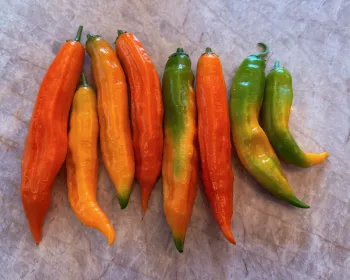
Aji Amarillo peppers in various stages of ripeness (Photo caption: Robyn Barker, used with permission).
Early fall is about the right time of the year to process Aji Amarillo peppers. It’s a little late for my Hatch peppers, which I didn’t catch before they turned red (Fig 2). I frequently wait for my jalapeno and serrano peppers to turn red – the flavor tends to be richer and fruitier and a bit hotter. But not all peppers improve with age. The shishitos become too dry, and the pulp of these Hatches seems to have thinned. But they are still usable!
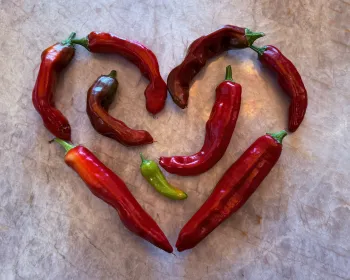
Ripe Hatch peppers (Photo caption: Robyn Barker, used with permission).
I decided to preserve some of my peppers so I could keep a little of the summer flavor to enjoy later in the winter. Both preparations can be used to make dips, marinades, or spice up sauces and soups. Although I made these sauces with the Hatch and Aji Amarillo peppers, the instructions will also work with many other varieties of chili peppers that you find in the grocery store produce section, your farmers’ market, or in your garden.
To prep the chili peppers, first slice off the stem and blossom ends and remove the seeds and the white pith. Use disposable gloves to protect your hands from the spicier peppers.
To keep the sauce smooth, remove the skin of the peppers. This can be done after blanching the peppers in boiling water, but, preferring the smokier flavor, I put them under a broiler for five minutes until they started to blister and blacken and then let them steam in a plastic bag or under tented aluminum foil for ten minutes. The skin then comes off easily (Fig 3).
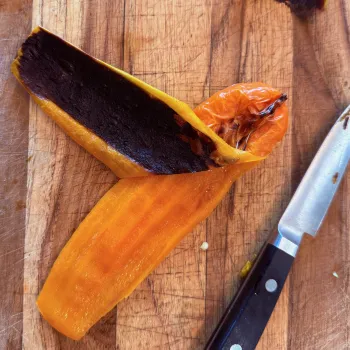
Roasted Aji Amarillo pepper that has been skinned (Photo caption: Robyn Barker, used with permission).
To make a paste with the Aji Amarillo peppers, I whirled them in my food processor with about a tablespoon of water until they were pureed. I then filled slots in an ice cube tray and put the tray into the freezer (Fig. 4). Each cube slot held about two tablespoons of puree. Once frozen, I can repack the cubes into a plastic freezer bag or vacuum-sealed bag, labelling them so I will remember exactly what they are, and use them as needed. You can find several recipes that rely on the Aji Amarillo paste. I’ve yet to try them, but am intrigued by:
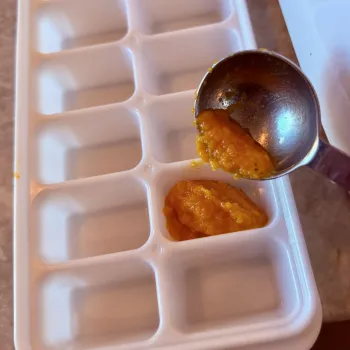
Aji Amarillo paste being loaded in ice cube tray (Photo caption: Robyn Barker, used with permission).
- Aji de Gallina: https://kitchenjoyblog.com/aji-de-gallina-peruvian-yellow-pepper-chicken/
- Dipping sauce: https://www.platingsandpairings.com/aji-amarillo-recipe/
- Peruvian Style Mahi Mahi: https://greenhealthycooking.com/peruvian-style-mahi-mahi-recipe/
I decided to make a more complicated sauce or salsa with the Hatch peppers because their mild flavor wasn’t quite so distinctive. This sauce can be kept in the refrigerator for up to a week or frozen for 6-month to a year.
Hatch Pepper Sauce
Makes about 1 cup
15 minutes prep time
½ cup roasted Hatch chili peppers
1 Tbsp olive oil
½ yellow onion chopped
2 cloves garlic, minced
¼ cup roughly chopped cilantro leaves and stems
½ lime, zested and juiced
2 Tbsp cider vinegar
1 Tbsp honey
½ tsp salt
- Heat olive oil in a small skillet over medium high heat. Add the onions and sauté until soft and translucent, stirring occasionally for five minutes. Do not brown. Stir in the garlic and sauté until fragrant, 30 seconds.
- Transfer the onion mixture to a food processor. Add the hatch chiles and pulse 8-10 times.
- Add the chopped cilantro, lime zest, lime juice, cider vinegar, honey and salt. Purée until smooth
- This sauce can be frozen in freezer-safe containers (be sure to leave room for expansion), frozen using the ice-cube tray technique described in the Aji Amarillo recipe above, or kept it in the refrigerator for up to a week.
Adapted from https://www.garlicandzest.com/hatch-green-chile-sauce/
Spotlight: Mary Nazara, Class of 2025 MFP Volunteer (November 2025)
Mary Nazara, UC Master Food Preserver Online Program Volunteer
County of residence: Los Angeles
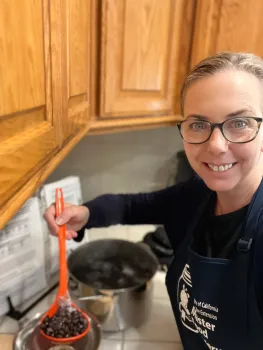
Mary Nazara, used with permission.
I started preserving in the summer of 2022 after a phone call from my sister. She had a tree full of ripe plums and didn’t want them to go to waste. I already had a canner I’d bought years earlier on clearance, still sitting unopened in my pantry because, honestly, I was too nervous to use it. I had read through the Ball canning books, watched videos, and done plenty of research—but I just couldn’t bring myself to start.
That all changed the day my sister and I made plum jam together. We spent the afternoon laughing, learning, and cheering every time we heard that satisfying “ping” of a sealing jar. It was such a fun day, and from that moment, I was hooked! After that first batch, I started canning on my own—mostly jam and tomatoes at first.
Before long, I wanted to try pressure canning. I loved the idea of having ready-to-eat meals on the shelf and not being limited to just high-acid foods. While researching safe recipes, I came across a YouTube video where someone mentioned wishing their state had a Master Food Preserver program. That got me curious, so I did some digging and found an online program I could apply for. I knew right away it was exactly what I wanted to do.
The Master Food Preserver program gave me the knowledge and confidence to safely preserve food for my family—and to help others feel comfortable doing the same. I love canning, freezing, and even a little dehydrating, but pressure canning is still my favorite! Being part of the Master Food Preserver community has been such a fun and rewarding experience.
Spotlight: Henry Shaw, Class of 2024 MFP Volunteer (October 2025)
Henry Shaw UC Master Food Preserver Online Program Volunteer
County of residence: Contra Costa
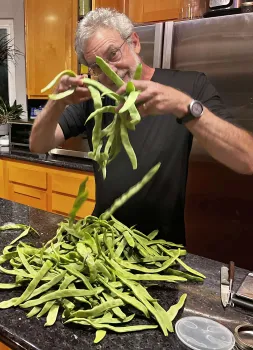
Image credit: Henry Shaw, 2025.
My love of food and cooking began as a small child at my mother’s side in the kitchen. Over the decades, both my culinary interests and kitchen skills have grown considerably. My spouse (also a member of the MFP Class of 2024) and I are avid foodies who love to garden, forage, and cook. We often share our garden’s bounty and kitchen creations with friends and colleagues. Becoming a volunteer with the UC Master Food Preserver (MFP) Online Delivery Program has been a natural and fun way to deepen our knowledge of food preservation and share it with others through online classes and publications.
I grew up in a family that always had a vegetable garden. My second-generation Italian mother used simple preservation methods like freezing (stews, chicken stock, and pasta sauce were staples) and drying herbs such as parsley, thyme, and what was then considered the “exotic” basil. This was 1960s New England—where basil truly was an uncommon ingredient! Canning, however, wasn’t something we did.
My passion for gardening and cooking went on pause during my high school and college years, but I rekindled while in graduate school in Pasadena, CA. Along with a few classmates, I dug up the backyard of our rental house to plant a large vegetable garden. It was so much easier to grow things there than it was in short growing season and rocky soils of New England!
In more recent years, I’ve maintained a year-round garden that produces more than we can possibly eat. That abundance led me to learn food preservation techniques such as canning high-acid foods, dehydrating fruits and vegetables, and freezing low-acid foods. Although I had used pressure cookers to speed up the making of stews and other dishes that usually require long cooking times, I had never pressure canned before becoming an MFP.
I retired in the fall of 2019 after a 36-year career as a research scientist and R&D manager at Lawrence Livermore National Laboratory. I immediately began volunteering at the Exploratorium in San Francisco and at our local library. I investigated becoming a UC Master Gardener, but I had missed the application window that year. Then, in March 2020, COVID-19 shut everything down and the world shifted to being online. Looking back, that shift turned out to be a good thing because I learned of the existence of the UC Master Food Preserver Program from a UCANR “EATLAC” online webinar series on the Science of Fermentation. I quickly investigated the possibility of becoming an MFP volunteer but was disappointed to learn that my county (Contra Costa) does not have an MFP Program. Nevertheless, I added my name and e-mail to a contact list in the event an opportunity became available to me in the future.
I did end up becoming a UC Master Gardener in the first post-COVID class of 2022 and in late 2023, more than a year and a half after putting my name on the MFP contact list, I received an e-mail inviting me to apply for a new MFP Online Delivery Program. Needless to say, I jumped at the opportunity.
As a graduate of the Online Delivery Program’s first class, I’ve been able to volunteer in many ways: serving as copy editor for this Newsletter; teaching online classes on preserving pomegranate and feijoa; joining several “Ask a Master Food Preserver” online panels; and co-leading our social media efforts (including creating most of our Facebook posts). I’m also preparing to lead a new statewide Food Preservation Helpline.
In my “spare time”, I continue to volunteer at the Exploratorium, as a UC Master Gardener, and as a Board member (past-President and current Vice President) of a local orchid society. My wife and I are also enthusiastic foragers of edible mushrooms and seaweed—though I admit she’s more into the latter than I am. Retirement is good, and as many retirees say, I don’t know how I ever found the time to work!
Pear-fection: Apple-Pear-Cranberry Pie Filling (October 2025)
Kirsten Hansen, UC Master Food Preserver Online Program Volunteer
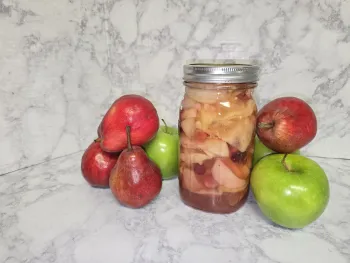
Jar of pie filling on a marble countertop (Photo by Penny Pearson, used with permission).
October is peak apple and pear season across much of California. This tasty Apple-Pear-Cranberry pie filling makes the most of the season’s abundance and gives you a start on holiday baking; when it’s time to make a holiday pie, just open a quart of the pie filling, add it to your favorite pie crust, and bake.
Apple-Pear-Cranberry Pie Filling
Yield: About 3 (1-QT/1-L) jars
Source: The All New Ball Book of Canning and Preserving © 2016
Ingredients
- 4 cups (1 L) water
- ¾ cup (175 mL) bottled lemon juice, divided
- 5 cups (1.25 L) thinly sliced peeled apples (2 lb./1kg apples)
- 5 cups (1.25 L) thinly sliced peeled pears (2 ¼ lb./1kg pears)
- 2 cups (500 mL) cranberries, fresh or frozen, thawed
- 2 1.2 cups (625 mL) sugar
- 1 tsp (5 mL) ground cinnamon
- 1/8 tsp (0.5 mL) ground nutmeg
Instructions
- Combine water and ¼ cup (60 mL) lemon juice in a large bowl. Submerge apple and pear slices in lemon water: drain.
- Combine fruit slices, cranberries, sugar, cinnamon, nutmeg, and remaining ½ cup (125 mL) lemon juice in a 6-qt (6-L) stainless steel or enameled Dutch oven. Bring to a simmer over medium heat, cover and cook 10 minutes or until fruit releases its juices, stirring occasionally.
- Ladle hot fruit mixture into a hot jar, leaving 1/2-inch (1-cm) headspace. Remove air bubbles. Wipe jar rim. Center lid on jar. Apply band and adjust to fingertip tight. Place jar in a boiling-water canner or atmospheric steam canner. Repeat until all jars are filled.
- Process jars for 30 minutes, adjusting for altitude (see table below). Turn off heat, remove lid from canner, and let jars stand for 5 minutes. Remove jars and set aside to cool.
- After jars are cool, check the seals, remove the rings, wash the jars if needed, label and store in a cool, dark place. Store any jars that did not seal in the refrigerator and use within a week. Alternatively, transfer the contents of unsealed jars to a freezer container or bag and freeze. Use within 6 months for best quality.
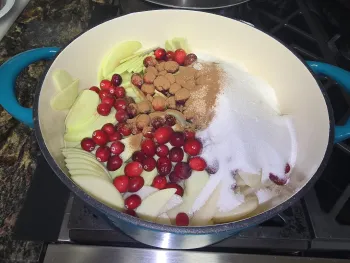
Image Credit: Penny Pearson, 2025.
To bake your pie:
Preheat oven to 400̊°F (200°C). Prepare your favorite pie crust. Roll out the piecrust into a 9-inch (23-cm) pie plate. Drain 1/3 cup of syrup from 1 jar of pie filling into a medium bowl. Whisk in 2 tablespoons (30 mL) cornstarch until smooth. Add remaining pie filling, gently stirring to blend into cornstarch mixture. Pour into an unbaked pie shell in a 9-inch (23-cm) pie plate set on a baking sheet. Bake at 400°̊F (200°C) for 30 minutes. Reduce oven temperature to 350̊°F (190̊°C); bake 25 more minutes or until golden brown.
Boiling water/Atmospheric Steam Canning Altitude Adjustments | |
Altitude Above Sea Level | Increase Processing Time by |
1,001 – 3,000 feet | 5 minutes |
3,001 – 6,000 feet | 10 minutes |
6,001 – 8,000 feet | 15 minutes |
8,001 – 10,000 feet | 20 minutes |
Want more pear and apple recipes? Join the Master Food Preserver Online Delivery Program in October and November for a series of pear and apple-focused online classes.
Pear-Fection: Preserving the Flavors of Fall, Tuesday, 10/14/25, 6:30 pm - 7:30 pm
Pear-Licious!: Preserving the Flavors of Fall, Saturday, 10/2, 10:00 - 11:00am
Core skills: Apple Butter & Dehydrated Apple Rings, Saturday, 11/8/25, 1:00 - 2:00 PM
From Orchard to Table: Apple Pie Filling & Freezing Apples, Wednesday, 11/19, 6:30 pm - 7:30 pm
Applications Now Open for 2026 UC Master Food Preserver Training Program! (October 2025)
Henry Shaw, UC Master Food Preserver Online Program Volunteer
Image Credit: Henry Shaw, 2025.
Do you want to learn more about safe food-preservation techniques? Do you have a passion for sharing your knowledge with others? Are you willing to donate your time as a volunteer for a good cause? Would you like to help people in your community learn to preserve food safely in their homes, reduce food waste, increase food security, and provide engaging ways for Californians to explore healthy food? Are you a resident of California? If so, you should consider becoming a UC Master Food Preserver yourself!
Applications are now open for the 2026 UC Master Food Preserver training program. Complete details of the application process, what the training entails, and the training schedule are available on the UC Master Food Preserver website. If you reside in a county that has a local county-based program, you should apply to that county’s program. Note that not all counties are conducting training in 2026 (see the website). California residents living in counties that do not have a county-based program (i.e., Alameda, Alpine, Butte, Contra Costa, Glenn, Imperial, Kern, Kings, Lake, Los Angeles, Marin, Mendocino, Monterey, Napa, Nevada, Placer, San Benito, Santa Clara, Santa Cruz, Stanislaus, and Ventura) are invited to apply to the 2026 training for the Online Delivery Program.
Once trained, UC Master Food Preservers must volunteer a minimum of 50 hours in their first year, and 25 hours/year subsequently. To maintain their active status past the first year, volunteers are also required to complete 12 hours/year of continuing education and pass an annual recertification quiz.
A Delicious Barbeque Sauce from Tomato Powder (September 2025)
Monica Gross, UC Master Food Preserver Online Program Volunteer
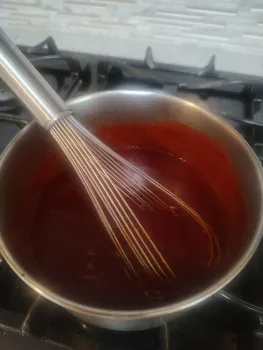
Image Credit: Monica Gross, 2025.
Can you imagine an activity that allows you to experience all of your five senses? Cooking and preparing food are just such activities! Allow me to walk you through an experience that involved seeing, hearing, touching, smelling, and tasting.
Using tomato powder to make a delicious barbeque sauce delighted all of my senses. The process involved reconstituting dehydrated tomato powder and adding a variety of ingredients to transform it into a tasty sauce that can be used for any barbeque entrée or side dish. I added all of the ingredients, except the cornstarch, to a saucepan and mixed them together with a whisk. Initially I saw that that sauce was thin and orangish colored (Fig. 1). Upon completion, the color changed to a darker, deeper reddish color (Fig. 2). The consistency also changed as it cooked. I used my sense of touch to feel that it was thickening. I could “feel” it changing as I stirred with the whisk (Fig. 3). I brought the sauce to a boil, then simmered about 20 minutes. I listened carefully and could hear the gentle “pop-pop” of the simmer alongside the louder drone of the range hood. When the sauce was almost complete, a pleasing aroma filled the air as I smelled its delightful scent. Of course, the ultimate test of the recipe was the tasting of the final product. Licking the spoon after the sauce was placed in its storage container was the highlight of the cooking experience. The satisfying conclusion was that the sauce is delicious and will make my family happy during dinner tomorrow night!
BBQ Sauce Made with Tomato Powder
Ingredients:
½ cup tomato powder
1 ½ cups water
1 cup brown sugar
1/3 cup apple cider vinegar
1 Tablespoon Worcestershire sauce
3 Tablespoons lemon juice
1 Tablespoon ground mustard
½ Tablespoon onion powder
1 Tablespoon smoked paprika
½ Tablespoon salt
1 teaspoon pepper
½ teaspoon garlic powder
1 Tablespoon cornstarch “slurried” in 1-2 Tablespoons cold water
Instructions:
- Mix all ingredients except the cornstarch in a saucepan and stir/whisk together.
- Bring to a boil and simmer for approximately 20 minutes until desired thickness is reached.
- For a thicker sauce, remove the pan from the heat and whisk in the cornstarch slurry. Return the pan to the heat, bring back to a boil, and simmer until the sauce thickens.
- Store sauce in clean container(s) in the refrigerator for up to a week or freeze in freezer-safe containers, leaving appropriate headspace, for up to six months.
For more information see:
- Last month’s Save the Season Newsletter explains how to make tomato powder - Making and Using Dehydrated Tomato Skins (August 2025) | UC Agriculture and Natural Resources
- Reconstituting Tomato Powder 334013.pdf
What’s the buzz? -- Infants and Honey (September 2025)
Kirsten Hansen, UC Master Food Preserver Online Program Volunteer
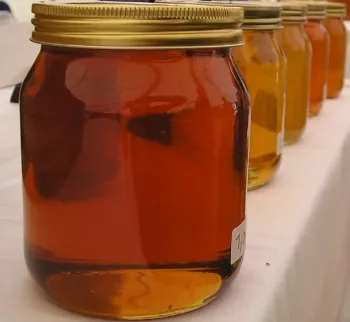
Image Credit: Kirsten Hansen, 2025.
I recently gave birth to my first child, which means that I left behind the many recommendations about what pregnant people should and should not eat and have entered the world of what infants should and should not eat. One very common recommendation is that infants under a year old should not eat honey, due to the risk of infant botulism. However, I was curious about what this meant: no spoonfuls of honey, of course, but what about baked goods with honey, or preserves that use honey as an alternative sweetener? I decided to do more research.
What is botulism?
Botulism is a serious disease caused by a neurotoxin created by the bacterium Clostridium botulinum. C. botulinum occurs naturally as inactive spores that are ubiquitous in the environment, including soil, water, freshwater and marine sediments, the surfaces of fruits and vegetables, and in seafood. The spores themselves do not make people sick. Under certain conditions, however, the spores can germinate into vegetative bacterial cells and produce botulinum toxins, neurotoxins that attack the body’s nerves, causing muscle paralysis, difficulty breathing, and in severe cases, death (University of California Agriculture and Natural Resources, 2018, p. 5-3). Botulinum toxins (there are several variants) are among the most poisonous biological substances known.
Home food preservers worry most about foodborne botulism, in which the neurotoxin is produced by C. botulinum under the following conditions:
- Anaerobic (low or no-oxygen) environment
- Low acid (above 4.6 pH)
- High moisture
- Temperature between 40° - 120°F
- Low salt (Centers for Disease Control, 2024)
These are exactly the conditions inside a low-acid (i.e., pH < 4.6) food product in storage in a canning jar. If C. botulinum spores are present in a low-acid food product (given their prevalence, we must assume they are) and are not completely destroyed by high-temperature processing (i.e., pressure canning), the spores can germinate into active vegetative cells and generate botulinum toxins. The risk of foodborne botulism is eliminated when safe food preservation techniques are used, which is why the Master Food Preservers program puts so much emphasis on using safe, tested recipes and adhering to the specified processing times for preserving food.
Infant botulism
In the U.S., 200 - 250 cases of botulism are reported annually, of which 60 - 70% involve infant botulism (CDC National Botulism Surveillance System). Infant botulism is completely different from the foodborne botulism that affects adults and older children. Infant botulism typically affects infants under 12 months of age but is most common in those under 2 months of age. It occurs when infants ingest C. botulinum spores that then germinate, colonize, and produce neurotoxin within the infant's intestinal tract. (Clostridium Botulinum & Botulism | Food Safety and Inspection Service, n.d.). It is not definitely known why infants are more susceptible to the germination of C. botulinum spores and subsequent proliferation of the bacterium in the gut than are healthy adults. In the past, the increased susceptibility of infants was thought to be due to the higher pH of infant gastrointestinal (GI) tracts than in adults, but it’s not clear that’s true. The current leading hypothesis is that infants lack the robust microbial community present in the GI tracts of healthy adults. C. botulinum is not a strong competitor for food resources in the presence of an established microbial community, which infants lack. This lack of competitors is thought to allow C. botulinum to proliferate. In short, infants’ gastrointestinal (GI) tracts are not mature enough to fight off the inactive C. botulinum spores and bacteria that adults and older children can handle, and the neurotoxin can develop from the bacteria that emerge as the spores break dormancy. The U.S. Food and Drug Administration, the Centers for Disease Control and Prevention, and the American Academy of Pediatrics all recommend that honey not be fed to infants under one year of age, and that fruits and vegetables should be washed before consumption (which, frankly, is good advice for everyone!) (Clostridium Botulinum & Botulism | Food Safety and Inspection Service, n.d.)
Unfortunately, most cases of infant botulism do not have a clear origin. Recent research has found that most cases of infant botulism occur when infants swallow microscopic dust particles that carry C. botulinum spores. (Harris & Dabritz, 2024, 305). Honey is a known but secondary cause. (California Department of Public Health, 2022). Although, we can’t stop infants from swallowing tiny bits of dust, we can refrain from feeding them honey, so the recommendation to avoid honey under a year old stands.
What about pasteurization?
Raw honey is not safe for infants, but I wondered about pasteurization. Unfortunately, the process used by the honey industry to pasteurize honey is not enough to deactivate the spores that can ultimately result in the production of botulinum neurotoxins. Per Romeo Toledo, a food scientist with the University of Georgia College of Agricultural and Environmental Sciences, honey must be heated to 250°F for a minimum of three minutes to destroy C. botulinum spores. Because this temperature burns honey and changes the flavor, industrial honey is heated to a lower temperature for longer. This destroys molds and common yeasts, but not C. botulinum spores. (Omahen, 2002). I found an article from 2002 that described a new sterilization technique developed by the University of Georgia that destroys C. botulinum spores (Omahen, 2002) but I could not find any information about the degree to which the honey industry has adopted the new procedure. Without further evidence, pasteurized honey must be considered unsafe for infants.
What about home preserved foods and baked goods?
Home preserved foods rely on several methods to make them safe. High-acid foods (below pH 4.6), such as pickles and jams, can be processed in a hot water canner because the acidity, heat, and processing time combine to destroy food spoilage organisms. However, hot water canners only reach temperatures of 212°F (the boiling point of water at sea level, boiling temperatures decrease with increasing elevation), but C. botulinum spores survive to temperatures of 240°F. Although C. botulinum spores can survive the hot water canning process, their growth is inhibited by the acidity and/or low water activity of foods that can be safely processed in a water-bath or atmospheric steam canner (University of California Agriculture and Natural Resources, 2018, p. 4-2). This means they are safe for adults, but not for infants! Items such as jams that use honey as an alternative sweetener should not be fed to infants.
Low-acid foods (above 4.6 pH), such as vegetables, soups, and meats, must be processed in a pressure canner, which uses pressure to heat food above 212°F. In this case, heat and time (but not necessarily acid) combine to make foods safe. At sea level, foods that are processed in a pressure canner at 10 psig reach 240°F, the temperature at which C. botulinum spores are destroyed. (University of California Agriculture and Natural Resources, 2018, 5-2). (Because water boils at a lower temperature at higher elevations, higher pressures are needed to reach spore-inactivating temperatures if one is canning in a location more than 1000’ above sea level.) Nevertheless, as discussed above, such high temperatures burn honey and ruin the flavor, so pressure canning is not a suitable method for honey preservation.
I could not find specific information about honey in baked goods, but most baked goods never reach temperatures above 212°F, so C. botulinum spores can survive. Recommendations from the American Academy of Pediatrics and the Center for Disease Control advise avoiding all forms of honey, including in baked goods and industrial products such as cereals for infants under a year old (Stanford et al., 2013).
In conclusion
Honey is safe (and delicious!) for adults and children over a year old. However, due to the risk of infant botulism it should be avoided in all forms for infants under a year old. All fruits and vegetables should be thoroughly washed before consumption.
References
Abdulla, C., Ayubi, A., Zulfiquer, F., Santhanam, G., Ahmed, M. A. S., & Deeb, J. (2012, July). Infant botulism following honey ingestion. BMJ Case Rep ., 2012(bcr1120115153). PubMed. 10.1136/bcr.11.2011.5153
California Department of Public Health. (2022, March). Frequently Asked Questions (FAQs) About Infant Botulism. California Department of Public Health. Retrieved July 20, 2025, from https://www.cdph.ca.gov/Programs/CID/DCDC/CDPH%20Document%20Library/FAQs_English_Updated_March2022_ADA.pdf
Centers for Disease Control. (2024, April 18). About Botulism | Botulism. CDC. Retrieved July 20, 2025, from https://www.cdc.gov/botulism/about/index.html
Centers for Disease Control, National Botulism Surveillance System. Case Reporting data for 2017 - 2021. https://www.cdc.gov/botulism/php/national-botulism-surveillance/index.html. Retrieved July 27, 2025.
Food Safety and Inspection Service, U.S. Department of Agriculture. (n.d.). Clostridium botulinum & Botulism | Food Safety and Inspection Service. Food Safety and Inspection Service. Retrieved July 20, 2025, from https://www.fsis.usda.gov/food-safety/foodborne-illness-and-disease/illnesses-and-pathogens/botulism
Harris, R. A., & Dabritz, H. A. (2024). Infant Botulism: In Search of Clostridium botulinum Spores. Current Microbiology, 81(10), 306. PubMed. https://doi.org/10.1007/s00284-024-03828-0
Omahen, S. (2002, September 05). New Process Makes Honey Safe For Infants. CAES Newswire. Retrieved July 20, 2024, from https://newswire.caes.uga.edu/story/1460/safer-honey.html
Sanford, M. T, et al. (2013), “Infant Botulism and Honey: ENY-128 AA142, 6 2013. EDIS 2013(6). Gainesville, FL. https://doi.org/10.32473/edis-aa142-2013. Retrieved July 27, 2025.
University of California Agriculture and Natural Resources. (2018). Fundamentals of Consumer Food Safety and Preservation: Master Handbook. UC Master Food Preserver Program. 9781627110211
Spotlight: Jadrian Johnson, Class of 2025 MFP Volunteer (September 2025)
Jadrian Johnson UC Master Food Preserver Online Program Volunteer
County of residence: Los Angeles

Image credit: Jadrian Johnson, 2025.
There is a unique alchemy in food preservation, a practice that feels just as much a form of time travel as it does domestic science. Within a simple jar, we can seal not just the fleeting sweetness of a summer peach, but the echoes of the hands that harvested it, the stories shared over a bubbling pot, and the enduring spirit of a family. For me, this craft is a conversation with my history, and its language was taught to me by two formidable women: my mother-in-law, Patti, and my Grandma Ruth.
My connection to my family’s Nebraska roots is a flavor that collapses time, reaffirmed with every spoonful of the grape jelly Patti sends at Christmastime. It’s a preserve made from an heirloom grapevine her own mother planted generations ago. It’s a taste of heritage, a direct throughline to the matriarchs who kept this tradition thriving. My other North Star was my Grandma Ruth, whose basement was a veritable family museum. Amidst the ghosts of my stylish grandparents’ vintage clothing and a guest room corner that was a perfect time capsule of seventies decor, I found my real treasures. There, in the coolest part of the cellar, stood two floor-to-ceiling cabinets, a library of captured seasons. Jars of home-canned green beans, tomatoes, pears, applesauce, and more stood like jewels on the shelves, a testament to her skill and a vibrant promise of bounty against the monochrome of a Nebraska winter.
With such profound inspiration, it seems inevitable I would find my way to becoming a canner. My own kickstart, however, was fired up in the summer of 2020. As the world rose up to protest profound social injustice, I felt a desperate, visceral pull to join the chorus on the streets. But being immunocompromised, I was warned by my doctors to stay home and not risk COVID-19 infection. Faced with the choice of safety over solidarity, I felt sidelined. Instead of succumbing to helplessness, I resolved to redirect that fire. I traded the pavement for the pantry and brought the protest into my kitchen.
My small Los Angeles backyard, bursting with the striking colors of nectarines, kumquats, and apricots, became my staging ground. I cranked up my kitchen and taught myself to safely harness the wild alchemy of fruit, sugar, and pectin, offering these jars as gifts to folks who made donations to social justice organizations—groups fighting for food security and nutritional education in underserved communities. That summer, this quiet act of creation, fueled by the legacies of Patti and Ruth, helped raise nearly $10,000 for charities.
From a bountiful basement and a legacy grapevine to my own California kitchen, the thread continues. It is a profound reminder that preservation is always an act of love, a way to honor the past while actively building a more just, more equitable, and infinitely more delicious future. I’m proud to be part of the UC Master Food Preserver class of 2025 to help empower others to continue these traditions in safe and sustainable ways!
*Article revised 10/15/2025