
Blog by Lanie Keystone
In these lovely Solano County March days, we’re being teased by the real promise of Spring. And, it seems that the hummingbirds, who have wintered in warmer climes, are tempted to return to our backyards.
That will be one of the true harbingers of Spring’s arrival. So, it is time to get ready to give those hummingbirds a warm welcome.
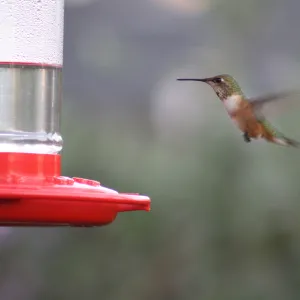
One way to welcome them back is to prepare your hummingbird feeders, fill them with tempting sugar water, and hang them in a partially shaded area. The best place is on the north or east side of your house, about 4-6 feet above the ground. For safety’s sake, avoid dense bushes where predators hide. Make sure the feeders are visible to the birds but protected from strong winds. The perfect nectar formula is 1 cup of white granulated sugar stirred into 4 cups of water. Hang 3-5 separated feeders in your yard and watch the show!
OR---if you think that’s a lot of sugar to use over the season—try flowers!
Here are 8 successful plants and flowers for attracting hummingbirds.
The good news is, you can plant them in pots or in the ground, and they are all suitable for our growing zone.
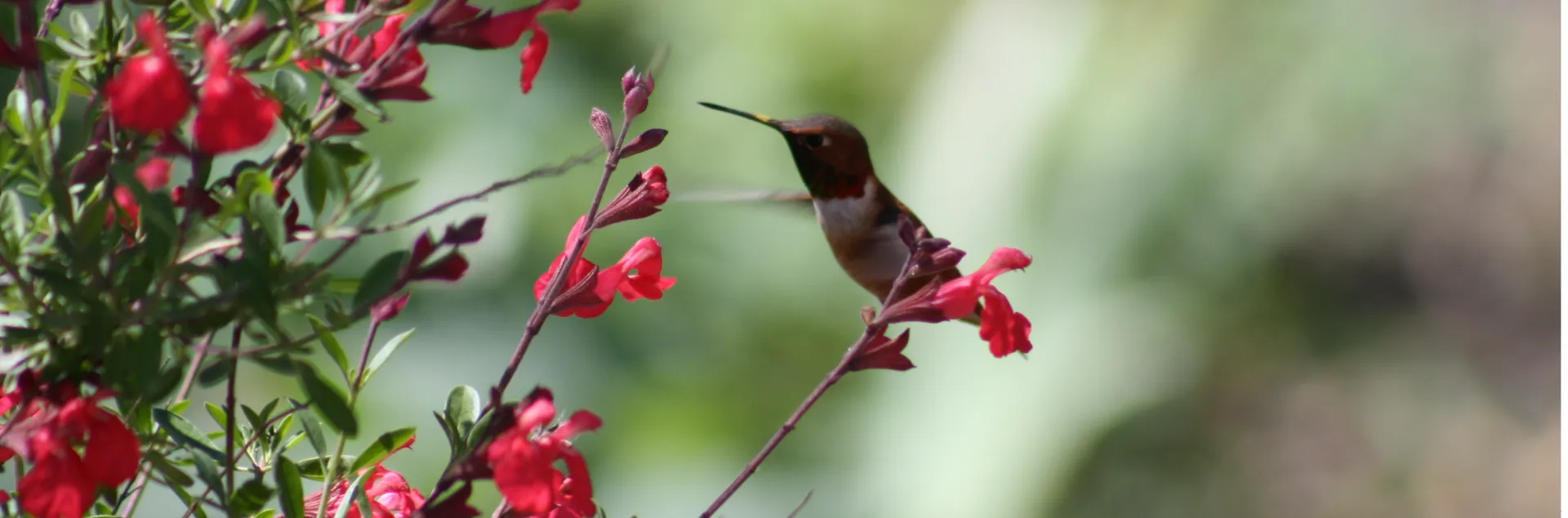
Red Salvia: The bright red blooms and lush green foliage are hummingbird favorites. They have tubular flower spikes that produce an abundance of nectar from April to November. It is self-cleaning—no deadheading needed--adapts well to containers and is drought-tolerant.
Care: Well-drained, average soil; drought-tolerant; full sun to partial shade.
Size: 2-3 feet tall and wide
Butterfly Weed: The bright colors of the red and orange tubular bloom are easy for the birds to spot. It is compact and drought-tolerant once established. And it isn’t a spreading Milkweed, unlike its cousin.
Size: 1-2 feet tall and wide
Care: Well-drained, loamy soil; low water; full sun
Bee Balm: Red and tubular blooms are my favorite for hummingbirds. And it’s deer resistant!
Care: Well-drained soil; somewhat drought-tolerant; full sun
Size: 4-5 feet tall
Agapanthus: Hummingbirds adore these large clusters of deep, violet-blue, trumpet-shaped blooms. They grow very compactly—and bloom more prolifically when root-bound. 'Ever Sapphire' is a favorite—it is semi dwarf and is drought-tolerant.
Care: Well-drained average soil; drought-tolerant; full sun to partial shade.
Size: 20-24 inches tall and 12-18 inches wide
Hyssop: This hardy perennial has small, tubular lavender-blue flowers and fragrant foliage—making it a real winner. It’s a compact, low-maintenance plant that’s ideal for limited spaces.
Care: Full sun; well-drained soil; somewhat drought-tolerant
Lantana: Yes! Ever-popular Lantana—it’s probably already in your yard! The combo of hot pink and bright yellow, as well as an extended blooming season, makes this vining plant a favorite for all. We all know how it thrives in the summer heat when others start to fade…including us!
Care: Well-drained, slightly acidic soil; drought-tolerant; full sun
Size: 10-12 inches tall and wide.
These beautiful favorites are not only hummingbird worthy, but are wonderful, all-around beneficial pollinators, featuring vivid, colorful blossoms that are filled with rich nectar. A delightful haven for bees and butterflies, too--and perfect for gardens, patios, and porches.
They all spell Spring and Summer joy.
Image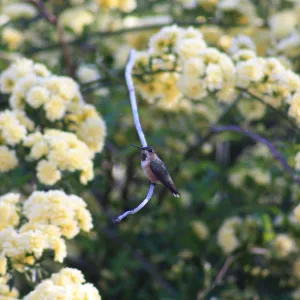
Hummingbird in a Lady Banks rose.