
A growing number of invasive pests are threatening our oak, sycamore, maple, and ash trees, even edible favorites like avocado are at risk. When trees are under attack, the first signs of trouble are easy to miss which can be detrimental to a tree’s health. It is important to monitor your trees regularly for signs of stress and damage. By learning to look for early warning signs we can all help protect our trees and prevent the spread of invasive pests.
Common Signs of Tree Pest Infestations:
- Discolored damaged leaves, or excessive leaf drop
- Thinning canopies or branch dieback, often starting in the upper branches
- Small holes in the bark for pest exit or entry points
- Sawdust or powdery residue, collecting on bark, branches, or at the base of the tree
- Oozing sap or dark stains, trees sometimes “bleed” where pests bore in
- Evidence of pest damage should not be overlooked. Infestations can multiply quickly and spread to neighboring trees
Scouting for Invasive Tree Pests:
Be on the lookout for these three invasive species and report any signs of infestation to your County Agricultural Commissioner or UC Cooperative Extension Advisor.
Goldspotted oak borer (Agrilus auroguttatus), (GSOB)
- Current Distribution: Southern California counties including San Diego, Riverside, Orange, and Los Angeles.
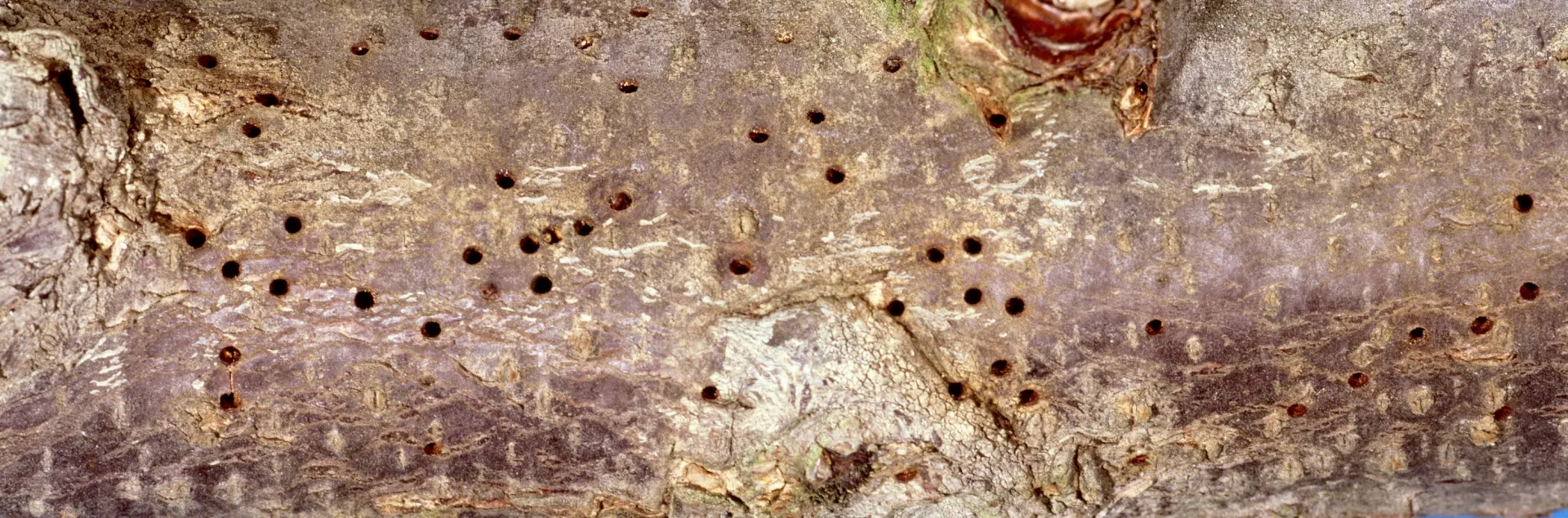
- GSOB Identification: The adult is a bullet-shaped beetle about 10mm (0.4 in.) long and has six golden yellow spots on its dark green forewings.
- Unique Damage Signs: D-shaped exit holes about 1/8 in. wide, dark staining and oozing sap just beneath the bark.
- Host Trees: Coast live oak (Quercus agrifolia), canyon live oak (Quercus chrysolepis), and California black oak (Quercus kelloggii).
- More Information: UC ANR Goldspotted Oak Borer Website
Mediterranean oak borer (Xyleborus monographus), (MOB)
- Current Distribution: Counties of Napa, Sonoma, Lake, Sacramento, El Dorado, Yolo, and Mendocino.
- MOB Identification: The adult are light brown and 3 mm (1/8 inches) long, with a pattern of bumps on the tip of the abdomen.
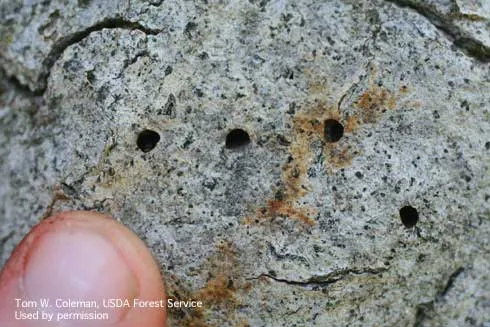
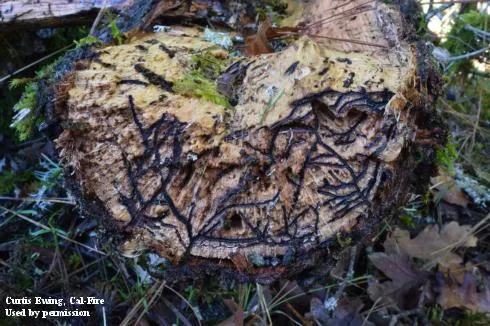
- Unique Damage Signs: The bark has abundant round entrance and exit holes about 1/16” (1.3-1.5 mm) in diameter. Branch death (flagging) in the top third of the tree, broken limbs with tunnels, called galleries, that are trellis patterned and black stained.
- Host Trees: Valley oak (Quercus lobata) and blue oak (Quercus douglasii).
- More Information: UC ANR Mediterranean Oak Borer Website
Invasive shothole borer, (Euwallacea spp.), (ISHB)
- Current Distribution: Two species found in Southern California counties of San Diego, Riverside, Orange, Los Angeles, Ventura, and Santa Barbara. Third species found in Santa Clara and Santa Cruz counties.
- ISHB Identification: The most accurate way to visually determine if a tree is infested with ISHB is to find beetle entry holes that are the right size and shape.
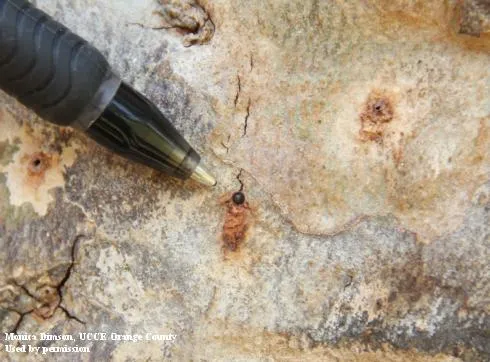
- Unique Damage Signs: Perfectly round entry holes about 0.85 mm (less than 0.04 inches) in diameter accompanied by attack symptoms including staining, gumming, white powdery exude, and frass.
- Host Trees: ISHB has a wide range of host trees in California, including avocado (Persea americana), box elder (Acer negundo), California sycamore (Platanus racemosa), oaks (Quercus), and cottonwoods (Populus).
- More Information: UC ANR Invasive Shothole Borer Website
You Can Prevent the Spread of Invasive Tree Pests
Invasive pests can spread quickly, but if caught early more trees can be saved and the spread to new areas can be reduced. The more eyes we have on our trees the better chance we have of detecting pests before they spread. Everyday observers, like you, play a critical role. Scouting saves trees. Keep an eye on the trees near your home, neighborhood, parks, and recreation areas.
Don't move firewood!
Many wood-boring pests, including GSOB, MOB, and ISHB, are spread by the transport of infested wood. Buy firewood where you intend to burn it. Visit dontmovefirewood.org and www.firewood.ca.gov for additional resources and information that you can share with others. For these and other pests, visit the UC IPM website at ipm.ucanr.edu.
Have questions, need to make a report?
UC Master Gardener volunteers are here to help. Connect with your local program today.
To report invasive species and for information about them, specific to your area:
- Contact your County Agricultural Commissioner’s office
- Reach out to your local UC Cooperative Extension Office