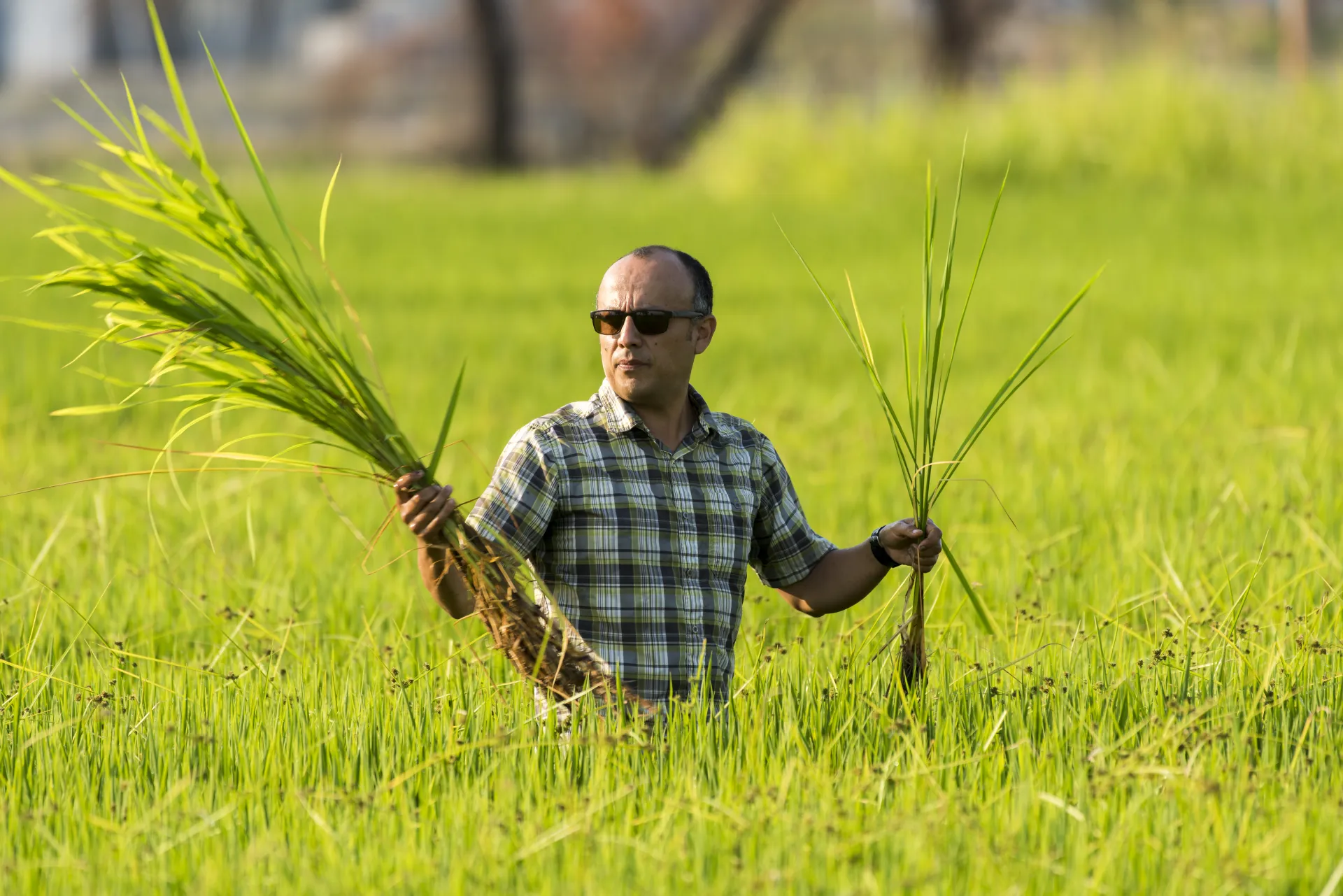
Luis Espino, Rice Farm Advisor, scouting for weedy rice in the field. Photo Credit: California Rice Commission.
"We continue to rely on the leadership of UCCE to help tackle our difficult problems. They bring science and practical solutions to the field." - Tim Johnson, CEO, California Rice Commission
The Issue
Weedy rice (Oryza sativa spp.) poses a serious threat to California’s rice industry. Since weedy rice is the same species as cultivated rice, it cannot be selectively controlled with herbicides because herbicides that control weedy rice would damage the rice crop. Greenhouse studies in California have shown that weedy rice infestation can result in yield losses of 69%, and the presence of weedy rice also potentially reduces grain quality and milling yield. This can result in lower prices for growers and damage to the reputation of the California rice industry. The steady spread of this weed during the past decade led to a coordinated research and outreach program to contain and manage the weed.
How UC Delivers
In response to the growing threat, a team of University of California Cooperative Extension (UCCE) rice experts launched a coordinated research and extension program in 2015–2016 to track, study, and manage weedy rice in California, supported by the rice industry and the California Crop Improvement Association.
Between 2016 and 2025, UCCE staff worked directly with growers and Pest Control Advisers (PCAs) across a nine-county region (Sutter, Yuba, Butte, Glenn, Placer, Sacramento, Colusa, and San Joaquin). More than 200 field samples of suspected weedy rice were collected during on-farm consultations.
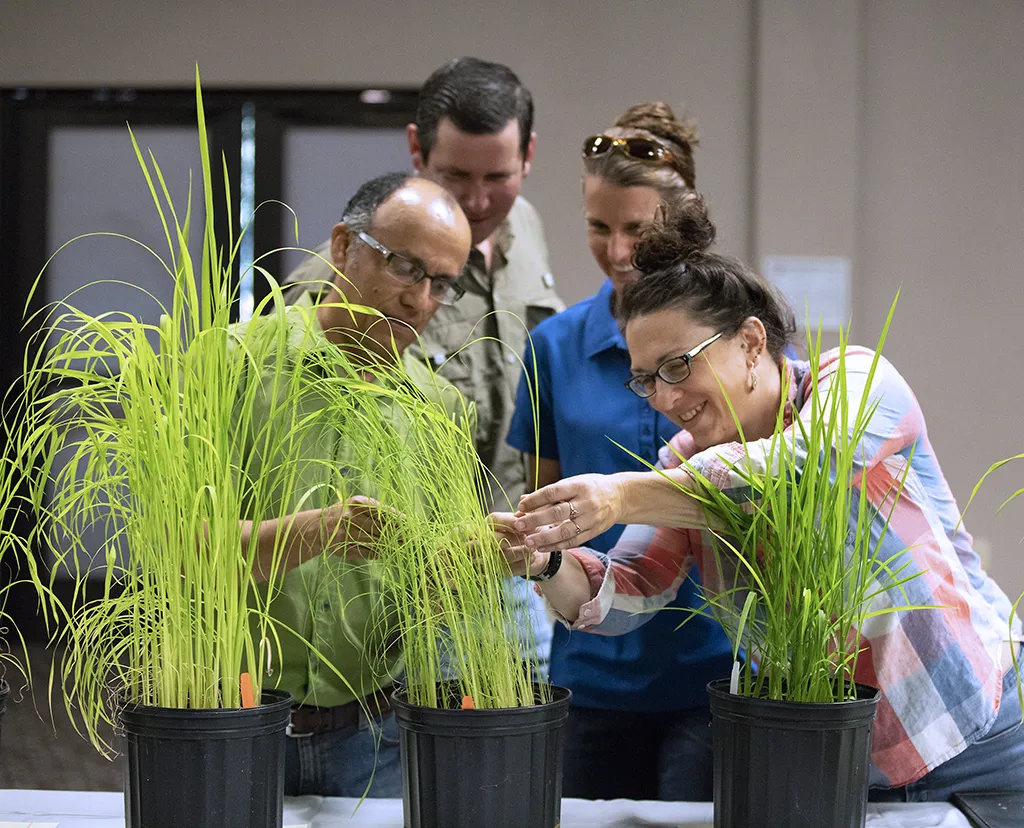
Luis Espino (UCCE), Timothy Blank (CCIA), Michelle Leinfelder-Miles (UCCE), and Whitney Brim-DeForest (UCCE) at a 2019 Weedy Rice Workshop looking at weedy rice plants as part of a display for stakeholders. Photo Credit: Evett Kilmartin, UCANR.
The team conducted extensive research:
a statewide survey covering 14,000 acres of known infested fields (first in 2020, updated annually through 2025);
the first comprehensive genetic and phenotypic analyses of California weedy rice populations, which have identified 11 genetically and phenotypically distinct biotypes;
field trials to test Best Management Practices; and
greenhouse experiments to determine yield loss and herbicide efficacy.
The team also conducted outreach and education, including:
a targeted weedy rice newsletter;
a weedy rice website (caweedyrice.com);
a demonstration booth at the Annual Rice Field Day (2016–2019, 2021–2025); and
a series of weedy-rice specific meetings with PCAs, growers, and industry members, reaching over 2000 individuals over eight years.
The Impact
UCCE generated vital research and actionable outcomes that significantly improved weedy rice management in California.
New Knowledge and Practices: The team identified 11 genetically distinct weedy rice populations in the state, critical to understanding its spread and developing control strategies. Field and greenhouse trials showed that weedy rice can germinate under flooded conditions, contradicting previous assumptions, and helped confirm that fallow and managed fallow systems can successfully eliminate infestations.
Economic Impact: Greenhouse studies revealed potential yield losses of 69% when infestations are left unmanaged. By identifying potential spot-spray herbicide options and testing new herbicides, researchers provided feasible, targeted control methods that avoid crop damage. These best management practices can help prevent future yield losses and protect the market value of California rice.
Industry Behavior Change: UCCE’s outreach, through newsletters, field days, and direct grower engagement, raised awareness and equipped stakeholders with identification tools and management guidelines. As a result, grower adoption of early detection practices, improved field sanitation, and rotation or fallow practices has increased, with a 2019 survey showing 92.3% of respondents scouting on a monthly basis, and 77.5% using certified seed (prior to passage of the certified seed law). Additionally, in 2019, the rice industry adopted a self-imposed requirement to use only certified seed to reduce the spread of weedy rice based on recommendations from UC research.
Scientific Advancement: A phylogenetic tree created from the genetic analysis places California’s weedy rice in the global context, improving understanding of potential sources and migration patterns. Drone imagery trials confirmed that weedy rice cannot be visually detected with current technology, ensuring that the industry will not fall prey to unreliable tools.
This long-term effort supports UC ANR’s public value of promoting increased stability, efficiency, and profitability of agriculture and working landscapes. The program serves as a model for tackling agricultural pests through coordinated research, stakeholder engagement, and sustained outreach.