
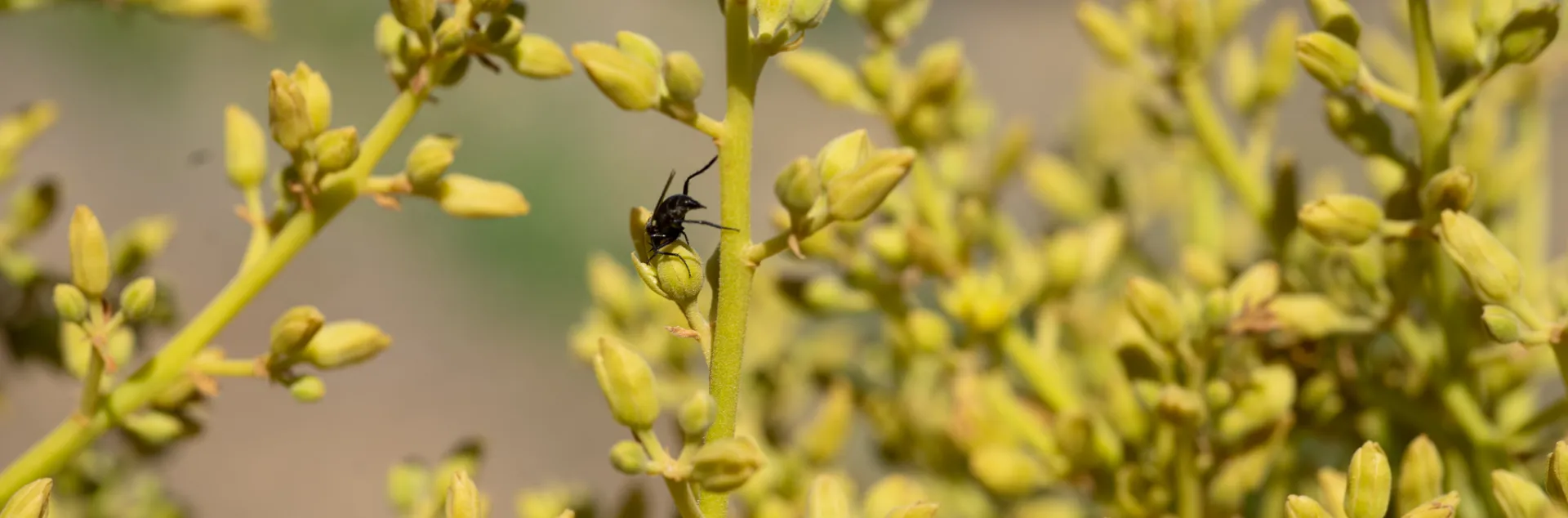
Avocado pollination is a little-understood process influenced by flower biology, environmental conditions, and pollinator behavior. Our study from UC Cooperative Extension and UC Davis aims to shed light on the complexity of avocado pollination and the role of various insect species in enhancing fruit set. Understanding these dynamics can help growers improve yields and optimize orchard management.
Understanding Avocado Pollination
Avocado flowers exhibit a unique pollination process known as dichogamy, where each flower transitions from a female phase (stigma receptive) to a male phase (pollen release). This transition occurs at regular intervals and depends on the cultivar type (Type A or Type B). While self-pollination can occur during brief self-overlap periods, cross-pollination—when pollen is transferred between different cultivars—has been found to enhance fruit production.
Factors influencing cross-pollination include the proximity of pollenizer trees, the timing of male and female bloom phases, and the presence of active pollinators. Weather conditions and site management practices further shape the pollination landscape.
Key Pollinators of Avocado Trees
Multiple insect species might contribute to avocado pollination, including bees, wasps, flies, beetles, and thrips. Each group varies in its efficiency and frequency of avocado flower visitation.
Bees: The Primary Pollinators
Bees, particularly honey bees (Apis mellifera), play a crucial role in avocado pollination. Honey bees increase pollination rates, but the majority of honey bees visit a limited area of 1-3 trees, performing cross pollination between cross-cultivars located within two rows. Only a small percentage of forager bees, called "scout" bees, have longer foraging distances and are capable of transferring pollen over hundreds of meters. While increasing honey bee density increases pollination rates, studies have repeatedly shown since the 1960s that honey bees prefer non-crop flowers over avocado blooms, likely due to the chemical composition of avocado nectar which is high in potassium and phosphorus.
Bumble bees (Bombus occidentalis) have been minimally evaluated in California for their pollination potential, but have been observed foraging in Hass and enhancing yield in trees within three rows of managed colonies. Additionally, wild bees, including species like Ceratina acantha, Agapostemon texanus and Halictus tripartitus, contribute to pollination, particularly in orchards with diverse floral resources and nearby wild habitat for nesting.
Other Insect Pollinators
- Wasps: Seven species, primarily from the Crabonidae and Vespidae families, have been recorded visiting avocado flowers.
- Flies: More than 20 fly species, including syrphid flies (hoverflies), have been observed visiting avocado flowers. Some flies, such as blow flies, have been observed depositing avocado pollen. These insects tend to move randomly, which can facilitate cross pollination.
- Other Insects: Beetles, thrips, and moths may also contribute to pollination, though their effectiveness remains uncertain.
The Impact of Habitat and Management Practices
EXTERNAL IMAGEOur main research goals are to identify the species of pollinators visiting avocado in Ventura and ask how they are influenced by farm management, habitat, and weather. We are tracking avocado visitors in 10 avocado ranches in Ventura by using visual surveys and netting at individual trees which we track from bloom to fruit set. Preliminary findings suggest that increasing the presence of non-crop flowers can impact pollinator behavior and fruit set.
- Flowers matter: Avocado trees surrounded by higher counts of non-crop flowers, either from intentionally-planted hedgerows or weedy flowers, have more honey bees visiting their flowers. These trees subsequently had higher fruit counts when we assessed fruit set (Fig. 1).
- EXTERNAL IMAGELandscape-scale habitat: Orchards near natural, non-crop habitats have a higher diversity of wild pollinators in the orchard flying around, but we aren’t sure yet if this means higher crop visitation and pollination.
- Weather conditions: Warmer temperatures correlate with increased pollinator activity, but we want to know if temperature variability throughout an individual orchard also influence the response of pollinators.
Next Steps
We are still working on learning more about avocado pollination, specifically by identifying and analyzing collected pollinators to see who are the key players besides honey bees. We are also designing experiments to measure pollination efficiency of different insect species and collecting detailed weather data to assess its impact on pollination dynamics. We’ll keep you tuned in for updates here at Topics at Subtropics as we learn more.