
I was in a citrus orchard in San Diego recently with some colleagues, looking for sap-sucking hemipterans to run an experiment. I kept getting distracted, however, by some small flies. They were shiny, bright yellow with black stripes, like a miniature, polished hoverfly. Every tree I inspected in this corner of the orchard had a dozen or so of these little flies flitting about (Figure 1). My team was calling me on to move to the next part of the survey, so I grabbed my aspirator from the truck and sucked some up for a closer look back at the lab.
Flies (Diptera, the ‘two-winged’ true flies, which have their hindwings reduced into halteres for balance during flight) are everywhere, being among the most common and specious type of animal globally. They fill every ecological role from decomposer to pollinator and herbivore to predator, and include the biting mosquitoes and tsetse flies. Their success is partly attributed to their holometabolous life cycle, which allow the immature larvae (‘maggots’) to focus on feeding and growing, often obscured in a mushy or liquid substrate, and the winged adults to focus on dispersal and reproduction, which they do very well, being among the most apt and agile animals in the air.
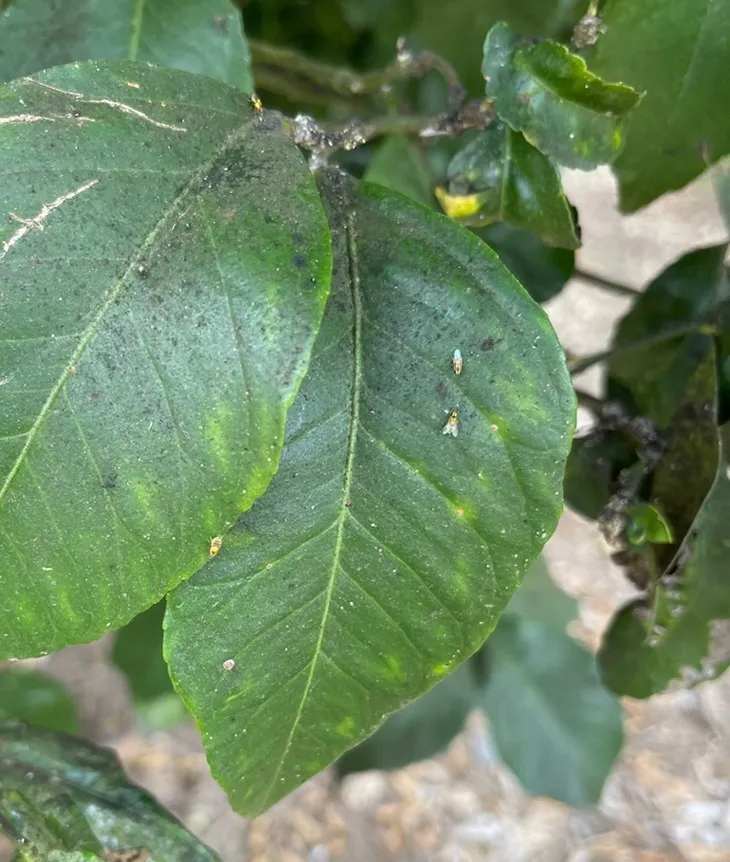
Figure 1. Four of the mystery flies seen on leaves of tree in a citrus grove in San Diego County. They were determined to be Thaumatomyia sp. (Diptera: Chloropidae), a common grass fly that is a predator of root aphids and not a pest of citrus. Some red armored scale insects are also visible on the leaf. Credit: Bodil Cass.
A swarm of flies in a citrus grove isn’t necessarily noteworthy, given the ubiquity of their taxonomic order. Unless, they’re an invasive species not established here, especially any of the species that feed on ripening fruit and render the produce unmarketable. The flies in question were slightly larger than a vinegar fly like Drosophila spp. and smaller than a true Tephritid fruit fly. In Southern California I might expect to occasionally run into Spotted Wing Drosophila (Cherry Vinegar Fly, Drosophila suzukii, whose maggots feed on fresh berries (Caprile et al. 2011). I might also catch a cloud of Mexfly (Anastrapha ludens) or Medfly (Ceratitis capitata) from one of the sterile insect technique release programs that drop millions of irradiated flies from aircraft to suppress and eradicate any breeding populations of invasive Tephritids (CDFA, n.d.; “Fruit Flies” 03/2025). Under the microscope mystery flies were not a visual match for either of these known pest species, based on their distinctive markings and size. My mind still abuzz from one of the worst true fruit fly years on record (Sequeira and Bond 2024), it was still important to identify them, to rule out any other new introduction incompatible with fruit farming.
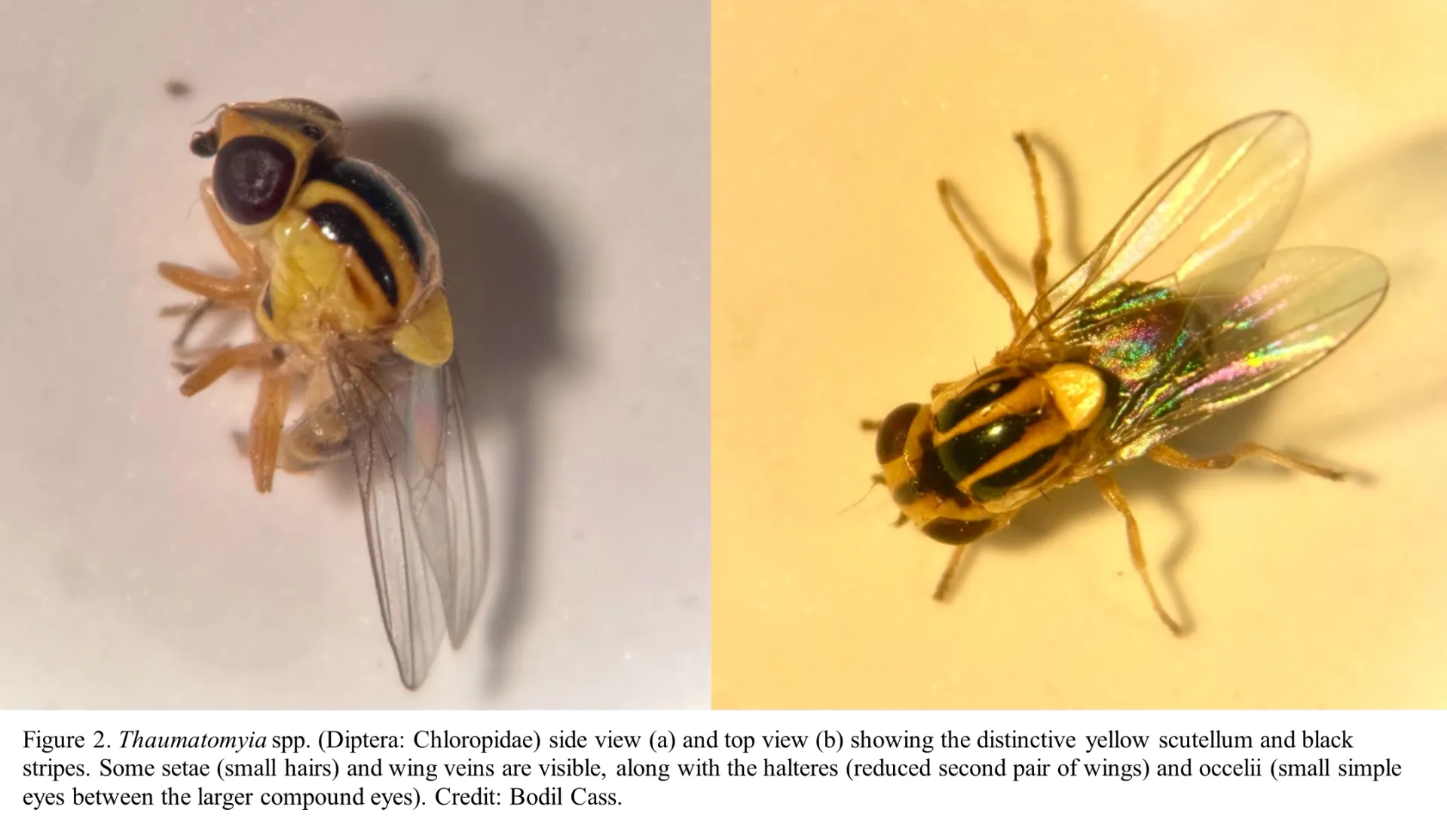
The mystery flies in this case were an innocuous fruit or grass flies (Chloropidae). Based on their morphology under the microscope (Figure 2), these were likely the cosmopolitan species Thaumatomyia glabra, which is unusual in the chloropid group because their larvae are predators of root aphids (Sabrosky 1935). This species has only minute morphological differences to Chlorops spp., another common chloropid that is a stem borer of grasses (Sabrosky 1943). Neither are a concern for citrus growers. They were likely coming from the diverse flora in the adjacent riparian area. Most chlorops are detritivores in decaying vegetation, but the family also includes some agricultural pests of turf and grain production (Sutherland et al. n.d.) and includes the eye gnats, which are mechanical vectors of some animal pathogens such as the causative agent of conjunctivitis (pinkeye; Bethke, Vander Mey, and Bates 2013). I was delighted to learn that some less common species in the chlorops family utilize diverse food sources including dung and bird nest debris. The larvae of one Australian genus reportedly develop as a parasite under the skin of frogs and toads (Hoskin and McCallum 2007).
In this case, the yellow and black stripes were not a warning sign but a beneficial predator common in the local ecosystem. My colleagues report seeing them visiting avocado flowers for nectar in Ventura County (Figure 3). A delightful find, that I’m glad I took the time to notice and read about. If you find an insect that needs identifying, please contact your local UCCE office or the CDFA Pest Hotline (1-800-491-1899; https://www.cdfa.ca.gov/plant/reportapest/).
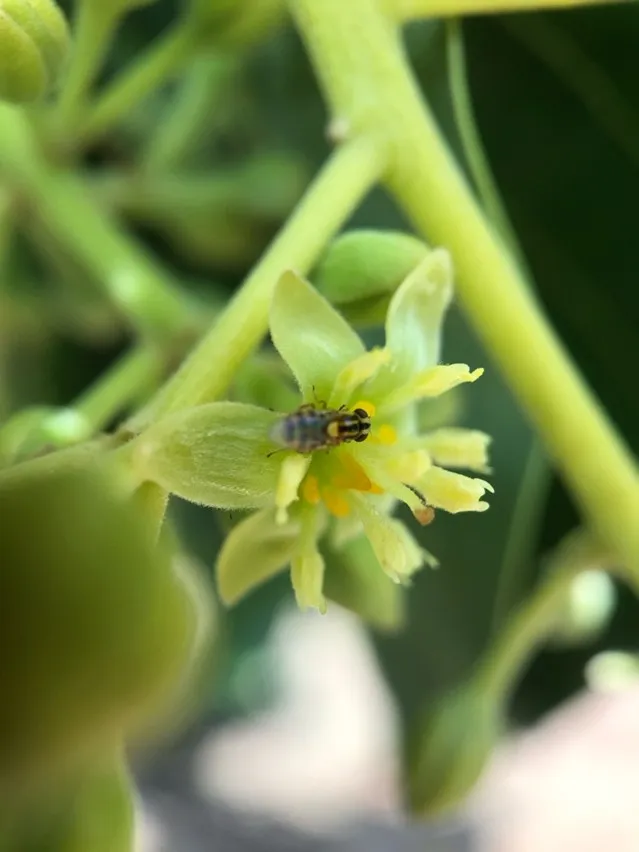
Figure 3. A chloropid fruit fly visiting an avocado flower for nectar in Ventura County. Credit: Hamutahl Cohen.
References
Bethke, J. A., B. Vander Mey, and L. M. Bates. 2013. “Eye Gnats Management Guidelines--UC IPM. UC ANR Publication 74164.” 2013. https://ipm.ucanr.edu/PMG/PESTNOTES/pn74164.html?src=302-www&fr=4466.
Caprile, J. L., M. L. Flint, M. P. Bolda, J. A. Grant, R. Van Steenwyk, and D. R. Haviland. 2011. Spotted Wing Drosophila. Edited by M. L. Fayard. University of California, Davis, CA 95616: UC Statewide Integrated Pest Management Program.
CDFA, Plant Health Division, and PDEP. n.d. “Preventative Release Program (Medfly).” Accessed July 22, 2025. https://www.cdfa.ca.gov/plant/PDEP/prpinfo/.
“Fruit Flies.” 03/2025. UC Statewide IPM Program (UC IPM). 03/2025. https://ipm.ucanr.edu/home-and-landscape/fruit-flies/#gsc.tab=0.
Hoskin, Conrad J., and Hamish McCallum. 2007. “Phylogeography of the Parasitic Fly Batrachomyia in the Wet Tropics of North-East Australia, and Susceptibility of Host Frog Lineages in a Mosaic Contact Zone: FLY PARASITISM IN A FROG CONTACT ZONE.” Biological Journal of the Linnean Society. Linnean Society of London 92 (3): 593–603.
Sabrosky, Curtis W. 1935. “The Chloropidae of Kansas (Diptera).” 1935. https://www.jstor.org/stable/25077340?seq=1.
———. 1943. “A Revised Synopsis of Nearctic Thaumatomyia (=chloropisca) (Diptera, Chloropidae).” The Canadian Entomologist 75 (6): 109–17.
Sequeira, Cecilia, and Suzanne M. Bond. 2024. “USDA and CDFA Declare California Free of Invasive Fruit Flies.” Animal and Plant Health Inspection Service. August 27, 2024. https://www.aphis.usda.gov/news/agency-announcements/usda-cdfa-declare-california-free-invasive-fruit-flies.
Sutherland, A. M., M. L. Flint, M. A. Harivandi, H. S. Costa, R. S. Cowles, D. D. Giraud, J. Hartin, H. K. Kaya, and K. Kido. n.d. “Frit Fly.” UC ANR Publication 3365-T. Accessed July 22, 2025. https://ipm.ucanr.edu/agriculture/turfgrass/frit-fly/#gsc.tab=0.