
Introduction
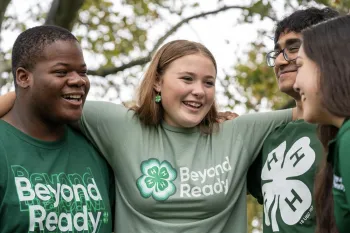
Supporting the mental and emotional wellbeing of youth is a priority of the 4-H positive youth development program. In fact, each of the four Hs (Head, Heart, Hands, and Health) relate to mental wellbeing. Our head is the place where we think, have emotions, and make decisions. Our heart is a metaphor for the love and warmth we share with others experiencing a mental health challenge. Our hands are used to serve the needs of those experiencing a mental and emotional challenge. And our health encompasses our physical, mental, and emotional wellbeing. The University of California Cooperative Extension program prioritizes youth mental wellbeing through its public value of "Promoting healthy people and communities."
What is Mental Health First Aid?
Mental Health First Aid (MHFA) is a training program that teaches how to provide initial care for people struggling with mental health challenges. Created in Australia in 2000, this evidence-based program has expanded worldwide to 50 countries with over 54,800 instructors training over 8.5 million people worldwide (Mental Health First Aid International, 2026). Just in the United States, MHFA has trained 4.5 million people.
The goals of MHFA are to: 1) educate adults about common mental health challenges, 2) reduce mental health stigma, 3) teach adults how to recognize the signs and symptoms of a person in crisis, and 4) equip adults with skills and resources to support a person having a mental health crisis (Iaccopucci et al., 2024).
Central to MHFA is the ALGEE action plan, which provides a framework for how to respond to a person experiencing a mental health challenge. ALGEE is an acronym that represents: 1) Assess for risk of suicide and self-harm, 2) Listen nonjudgmentally, 3) Give reassurance and information, 4) Encourage appropriate professional help, and 5) Encourage self-help and other support strategies.
Types of MHFA Training
There are three primary MHFA trainings: 1) Adult Mental Health First Aid (MHFA), 2) Youth Mental Health First Aid (YMHFA), and 3) Teen Mental Health First Aid (TMHFA). The Adult MHFA training is designed for adults who work and interact with other adults. In the context of the 4-H youth development program, this can be the interactions that 4-H professionals have with each other and with other adult 4-H volunteers.
The Youth MHFA training is designed for adults who work with youth. In 4-H, this can be adult 4-H volunteers who lead projects or lead a community club of youth members. In an after-school setting, this can be a school staff who leads a 4-H project in out-of-school time, such as after-school.
Last, Teen MHFA is designed for teens to support their peers. In 4-H, these can be teens who support their friends in 4-H and also at school. While each of these programs are unique, they all rely on the ALGEE action plan as the core way in which we respond to people experiencing a mental health challenge.
Does MHFA Work?
Since 2013, there have been over 90 peer-reviewed scientific studies on MHFA. A study of 384 Australian parents of adolescent youth (ages 12-15) revealed a non-significant reduction in adolescent cases of mental health problems, a non-significant improvement in parental support reported by adolescents with a mental health challenge, and a non-significant improvement in the quality of parental support of adolescents with a mental health challenge (Morgan et al., 2020). This study also found a significant improvement relative to a control group regarding parental knowledge of youth mental health challenges and adolescent perceptions of parental social support.
A study of 988 students receiving Teen MHFA found statistically significant improvements in mental health literacy, confidence in providing MHFA to a peer, help-seeking intentions, and student mental health (Hart et al., 2016). This study also found a significant reduction in stigmatizing attitudes.
A study of 246 adults in Australia found significant improvements in recognition of schizophrenia, confidence in offering help, knowledge of adolescent mental health challenges, and application of the ALGEE action plan (Kelly et al., 2011).
The MHFA evidence-based program helps people identify the signs and symptoms of mental health challenges and know how to respond using the ALGEE action plan. In particular, MHFA has been shown to:
- Reduce stigma and increase empathy toward those with mental health challenges
- Increase knowledge of the signs, symptoms, and risk factors of mental health and substance use challenges
- Increase confidence and likelihood to help someone in distress
- Increase skills and knowledge as First Aiders to manage their own mental wellbeing
Learn more about the impacts of MHFA here.
Where To Get MHFA Training
The California 4-H program offers trainings for Adult MHFA, Youth MHFA, and Teen MHFA. The cost is $125 per person, which provides access to the online curricular materials along with 8 hours of instruction. There is an online registration where you can pay via credit card.
NOTE: For those who are a California 4-H professional (Advisor, CES, RPC, etc.), active 4-H volunteer, or 4-H teen member, there are a limited number of fee waivers. To learn more about Youth MHFA and Teen MHFA, please contact Ally Lemmer (alemmer@ucanr.edu) or Jenna Colburn (jcolburn@ucanr.edu) at the CA statewide 4-H office. In addition, please contact 4-H Advisor Matthew Rodriguez (mrro@ucanr.edu) for questions pertaining to Adult MHFA classes.
References
Hart, L. M., Mason, R. J., Kelly, C. M., Cvetkovski, S., & Jorm, A. F. (2016). ‘teen Mental Health First Aid’: a description of the program and an initial evaluation. International journal of mental health systems, 10(1), 3.
Iaccopucci, A. M., Lobenstein, M. M., Lewis, K. M., & Norrell-Aitch, K. (2024). Implementing Youth Mental Health First Aid Training in Cooperative Extension Programs. Journal of Human Sciences and Extension, 12(3), 2.
Kelly, C. M., Mithen, J. M., Fischer, J. A., Kitchener, B. A., Jorm, A. F., Lowe, A., & Scanlan, C. (2011). Youth mental health first aid: a description of the program and an initial evaluation. International journal of mental health systems, 5(1), 4.
Morgan, A. J., Fischer, J.-A. A., Hart, L. M., Kelly, C. M., Kitchener, B. A., Reavley, N. J., Yap, M. B., & Jorm, A. F. (2020). Long-term effects of Youth Mental Health First Aid training: randomized controlled trial with 3-year follow-up. BMC psychiatry, 20(1), 487.