
Article by Peg Smith -
As gardeners we hear a consistent message that we should plant ‘to attract pollinators.’ Often our first thoughts quickly turn to the honeybee. But the honeybee is a non-native pollinator in North America. An introduced pollinator, brought to Jamestown in 1622 and not seen in California until 1853 when twelve hives purchased in Panama were transported by rail, mule, and steamship by a Texan beekeeper, Christopher A. Shelton. Many bees did not survive the arduous journey. The surviving bees, enough for a single hive, soon propagated on the almost two thousand acres of Ranchero Potrero de Santa Clara where Christopher A. Shelton settled.
Are honeybees the only pollinators? Let us take a step back in evolutionary time to see how the relationship between flower and pollinator progressed.
When did flowers evolve?
The fossil record gives us data on plants and animals from millions of years ago and shows how evolutionary developments have led to today’s plants and animals. The current fossil record indicates that the first primitive plants appeared around 400 million years ago. These earliest plants reproduced by spores. Over time, gymnosperm plants that reproduce by cones or seeds show in the fossil record. There are identified descendant gymnosperms from these early plants that belong in four groups: conifers, gingko, cycads (a common house plant usually known as ‘sago palm’ is a cycad), and Gnetales (tropical evergreen trees, shrubs, and lianas).
Early flowering plants, angiosperms, show in the fossil record around 174 to 65 million years ago. Most of the flowering plant families that we are familiar with had developed by the end of this period. From the lowly grass growing in the sidewalk crack to the majestic oaks, all involve flowers in the reproductive process. Eighty percent of today’s flowering plants are descendants of the early flowering plants of 174 million years ago.
What is pollination?
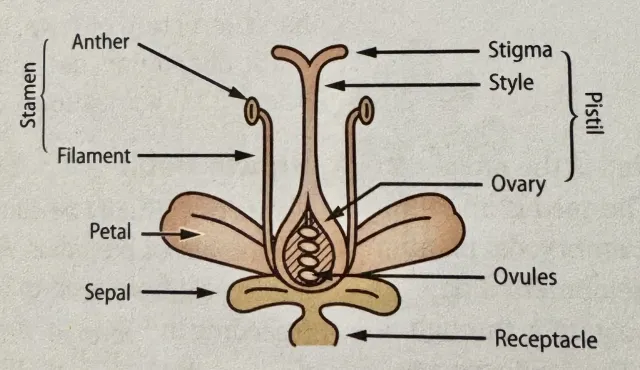
Pollination occurs when pollen from the male (anther) of a flower is transported to the female (stigma) part of the flower. This process of fertilization leads to seed development that assures the next generation of a plant. There are several ways the transport of the pollen can occur: wind, water, insects, bats, and birds.
What were the earliest pollinators?
As the evolution of flowering plants continued, the evolution of the pollinators was also advancing. Today, there are generalist pollinators such as the honeybee that pollinate a variety of plants, and specialist pollinators where their adaptations are only ‘a good fit’ with one particular plant.
From the fossil record, it is estimated that the first land-based insects originated about 480 million years ago, with the development of flight following about 80 million years later. The distinct groups of Hymenoptera (wasps, bees, and ants), Lepidoptera (Moths), Diptera (flies), and Coleoptera (beetles) developed about 145 to 66 million years ago.
Birds are thought to have originated from a famous transitional ancestor, Archaeopteryx, which combined both reptilian features (teeth) and avian features (feathers, wings) about 150 million years ago.
Bats evolutionary history shows in the fossil record around 50 million years ago, but the fossil record is sparse. It is thought that bats were at first flightless, later evolving to the ‘flying mammals’ that are one of nature’s best natural pest managers, as well as pollinators.
Insects, birds, and bats were following their individual evolutionary pathways, but also developed co-evolutionarily with the flowering plants.
Over the next few months, we will look at some generalist pollinators, some specialized pollinators, and their plant hosts. We will also look at pollination of California native plants, with the idea that when you ‘plant for pollinators’ in your design, you will be able to provide the plants and environment to support the myriad and variety of pollinators throughout their life cycles.
Here is an example of a ‘special relationship’ between plant and pollinators.
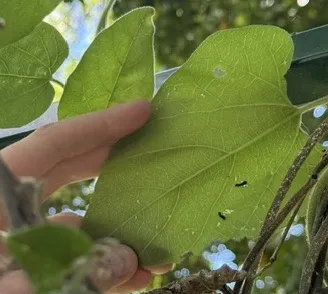
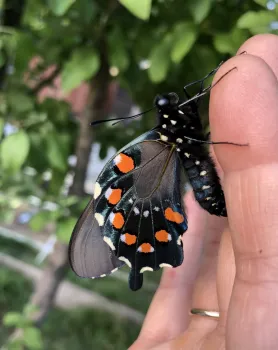
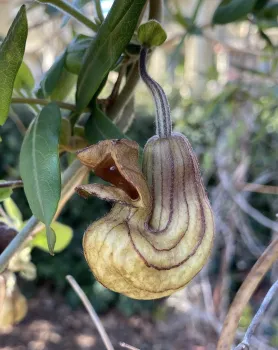
The California pipevine Aristolochia californica (rhizome) is a native of Northern California and is often called Dutchman’s pipe because of the shape of the flowers that bloom from January through April. After bloom, heart-shaped leaves emerge. The pipevine swallowtail butterfly depends exclusively on these leaves to deposit their eggs and for caterpillar food. These leaves are the only food source for the pipevine caterpillar and contain aristocholic toxic acids that make the caterpillars and butterflies unpalatable to predators. The caterpillar coloring, black with bright orange projections, indicates to predators its toxicity. Mature caterpillars will move to a sheltered place, such as a bark crevice, to pupate.
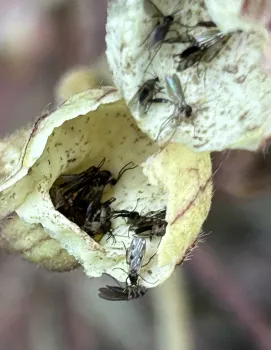
The pollination of the California pipevine relies on the process of ‘pollination by deceit.’ The unusual odor of the flowers, sometimes described as decaying mushrooms, attracts fungus gnats (Mycetophilidae) that are guided by stiffened flower hairs to move through the convoluted chamber of the flower, collecting pollen. After a period of time, the flower hairs relax, and the gnats are able to escape to pollinate other pipevine flowers.
Here we have an intricate dependency of an exquisite butterfly relying on a single plant with a specific pollinator for its source of food for the caterpillars and the future of its existence.
For more information, watch this video from Jepson Herbarium on the Aristolochia californica (California pipevine) and its relationship with the pipevine swallowtail butterfly.