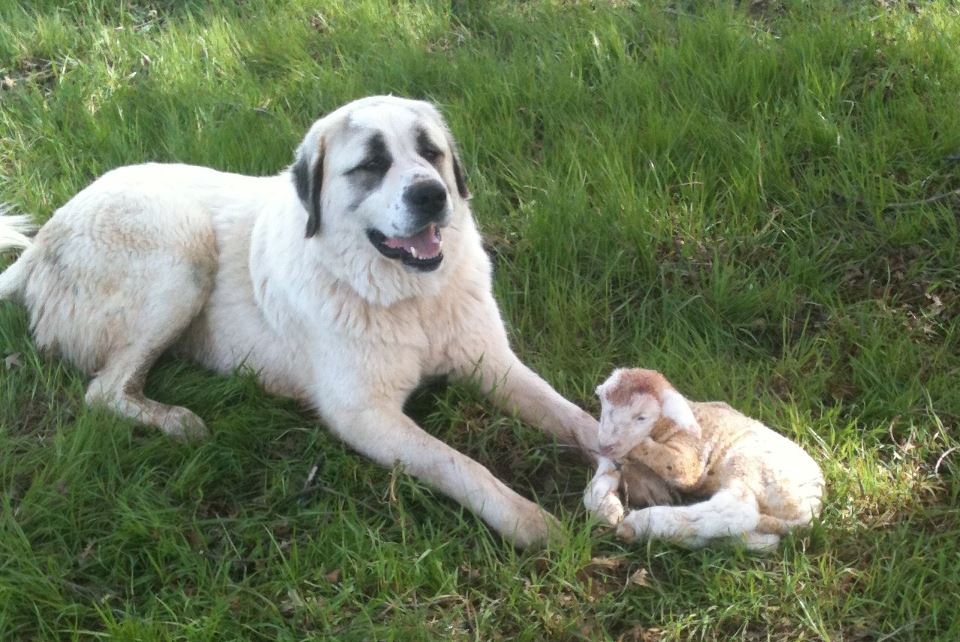
If you've followed Ranching in the Sierra Foothills for very long, you'll know that I've written about livestock guardian dogs (LGDs) frequently. I've owned LGDs for 20 years; I've researched their effectiveness and behavior for nearly 9. As a sheep (and recently, goat) producer in the Sierra foothills, I know they can work. As a researcher, I'm trying to think about why they work - and about their limitations. I suspect this blog post may be the first of a number of such musings!
My friend and colleague Dr. Carolyn Whitesell published a paper in the Western Agricultural Economics Association's Western Economics Forum several years ago examining the economic implications of using LGDs. We concluded that while it may be difficult to estimate how many livestock didn't die because they were protected by an LGD, successfully bonding a pup with livestock - and raising that pup to working-age adulthood - was a key driver in cost-effectiveness.
In another paper we published in the California Fish and Wildlife Journal, we suggested that case studies of LGD successes (and failures) were a valuable way to help producers understand where these dogs work - and where they might not. We went on to describe three case studies - one in an open range sheep production setting, one in a foothill small flock setting, and one in coastal mixed livestock operation - where LGDs had been used with varying degrees of success.
With a number of other colleagues, we also worked with several ranchers to learn how to bond an LGD pup with cattle. For me, this was hugely valuable - we learned that the techniques that I'd used to successfully bond LGD pups with sheep worked with cattle. We also learned that the cattle needed time to bond with the dog! And we learned (again) that paradigms are critical! If you think a dog will work in your operation, you'll figure out how to make it happen. If you're skeptical, every time there's a problem, it will confirm your skepticism.
Most recently, I've been working with Nofence, a Norwegian virtual fence (VF) company, to see if VF technology can be used safely with LGDs. One of the potential drawbacks of virtual fence (at least for sheep and goat producers) is the lack of a physical barrier to keep predators out of the flock. We're finding that LGDs respond very well to VF technology; our current work will assess LGD welfare associated with VF collars.
One of the questions that has come up in this work - and the question that prompted this blog post - is whether VF technology can take the place of effective bonding between LGDs and livestock. In other words, will VF technology turn a failed LGD into an effective one? I'm convinced that it cannot - I'm absolutely convinced that a dog must be bonded to livestock first (and vice versa).
In my direct experience, LGDs are far and away the most effective predator deterrent I've used. Electro-net fencing will keep coyotes out (mostly - I've seen a coyote jump my 42" high fencing), but it won't keep mountain lions out. Night-penning might solve my predator challenges, but it comes at the cost of increased labor, infrastructure, and disease problems. Human presence (and I mean 24/7 human presence) might work in nearly every case - but I could never afford it at my scale (300+ ewes at my peak). I can honestly say that in the 18 years I operated a small-scale commercial sheep business in Placer and Nevada Counties, I only lost one ewe to a predator where I had a dog with my sheep.
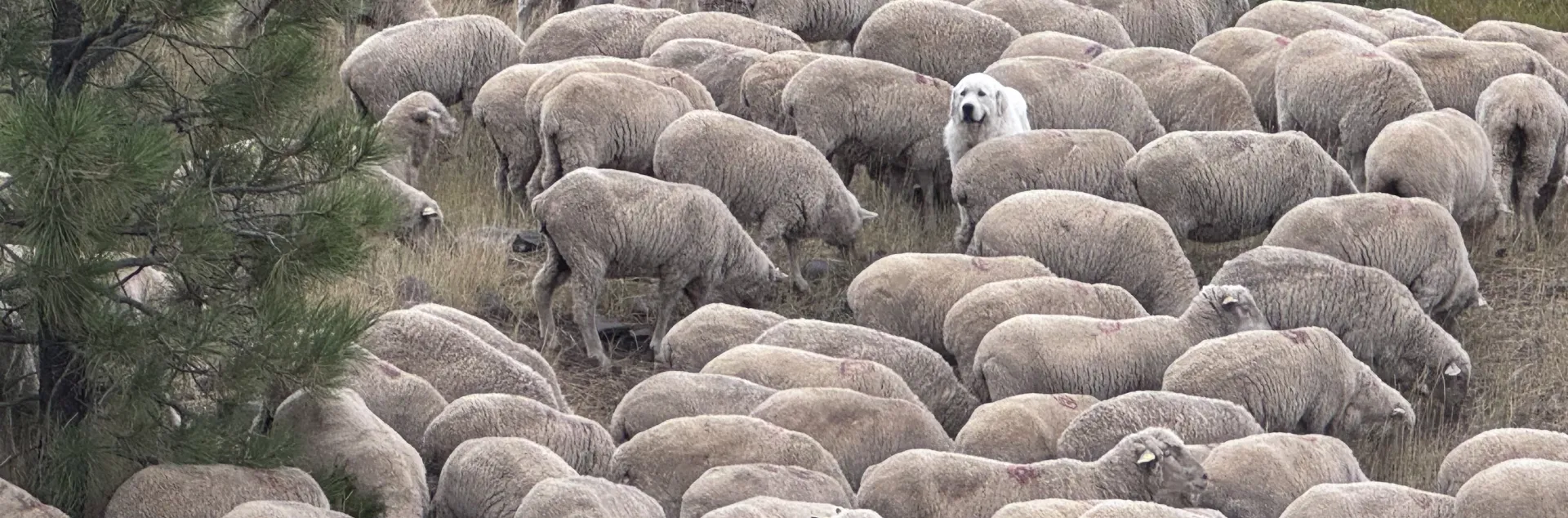
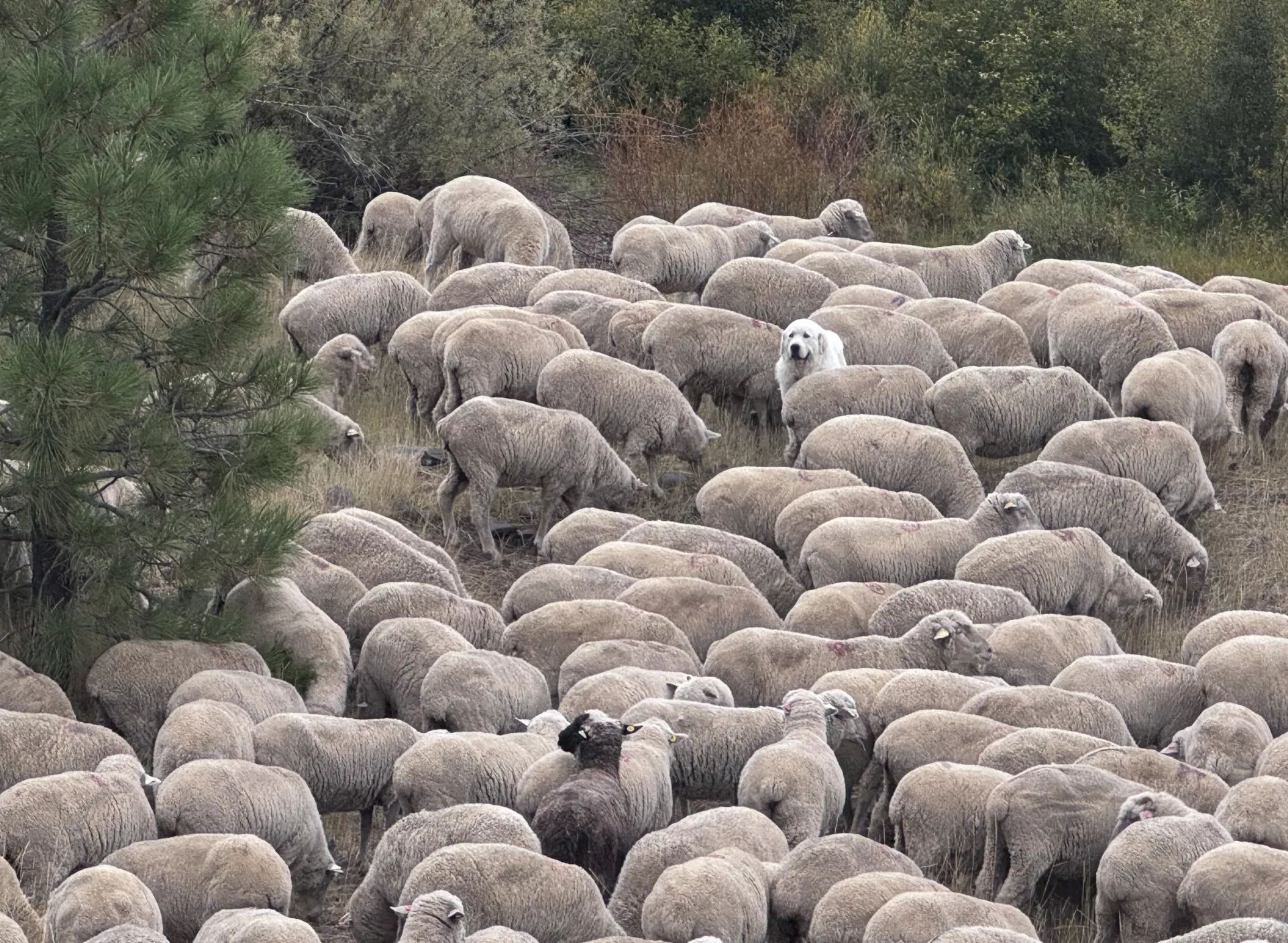
But the research I've done has also helped me understand that the success of LGDs as a predator deterrent is hugely site- and operation-specific. These dogs work well in the open range sheep outfit that collaborates in my research because the sheep are herded, and because these bands are comprised entirely of dry ewes and rams - no lambs. These dogs have worked well in my operation because someone could be there to feed them every day. In both these examples, the livestock were bonded with the dogs - my sheep would follow my big white dogs wherever they went.
Cows that have been chased by canids (domestic dogs, coyotes, or gray wolves) are not as excited to share the landscape with these big white dogs. I'm convinced that with work, we can successfully bond LGDs with cattle, even when this is the case. I'm also convinced that most producers don't have time to do so, especially if they are skeptical to begin with.
I also think that VF technology can help make dogs more useful in extensive rangeland settings. VF can help keep dogs away from recreation areas and off roadways. VF technology can help keep dogs in closer proximity to livestock (sheep or cattle). But VF technology can't replace the need for cross-bonding.
Finally, I have noticed that in conversations about nonlethal deterrents for wolves and mountain lions, the assumption is that if you have a depredation problem, one answer is to go out and buy and LGD. My experience (and hopefully the thoughts above) suggest that this is terribly naive! I do think an LGD can help reduce depredation in most situations. If that LGD is bonded with that operation's livestock. And that takes time. Experience - and research - suggests that a pup needs to be started with livestock at 8 to 10 weeks of age. That pup won't be mature enough - in size and maturity - to go to work for another 18 months. A producer can't suffer a loss this week and buy a dog next week that will solve all of his or her predator problems.
I do think we can learn much from other dog/livestock cultures. I would love to learn from livestock producers in southern Europe and Eurasia who use LGDs to guard cattle, sheep, and goats - and their families - from wolves and European brown bears. I'd love to learn from ranchers in the Northern Rockies who have incorporated LGDs into their cattle operations. And while I like to think that research like I'm doing is important, I also know that ranchers often learn more from other ranchers than they do from me!