
Spring is just around the corner! With the increase in daylight hours and gradually warming days, our fruit trees will respond by going into bud break, leaf set, and full flower. The orchard is lovely this time of year but there is the potential lurking for a devastating disease to infect those trees. That disease is known as fire blight.
Fire blight is a bacterial disease caused by the bacterium Erwinia amylovora. In California pear, apple, crabapple, and quince fruit trees are most severely affected. California ornamental trees most often affected are pyracantha (firethorn), hawthorn, cotoneaster, mountain ash, and toyon.
Fire blight overwinters in infected trees, becoming active when nighttime temperatures are above 55° and daytime temperatures are in the 75°–85° range. Any rain or humidity during this period increases the activity of the pathogen. This disease comes on quickly in the spring, but you can be ready for it.
Some of the signs and symptoms you may observe are as follows:
• You may see a light tan liquid oozing from branches or along the trunk.
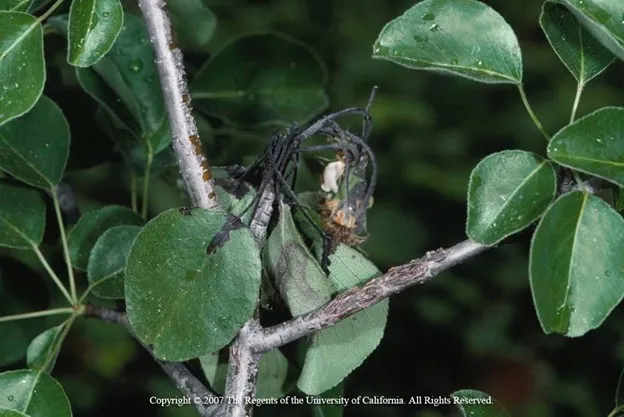
• Infected blossoms on pear trees will turn black while infected apple tree blossoms will turn brown.
• Leaves that look dry and dead hang on the tree instead of falling off.
• Leaves may have a scorched appearance. The scorched appearance accounts for the common name of the disease, fire blight.
• Young leaves and shoots wilt and bend downward forming the shape of a shepherd’s crook.
Managing fire blight takes diligent observation and quick action. You will need three tools: a pair of pruning shears, a curved pruning saw, and a hand lopper. Make sure your tools are sharp so you can make clean cuts.
Understanding how fire blight spreads will help you determine where to make the most effective pruning cuts. Fire blight bacteria move through healthy wood in narrow paths about 1½” wide. While the infection is narrow, it can extend 2 to 3 feet beyond the main infection. Infected tissue closest to the main infection will appear brown. As the infection moves out it turns red. Past the red area you will see dark flecks. Your goal is to catch the infection in the early stage before it can spread to the trunk of the tree. It is recommended your pruning cuts go back to healthy tissue with NO visible brown, red or flecking and then go back an additional 8” to provide a safety margin.
Start inspecting your trees now (January) while the bacteria are dormant. Remove any wounds or cankers which are visible along with any twigs or branches exhibiting signs of past infection.
As the weather warms, be watchful for new infections (signs and symptoms listed above) and prune immediately. Quick action is imperative, as this disease can spread within 1–3 weeks. The live pathogen often lives in the blossoms and is easily spread by pollinators. Young trees suffer more damage than older established trees so pay particular attention to trees with young, vigorous growth.
While there is no chemical control for this disease, with diligence and good observation skills you can spot the signs and symptoms and take quick action to curtail this disease. Keep the area under your trees free from dead leaves and debris. Do not compost any of this material. Any pruned branches should be disposed of in the green waste bin.
While there are no known trees or shrubs in the pome fruit or Rosaceae family which are completely immune to fire blight, some varieties are resistant to fire blight. These varieties limit or slow the spread of the disease. If you are replacing trees or planting new trees, select trees which are known to be resistant to fire blight.
UC IPM Information: Fire Blight
https://ipm.ucanr.edu/home-and-landscape/fire-blight/pest-notes/#gsc.tab=0
Help Desk of the UC Master Gardeners of Contra Costa County (BHD)