

How easy is it to pick the best container for your plant? Is it just a matter of size of the container—10 inches versus 12 inches?—or color? Below are some factors to consider that will help provide your chosen plant the best chance at a healthy and happy life.
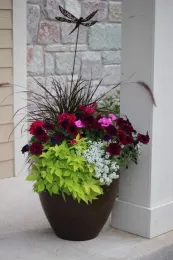
Know Your Plant
Knowing the plant’s needs is paramount to its success in the new, constricted and non-native environment that you are creating.
Know the maximum or allowable size of your plant to ensure the selected container will be suitable for the plant or if the container will need to be changed for a larger size as the plant grows. If the plant can be trained to accommodate a small pot, e.g., bonsai plantings, the size of the pot may not be as limiting a factor.
What do you want as the focal point of the plant—exposure of a unique root system as for caudiciform succulent plants, colorful flowers, or foliage?
Will the plant become too tall and top-heavy for your container or become a vining plant unsuitable for the shallow container you’ve chosen? What is the spread of the plant, and will it fit into the location chosen? What are the rooting needs of the plant? Does it have a tap root needing deeper soil or do the roots tend to spread horizontally?
Does the plant like evenly moist soil, well-drained soil, or are there preferences for overhead watering versus water from beneath?
Know the minimum temperatures that the plant can tolerate, e.g., frost hardiness, sun or shade preferences, and maximum temperatures. Knowing the native origins of the plant can provide guidance for its preferred climate. Plants from tropical jungles will need special care in our arid environment. Does your selected location provide the ideal temperatures and light exposure?
Does the plant retain its color, flowers, leaves, fruit throughout the year, or does the attractiveness of the plant change over the seasons? A plant that has finished flowering or loses leaves during dormancy may need to be moved into a less prominent location.
Having an idea of the purpose for the plant will also help in choosing the appropriate container. Some considerations include whether the plant/planting is an annual vs. perennial, being grown for propagation, in a temporary container during training or until reaching desired size, specimen or show plant, or an accent plant.
When choosing a container, consider the physical space in which the container will be located. A larger heavier container may be suited for a tree or shrub-type plant in a larger landscape. Smaller containers may be more suitable in smaller locations. In addition, other factors about the space should be considered such as the surrounding plants/landscape, color schemes, desired setting (relaxing, energizing), or informal versus formal themes.
Container Characteristics
The container’s height and width are critical considerations:
- Revisit the characteristic(s) and needs of the chosen plant(s) such as mature root depth (vertical) and spread (horizontal).
- The size of the pot also affects the growth of the plant. Do you want the plant to stay small or continue to grow vegetatively without flowering? Do you want to highlight the foliage, flowers, or trunk or root system?
- Do you want to draw attention to certain parts of the plant?
- The height and width of the pot should accommodate the plant as it grows unless the plant is trained to grow in a specific direction or pruned to a specific size.
- Deeper containers (18 to 24 inches or taller) allow roots to grow down and access moisture and cooler temperatures. This may be important for perennials and taller plants.
- Shallow containers (6 to 9 inches or less) are suited for succulents and some vegetables, e.g., lettuce.
- The height of the pot should accommodate sufficient room for any top dressing and watering at the top.
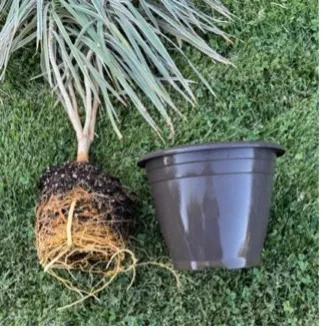
- A plant in a smaller pot does not always have enough room for rapidly growing roots especially if the bottom of the pot is narrower, as shown in the figure below.
The color or decorative nature of a container can vary greatly in how the plant is perceived in the garden:
- The wrong or inappropriate color or decorative nature of a container can detract from the form and attributes of the plant. Avoid bright colors or complex patterns that draw attention downward to the container and not the plant.
- A specimen plant or a plant used in plant shows will benefit greatly from a container that helps the observer focus on the qualities of the plant and not be distracted by the container.
- Choose colors that fit in with the theme of the location, e.g., cool and relaxing, tropical, or desert.
- A color wheel for gardening may be used to identify warm colors (yellows, oranges, reds), cool colors (greens, blues, purples) and blends of these colors to create various themes for your plantings and containers. See this website for additional details on using a color wheel for garden design.
- Try to achieve harmony with colors, textures, and proportions.

The bright colors of the pot below may distract the viewer from the plant in the pot.

The shape of the pot should enhance the form of the plant. Rectangular or oval pots are suitable for plants with asymmetrical forms. Round pots are suitable for plants with radial to bilateral symmetry.
Sharp or thin rims can result in stems being cut or bent from the weight of the stems. Flat or scalloped rims can provide some support for a plant with pendant or horizontal stems. Examples include rounded rim pots for hanging plants or scalloped rim African violet pots. A rim or opening that narrows at the top may make removing a rootbound plant very difficult without destroying the pot. Look for an opening or rim that widens at the top.
The foot ring is the part of the pot that holds the pot above the surface. A shallow foot ring can result in fine soil particles or roots impeding drainage. A cut in the foot ring further ensures that drainage from the pot is not blocked. Check all holes to make sure they are fully open. The foot ring on this pot is very shallow; however, the pot has channels to ensure that water drains out from under the pot.

Plant containers must have adequate drainage. Test a pot for drainage by filling the empty pot ¼ full on a flat surface and check if the water drains. Sometimes the presence of a hole does not mean that the pot drains well. Drill additional ½-inch holes in the container with a drill bit suitable for the pot material; a ceramic bit may be needed using adequate eye protection. If a pot does not have holes, it is still usable. Another pot with drainage can be placed into the first pot with some elevation off the bottom of the first pot. Monitor your containers to ensure water is not stagnating in the bottom of the pots.
The current and future weight of the pot, plant, and planting media should be a consideration. Some factors include whether the plant will stay in its current location, and, if not, the gardeners’ physical capability or equipment to move the plant. Does the container have sufficient weight to keep the plant in place during wind events? Lightweight pots, especially those with narrow bottoms, may need additional bracing during wind events or moved into a protected location.
Types of Containers and Accessories
Plant containers are available in many sizes, shapes, and materials. Although there are benefits and challenges to each type, some of the challenges (cons) may be benefits (pros) in the right setting. For example, a large heavy pot may be desired for a small tree or shrub. The following table includes some pros and cons for various types of containers.
|
Once you’ve chosen your plant and container, other plant needs that should be considered include type of media or soil, planting methods, amount and frequency of fertilization and watering, pest control, and pruning, which are out of scope for this article. However, following are some references and websites for further information on container gardening. Additional resources are available by searching online for “indoor gardening,” “container gardening,” or “small-space gardening.”
Sound like a lot of work? Container plantings can be fun with a little care!
Author: Emily Kishi, UC Master Gardener
Container Gardening Basics by the UC Master Gardeners of Santa Clara County.
Container Gardens by M. Roll and C.R. Wilson of Colorado State University Extension.
Container Gardening (Ornamentals) by Ellen Zagory of UC Davis Arboretum video.
Donaldson, Stephanie and McHoy, Peter, 1999, The Practical Encyclopedia of Container Gardening Indoors and Outdoors, Anness Publishing Limited, London.