
The Eastern Sierra Business Resource Center in Bishop, operated by the Sierra Business Council in partnership with Inyo County, the Small Business Development Center at CSU Bakersfield, and others, has created quite a buzz since opening in Fall 2024. Meryl Picard, the Center’s Executive Director, has made strides to develop strong programming and fill the calendar with events and training. The Center held a leadership class in the fall that served nonprofits and small businesses. It hosted hiring events for Marshall’s upon its opening. The Center also has a series of customer service trainings it will be taking on the road throughout the Sierra. Our UCCE office held a series of community economic development fundamentals workshops at the BRC in the fall.
The Center has also become a sort of community hub—many groups want to use the space in a multi-purpose format, highlighting the Center’s role not only as a business support system but as a venue for multifaceted community activities. If this represents a broader trend for Bishop and the Eastern Sierra, the Center’s blend of programming and community use aligns with the concept of entrepreneurial ecosystems, a framework recently explored by a national entrepreneurial working group I joined. (The working group was recently launched by Extension academics through the North Central Regional Center for Rural Development at Purdue University.)
Speaking of that group, I had a conversation at one of our national CED Extension conferences last year with one of the leads of this initiative, Dr. Jason Entsminger of the University of Maine, about rural tourism economies and economic development strategies. Sector-based planning, or cluster strategies, are not necessarily outdated, he noted. But he reminded me that fostering entrepreneurial ecosystems can serve as an effective framework for the low-density, outdoor recreation communities we work in.
What is an entrepreneurship ecosystem?
For more than a decade, rural development practitioners and researchers have increasingly championed entrepreneurial ecosystems as a best-practice theory and strategy. Definitions vary (see appendix for examples). Some, like this CAMEO toolkit, Walton Family Foundation resource, and State of Oregon description focus on categories of support like mentorship, access to capital, infrastructure, entrepreneurial culture, human capital, business-friendly regulatory climate.
These definitions are helpful, but they do not always foreground the defining feature of an ecosystem: the dynamic interplay among actors within the system. As Tessa Conroy and Sarah Low describe in their work on ecosystem building, it is not simply the presence of supports that matters, but how those supports interact, reinforce one another, and evolve over time. Ecosystems hinge on networks — and on the strength of relationships across those networks.
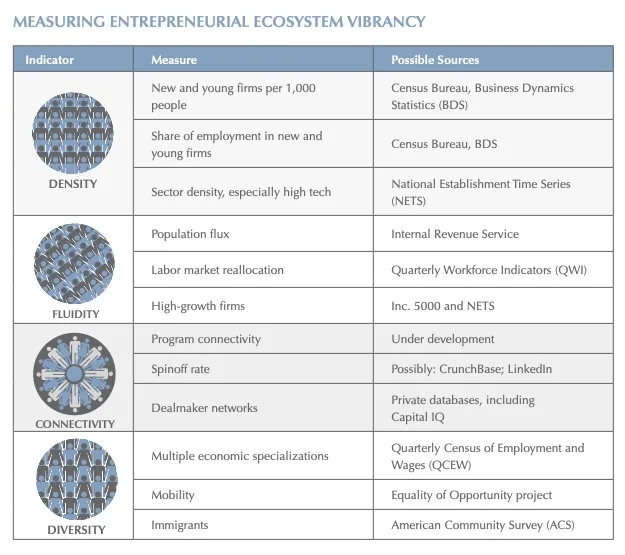
Kauffman Foundation resources help with this perspective. Dane Stangler and Jordan Bell-Masterson outline a four-pillar framework for measuring ecosystem activity:
- Density (new and young firms)
- Fluidity (population and labor market movement)
Connectivity (spinoffs, deals, and networks) - Diversity (specializations, economic mobility, immigration)
Another Kauffman resource highlights the importance of champions and conveners, clear onramps for support, intersections of ideas and people, and stories and culture that reinforce what makes a region distinctive.
–Kauffman Foundation Entrepreneurial Ecosystem Building Playbook 3.0 |
Notes on rural entrepreneurs and regional business and industry
It almost goes without saying, but is important to underscore, that small business plays a special role in rural, small-town economies. Rural entrepreneurs are more likely to be sole proprietors, to operate more than one business, and to start businesses out of necessity rather than in pursuit of a clearly defined market opportunity. The challenge, then, is not simply how to increase the number of startups–we already have a healthy share–but how to help existing businesses grow and scale.
|
Small businesses in rural places are often purveyors of community identity, pride, and culture. They shape, and are shaped by, the community in ways that are often more visible and consequential than in urban contexts. As a core tenet of community development practice, small businesses hire locally, purchase locally, and invest in building improvements, all mechanisms that help retain wealth within the community (Appalachian Regional Commission, 2018).
At the same time, rural small businesses face structural challenges that can be more acute than those of their urban counterparts. Limited access to training and education, and smaller labor pools overall, constrain workforce pipeline development. Rural firms are often more distant from major markets and suppliers, making product development and customer acquisition more difficult. They are also less likely to benefit from spillover or multiplier effects generated by dense clusters of related industries (Appalachian Regional Commission, 2018).
From a regional perspective, supporting entities such as Chambers of Commerce, county governments, and special districts may lack the in-house capacity, or sustained state and federal support, to provide ongoing funding and technical assistance to entrepreneurs. Some observers argue that many rural communities remain overly focused on business attraction, “landing a big fish”, rather than cultivating growth from within (Radley and Macke, 2021).
Meanwhile, broader macroeconomic trends continue to favor metropolitan regions, where knowledge economies, talent concentration, and network density drive growth. John Lettieri of the Economic Innovation Group has observed that connectivity, within regional small business and development stakeholder networks, and between rural communities and larger economic hubs, is essential for rural economic vitality. His argument suggests that communities must intentionally position themselves within broader regional systems, rather than attempting to compete in isolation (Lettieri, 2017).
What actions might support an Eastern Sierra entrepreneurial ecosystem?
As with all community development efforts, each place must tailor its approach based on its resources, assets, and constraints. The following suggestions draw from policy, practice, and case examples in the literature and are offered to generate conversation and guide program design.
1. Treat the whole entrepreneur–integrate family, household, and community context into strategy.
Entrepreneurial ecosystems are not simply collections of workshops or toolkits. They focus on cultivating growth-oriented businesses while recognizing that entrepreneurs operate within family systems, community identity, and local culture.
Rather than relying on one-size-fits-all programming, ecosystems emphasize multi-faceted supports tailored to entrepreneurs at different stages of growth, and with varying needs. The goal is not merely to increase the number of startups, but to help promising firms scale and strengthen their long-term viability.
|
This includes mentorship, curated connections, and creating contexts where “happenstance” interactions can generate innovation. It also requires acknowledging that the entrepreneur’s success is intertwined with community stakeholder networks, social networks, and family life.
In addition to mentorship, tailored connection, and setting a context for happenstance occurrences (essential for innovation), the ecosystem takes a holistic approach to considering the entrepreneur in the context of community identity, and culture, and the social and family life of the business.
As part of an initiative from the St. Louis Fed, Investing in Rural Prosperity, Steve Radley and Don Mackey wrote about entrepreneurial ecosystem building in rural Kansas and Ord, Nebraska. About Ord, they write that ecosystems best practices take a holistic approach that treats entrepreneurs and their families as key to business success alongside community values and identity. The process is more than attracting capital and marketing a great product: “Building a vibrant region requires strong agency and committed advocates, who are able to see their self-interest embedded within the community interests,” they write (307).
2. Foster a culture of entrepreneurialism across the community.
Much of the ecosystem literature defines the approach by what it is not. It is not primarily about recruiting a major employer, importing a rigid toolkit, or encouraging large numbers of people to start businesses without adequate support. Instead, ecosystem thinking emphasizes cultivating a durable culture of entrepreneurship.
Fostering such a culture means creating visible energy around local business: opportunities for entrepreneurs to connect, share stories, and learn from one another. Storytelling appears repeatedly in ecosystem literature cited here in the blog, including Rural Development Initiatives, Appalachian Regional Commission, and the Kauffman resources, as a mechanism for building identity and leadership. Authentic narratives about local businesses can strengthen regional branding, reinforce shared purpose, and generate innovation.
|
Building a community and regional culture around entrepreneurship that creates a kind of organic environment for startups that also generates a recognizable “buzz”--energy around the place. The cultural environment is key because, along the lines of regional specializations that drive growth, the uniqueness of experience, business and industry, is what gives companies and regional markets an advantage, a business niche as it were.
Activities that reinforce culture may include Chamber awards recognizing emerging leaders, industry mixers or meetups, startup bootcamps, youth entrepreneurship programs, robotics camps, hackathons, or business competitions. Each community will design programming aligned with its character and capacity. What matters most is sustained engagement that builds trust, visibility, and momentum.
3. Assess and align ecosystem assets across organizations for the benefit of entrepreneurs.
Not only do we have to be able to leverage resources, but we have to share information for civic and business innovation. To function effectively, communities must understand the assets they already possess and how those assets interact. This begins with asset mapping and stakeholder engagement: identifying finance providers, mentorship networks, education partners, workforce intermediaries, regulatory supports, philanthropic actors, and civic institutions. It also requires candid assessment of gaps and redundancies. Here, community development practices in Extension offers expertise in asset mapping and stakeholder engagement. (This U.S. Department of Labor resource from the Center for Economic Competitiveness on asset mapping in the context of regional development systems is worth taking a look at.)
|
The Ord, Nebraska case study illustrates how coordinated systems outperform isolated programs. Faced with economic vulnerability tied to an agriculture-dominated economy, local leaders pursued diversification through a network of mutually reinforcing strategies: a revolving loan fund for small businesses, a local foundation investing in development projects, long-term leadership training initiatives, and mentorship supports for entrepreneurs.
Crucially, these strategies extended beyond business services. The community invested in enabling infrastructure and quality-of-life assets, including hospital and school improvements supported through bond initiatives, and passed a local sales tax to generate gap financing for economic development projects.
4. Support “Backbone” organizations (“Community Hubs”).
Entrepreneurial ecosystems require trusted conveners to align resources and bridge across organizations. The multi-stakeholder nature of ecosystem development—public agencies, private lenders, nonprofit organizations, educators, civic leaders—creates complexity that individual entrepreneurs or partners should not have to navigate alone. Civic and business leadership organizations play a central role in aligning resources, facilitating communication, and maintaining long-term relationships. They listen to entrepreneurs, identify barriers, and connect businesses to appropriate supports.
|
Rural Development Initiatives’ evaluation of Oregon’s Rural Opportunity Initiative underscores this point. A key lesson from ROI is that effective entrepreneurial ecosystems require strong local “backbone” organizations (“community hubs”) that facilitate support to entrepreneurs among a network of trusted supporting organizations (Lesson 7). Lesson 8 emphasizes that these backbone arrangements require sustained and continuous resources to maintain alignment among stakeholders and provide navigation support for entrepreneurs (Hause, Davis, & Hendrickson, 2021).
Conclusion: Ecosystems matter, but it takes long-term dedication and commitment
There are many ecosystem partners rooting for the Eastern Sierra Business Resource Center and other key ecosystem partners—town and Main Street Chambers, local agencies, the Eastern Sierra Council of Governments (ESCOG), nonprofits, elected officials, educators, lenders, and others. In many respects, we already have the component parts of an entrepreneurial ecosystem. When I tried to schedule a couple meetings at the BRC late last year, the space was fully booked, a telling sign of both demand and momentum. (Meryl Picard did graciously get us a spot for more than a couple meetings!)
Popularity alone, however, does not constitute an ecosystem. The opportunity before us is to translate that interest into a cohesive, long-term strategy that aligns partners around shared goals for supporting and growing local businesses. Ecosystem development is not a single program or event; it is sustained coordination. It requires backbone capacity, consistent investment, and a willingness to move beyond fragmented efforts toward a more integrated approach.
For the Eastern Sierra, this likely means strengthening support systems, expanding access to appropriate capital, improving connections to both local and distant markets, and cultivating new partnerships across counties and sectors. It also means continuing to foster the informal “collisions” and impromptu innovations that spark entrepreneurial energy—on both the civic and business sides.
If ecosystem thinking offers anything, it is a reminder that rural prosperity rarely arrives from the outside. It’s an inside, local job. When communities intentionally align their assets, invest in their people, and commit to the long work of building something durable together, they stand a chance at thriving.
Works Cited
Appalachian Regional Commission (ARC). 2018. Entrepreneurial Ecosystems in Appalachia: Literature Review. September 2018. https://www.arc.gov/wp-content/uploads/2018/09/EntrepreneurialEcosystemsLiteratureReview2018.09.pdf
Conroy, T and Low, S. University of Wisconsin–Madison Extension. 2021. Entrepreneurship 101, Session 3: Entrepreneurial Ecosystem Building. https://economicdevelopment.extension.wisc.edu/files/2021/08/Eship101_Session3.pdf
Federal Reserve Bank of St. Louis. 2021. Radley, Steve, and Don Macke. “Why Is Entrepreneurship Foundational?” In Investing in Rural Prosperity, Chapter 21. https://www.stlouisfed.org/-/media/project/frbstl/stlouisfed/files/pdfs/community-development/investing-rural/chapters/chapter21.pdf
Hause, K., Davis, E., and Hendrickson, M. 2021. Rural Entrepreneurship: Lessons Learned from Ecosystem Building in Oregon. Rural Development Initiatives. March 2021. https://rdiinc.org/wp-content/uploads/2021/06/RuralEntrepreneurship_LessonsLearned.pdf
Kauffman Foundation. n.d. Entrepreneurial Ecosystem Building Playbook 3.0. https://www.kauffman.org/ecosystem-playbook-draft-3/ecosystems/
Stangler, Dane, and Jordan Bell-Masterson. 2015. Measuring an Entrepreneurial Ecosystem. Ewing Marion Kauffman Foundation. https://www.kauffman.org/wp-content/uploads/2019/12/measuring_an_entrepreneurial_ecosystem.pdf
Lettieri, John. 2017. Testimony Before the U.S. Senate Committee on Small Business and Entrepreneurship. Economic Innovation Group. https://www.sbc.senate.gov/public/_cache/files/9/1/913100dd-59df-4dd0-a671-5862740a5411/45154E9618F9A8EE0A6F5D78CA9ECA1DE0FB7AEF39C9E1BF046CE22B3D69B8DE.lettieri-testimony.pdf
Oregon Business Development Department (Business Oregon). n.d. “Entrepreneurial Ecosystem.” Rural Opportunity Initiative. https://www.oregon.gov/biz/programs/roi/pages/entrepreneurialecosystem.aspx (HTML)
Penn State Extension. n.d. “Asset Mapping for Farmers Markets.” https://extension.psu.edu/asset-mapping-for-farmers-markets
Pickman, H. and Brown, S.. CAMEO Network. 2019. CAMEO LEEP White Paper. https://cameonetwork.org/wp-content/uploads/2019/11/CAMEO-LEEP-white-paper-2019.pdf
Walton Family Foundation. n.d. “Fundamentals of an Entrepreneurial Ecosystem.” https://www.waltonfamilyfoundation.org/about-us/newsroom/fundamentals-entrepreneurial-ecosystem
U.S. Department of Labor Employment and Training Administration, 2005. Illuminate Guide to Asset Mapping. https://www.jedc.org/forms/Illuminate%20Guide%20to%20Asset%20Mapping.pdf