

Introduction
In December 2025, our team was able to attend a United States Biochar Initiative (USBI) training event for California agriculture. This event hosted speakers from across the biochar industry, including soil scientists, technical assistance providers, and biochar processors. We were able to gain context on the process of creating biochar, how it interacts within the soil ecosystem, and what resources are available to growers to begin implementation.
Background on Biochar
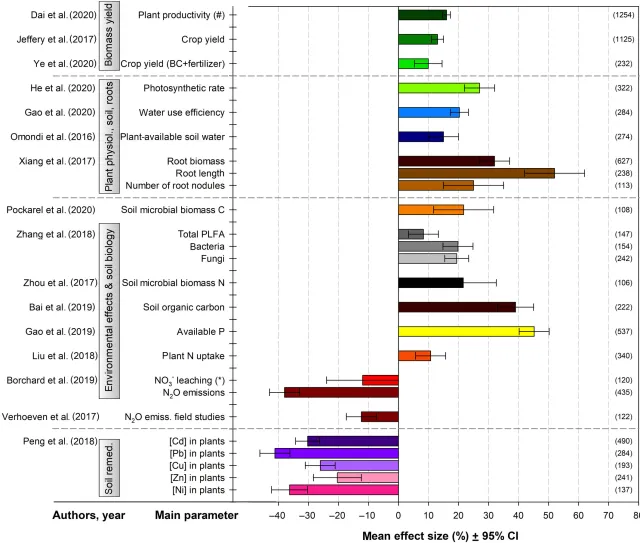
Biochar is the result of heating organic biomass without the presence of oxygen, creating pyrolysis gas rather than carbon dioxide. Different sources of organic biomass, or feedstock, result in a diverse range of biochar products with varying particle sizes. When applied in agricultural settings, there is evidence for a number of benefits across multiple types of biochars, as summarized in this graph from a meta-analysis by Schmidt et al. Some of these benefits include reduced compaction, increased microbial activity, improved water holding capacity, and savings on agricultural inputs.
EXTERNAL IMAGE
Figure 1. Relevant agronomic parameters were selected from 26 meta-analyses, including yield, water use-efficiency, plant nitrogen uptake and more. The percent change as a result of biochar application is displayed with 95% confidence intervals. Each parameter is paired with a number in parentheses indicating the amount of pairwise comparisons made.
Schmidt, H., Kammann, C., Hagemann, N., Leifeld, J., Bucheli, T. D., Monedero, M. a. S., & Cayuela, M. L. (2021). Biochar in agriculture – A systematic review of 26 global meta‐analyses. GCB Bioenergy, 13(11), 1708–1730. https://doi.org/10.1111/gcbb.12889
In fact, some soil scientists believe that the diversity of biochar products can be advantageous, allowing growers to adopt suitable forms of biochar into their existing operations. There are many ways to apply this product. Biochar can be pelletized and applied through a no-till drill, liquified and incorporated into liquid manure applications, banded, or simply added to a lime spreader - just to name a few.
Biochar applied by itself promotes structural improvements that increase water holding capacity and reduce compaction. However, implementing biochar with another organic material enhances microbial activity: amplifying affects through improved nutrient cycling. I think of biochar as “housing” for microorganisms, providing the infrastructure for them to thrive and contribute to soil health. Soil scientists from the event emphasized that biochar should be mixed and inoculated with another organic amendment like compost to optimize agronomic benefits.
Resources for Growers
A variety of relevant resources were provided throughout the event, from biochar application calculators to actual on-site agricultural waste processing and biochar production.
The National Biochar Atlas, created in collaboration with USDA, allows growers to identify which type of biochar is best for their soils, where to access it, and which rate is effective. Growers can input their soil analysis and explore biochar product options in order to meet specific soil health goals. This calculator also estimates the benefits of biochar implementation and provides a cost benefit analysis for their specific operation.
Healthy Soils Update
The California Department of Food and Agriculture (CDFA) has announced that biochar application will be eligible as a new practice in upcoming Healthy Soils Program solicitations. While we are still awaiting further details, potential application scenarios include biochar on its own, biochar and compost, and inoculated biochar formulations. CDFA also plans to address the wide variation in the price of biochar across the state with a different payment rate model than other HSP practices. The draft Request for Grant Applications for both the Healthy Soils and SWEEP block grants are expected to be released for public comment in early 2026. To stay tuned for updates, sign up for the CDFA Office of Agriculture Resiliency and Sustainability newsletter here.