Bug Squad

A daily (M-F) blog launched Aug. 6, 2008 and about the wonderful world of insects and those who study them. (Photo by Kathy Keatley Garvey)
Bug Squad: Article

Getting the Red In

September 26, 2008
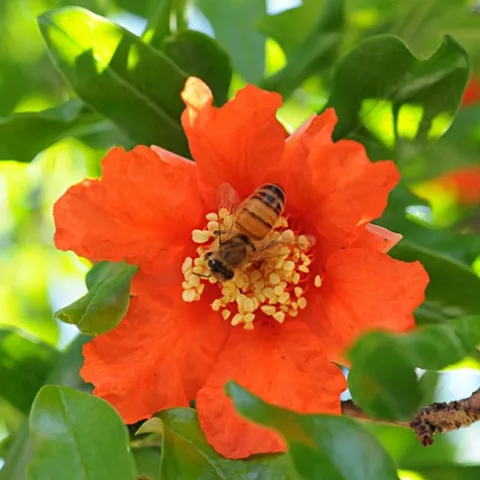
If you love pomegranates, you can thank a honey bee. If you love capturing images of pomegranates, you can thank a honey bee. And, if you love juicing them and making pomegranate jellyas I doyou can thank a honey bee. The honey bee makes it all possible.
View Article
Primary Image
UC Davis mosquito researcher Chris Barker will speak on "Environmental Drivers of Large-Scale Spatial and Temporal Patterns in Mosquito Abundance and Virus Transmission in California” on Nov. 26 from 12:10 to 1 p.m. in 122 Briggs, UC Davis. (Photo by Kathy Keatley Garvey)
Bug Squad: Article

From Beetles to Skeeters

September 25, 2008
So, you want to become an entomologist... Entomologists, future entomologists and others interested in science are looking forward to the fall seminars sponsored Oct. 1 through Dec. 3 by the Department of Entomology, University of California, Davis.
View Article
Primary Image
A newly emerged bee at the Harry H. Laidlaw Jr. Honey Bee Research Facility, UC Davis. During the busy season, a worker bee will live only four to six weeks.(Photo by Kathy Keatley Garvey)
Bug Squad: Article

It's All About the Bees

September 24, 2008
It's all about the bees. When A. G. Kawamura, secretary of the California Department of Food and Agriculture, and the newly selected State Apiary Board meet from 10 a.m. to 4 p.m. on Friday, Oct. 3 at the Harry H. Laidlaw Jr.
View Article
Primary Image
A honey bee on sage. Fossil evidence indicates that the very first insects inhabited this earth 400 million years ago. Honey bees existed at least by 7000 B.C., per a primitive drawing in a cave wall in eastern Spain. (Photo by Kathy Keatley Garvey)
Bug Squad: Article

Holy Moly!

September 23, 2008
Quick! How long have insects inhabited this earth? If you're taking a biology or an entomology course, you'll be asked that question on an exam. If you're attending the Entomological Society of America conference Nov. 16-20 in Reno, you probably already know that. A good answer: 400 million years.
View Article
Primary Image
A drone (front) starts his takeoff to find a virgin queen. At left is a worker bee, his sister. Drones don't survive the winter; the girls kick the boys out of the hive.(Photo by Kathy Keatley Garvey)
Bug Squad: Article

Oh, Brother, Where Art Thou?

September 22, 2008
It's tough being a drone honey bee this time of year. The drones, or male bees, don't survive the winter. Bee breeder-geneticist Susan Cobey of the Harry H. Laidlaw Jr. Honey Bee Research Facility at UC Davis admits to having a soft spot for drones.
View Article