
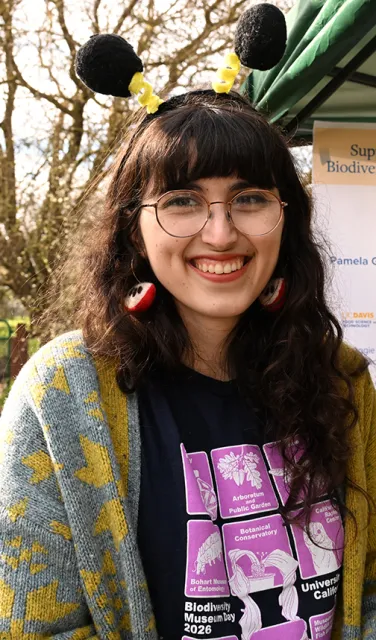
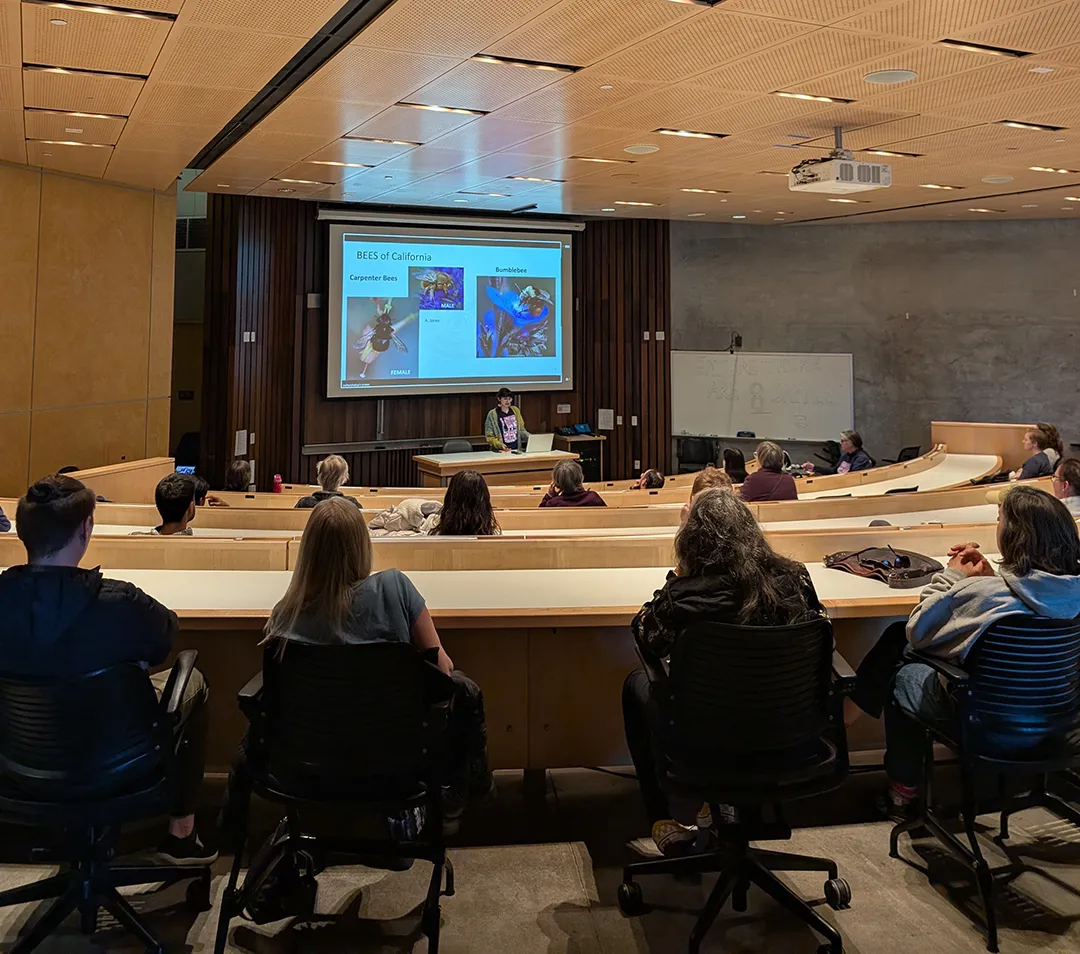
When Samantha "Sam" Murray, education and garden coordinator of the UC Davis Bee Haven, took the stage last Saturday during the 15th annual UC Davis Biodiversity Museum Day, her talk on "Creating Your Own Pollinator Garden" drew rapt attention.
"Pollinator populations are changing," Sam told the crowd in the Sensory Theatre of the Sensory Building of the Robert Mondavi Institute for Wine and Food Science. "Many pollinator populations are in decline and this decline is attributed most severely to a loss in feeding and nesting habitats."'
"One in three bites of food we eat are from a pollinator source," she said. "Pollinators need help and we know how to help them."
The UC Davis Bee Haven, installed by the Department of Entomology and Nematology (ENT) in the fall of 2009, is a half-acre pollinator demonstration garden showcasing more than 200 thriving plants. Located next to the Harry H. Laidlaw Jr. Honey Bee Research Facility on Bee Biology Road, the garden is open from dawn to dusk. Admission is free. Director of the garden is bee scientist Elina Lastro Niño, professor of Cooperative Extension, apiculture; a member of the ENT faculty; and the founder and director of the California Master Beekeeper Program.
Global Biodiversity Hot Spot
California is a global biodiversity hotspot for pollinators, home to approximately 1,600 of the 4000 native bee species worldwide. The late Robbin Thorp (1933-2019) UC Davis distinguished emerita professor, detected more than 80 species in The Haven. Native bees, which range from the tiny Perdita minima to the large Valley carpenter bee, Xylocopa sonorina, are threatened by habitat loss, pesticide use, and climate change.
Sam showed slides of some of the native bees, including the Valley carpenter bee, pointing out that the male, a golden color with green eyes, is known as "the teddy bear bee." The female is all black, a clear case of sexual dimorphism. Among the other bees she discussed were bumble bees, longhorned bees, leafcutter bees and mason bees.
Touching on "the concepts for creating a pollinator garden," Sam advocated using a wide variety of plants so "you have bloom year around. Help pollinators find and use them by planting in clumps, rather than single plants. Include plants native to your region. Native plants are adapted to your local climate, soil and native pollinators. Do not forget that night blooming flowers will support moths and bats. Include larval host plants in your landscape. If you want colorful butterlies, grow plants for their caterpillars."
The Mexican sage attracts all pollinators, Sam said. She mentioned several other pollinator favorites, including hummingbird sage, "hot lips" sage, rosemary, and sunflowers. (For a list of the plants in the Bee Haven, access https://beehaven.ucdavis.edu/learn. The chart shows the common name, genus, species, family, water use, bee resource, bloom time, and more.)
"Bees find plants by flower form, shape and contrast," Sam said.
She also recommended that a pollinator garden include bee houses or condos for leafcutter bees. They contain tubes, such as paper straws or bamboo. "Replace tubes in the spring," she said, "once the material filling last year's tubes have been chewed open, inicating that the bees developing in the tube have matured and left."
The Bee Haven website provides information on what makes a successful pollinator garden:
- Food: A diverse selection of nectar and pollen-rich plants to support bees year-round.
- Good choices include the mint, sunflower, rose, buckthorn, figwort, and plantain families.
- Bees vary in size, flower color preference, and feeding styles. Accommodate this with flowers of varying shapes, sizes, and colors.
- Place several of the same plant together, rather than spreading them around the garden.
- Water: A water source, such as a shallow dish or birdbath with pebbles, to keep bees hydrated.
- Shelter: Nesting sites for native bees. These include: Undisturbed soil • Hollow stems • Bee houses • Bare soil • Pavers set in sand • Rock crevices • Stumps and logs above ground • Grasses • Redwood fence posts • Plant material • Resin for propolis.
- Pesticide-conscious environments to support pollinator health.
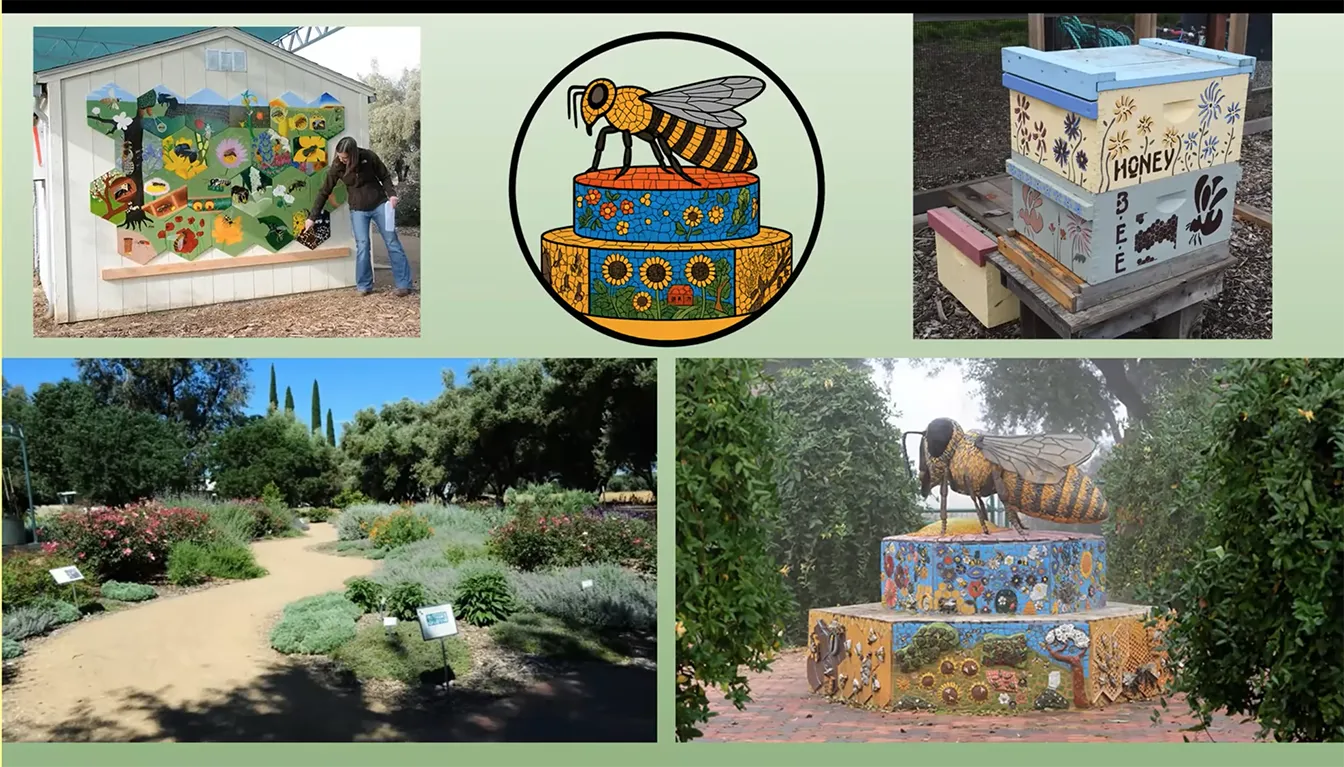
The UC Davis Bee Haven blends art, education and ecological design "to create meaningful habitat and learning opportunities," Sam said. A six-foot-long ceramic mosaic sculptor of a worker bee, the work of Donna Billick (the co-founder and former co-director of the UC Davis Art/Science Fusion Program), anchors the garden. Other art, all affiliated with the UC Davis Art/Science Fusion Program and/or UC Davis entomology art classes taught by UC Davis Distinguished Professor (now emerita) Diane Ullman, also brightens the garden. Ullman, who enjoys fusing art with science, co-founded and co-directed the program and now serves as the emerita director.
Sam was one of four speakers delivering presentations at the UC Davis Biodiversity Museum Day. Others were:
- Pallavi Shakya, doctoral candidate, lab of nematologist Shahid Siddique, "Into the Nematode World."
- Tracy Thomson, PhD, UC Davis Earth and Planetary Sciences, research assistant, "Hobnobbing in the Cretaceous: What's Up With Dinosaur Forelimbs?"
- Kyria Boundy-Mills, PhD, collection curator and research microbiologist, Phaff Yeast Collection. "Creative Uses of Yeasts."
The series is online at https://www.youtube.com/watch?v=ojEQZgEpC58
For more information on the Bee Haven, to sign up for the newsletter, or to book guided tours, contact beehaven@ucdavis.edu.
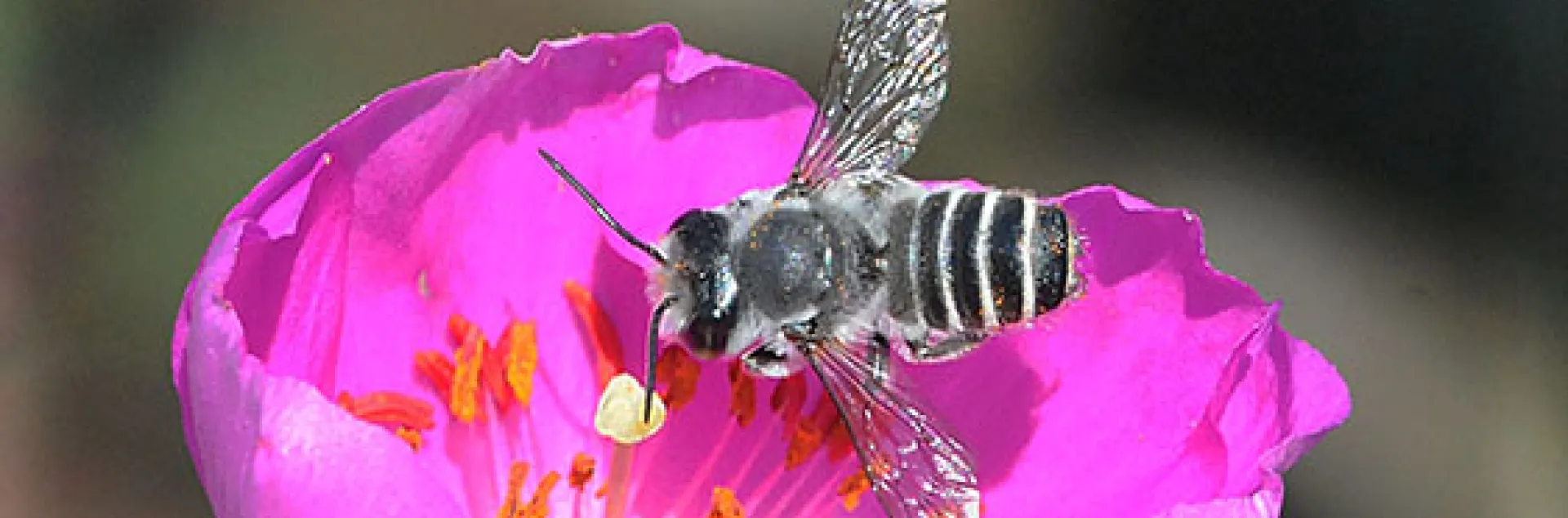
Cover image: Male leafcutter bee on rock rose. (Photo by Kathy Keatley Garvey)