Bug Squad
Article

Want to Help with Migratory Monarch Research?

Image
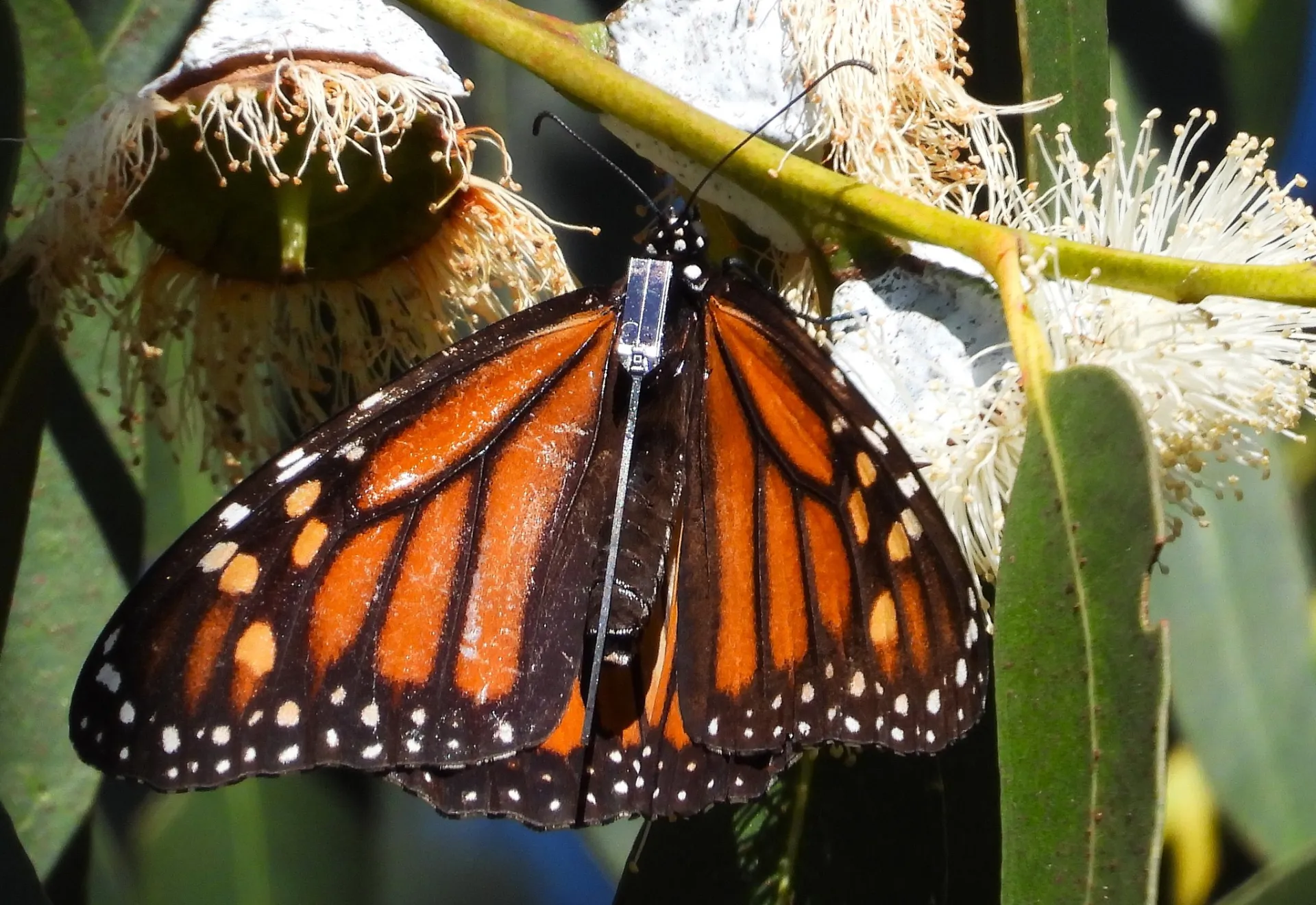
An "E-tagged" monarch. (Photo courtesy of Washington State University migratory monarch researcher David James)

Want to help with migratory monarch research? 

Entomologist David James, an associate professor at Washington State University (my alma mater), has launched an "E-tag" funding project to determine where monarchs from Idaho migrate--do they head for the California coast to overwinter or to Mexico? Or elsewhere? Where do they go?

You can donate to the project and track "your" monarch via a tiny transmitter (E-tag or radio tag) to learn the butterfly's "itinerary" and "destination." If you donate $200, you can name the monarch.

A post on this Facebook page, Monarch Butterflies in the Pacific Northwest, administered by Professor James, explains the project:
 
"The Washington State University Pacific Northwest Monarch tagging program, which started 14 years ago has proved that all Oregon Monarchs and the vast majority of Washington Monarchs migrate to California and overwinter along the coastline. However, it has not answered the question of where the majority of Idaho Monarchs go. From many thousands of Monarchs tagged in Idaho, only three have been recovered in California (compared to hundreds of Oregon and Washington-released Monarchs). Where do most Idaho Monarchs migrate to? It is possible that they head due south (we have some short-distance tag recoveries that suggests this), flying through Utah, Arizona and perhaps end up in Mexico for overwintering. Conventional tagging, using paper tags seems unable to throw a light on this mystery likely because of the wide, open spaces and relative lack of people to sight tagged Monarchs on an inland route south through Utah and Arizona."
 
Tiny Transmitter
"Excitingly, due to very recent technological advances, we now have the opportunity to track individual Monarchs via the use of a tiny transmitter that can be carried by a Monarch!" the post continues. "This solar-powered transmitter allows us to see the progress and route taken by a monarch in real-time! Signals produced by these E-tags are detected by any cell phone with Bluetooth capability that is within about a quarter of a mile of the butterfly. The signals and data are automatically transmitted to a central data-gathering point and available to scientists."
 
James says that "This year, we hope to E-tag at least 100 monarchs in Idaho. Unfortunately, E-tags cost $200 each, so we need donations. We will accept any amount but if you want to contribute the full cost of a tag, then you can name the Monarch that carries your tag. You will also be able to track the progress of your Monarch on your cell phone! If you are interested in helping our research and solving this mystery, then go to: http://adoptamonarch.org where you will find all the details about the program and how to donate. Hopefully, our Monarch E-tagging program this year will go a long way towards solving the Idaho Monarch Mystery and you will be part of it!"
 
Image
Paper-tagged monarch fluttered from Ashland, Ore., to Vacaville, Calif., in seven days in the summer of 2016. (Photo by Kathy Keatley Garvey)
And as explained on the http://adoptamonarch.org page: James is "directing research throughout Idaho during 2026, to determine the migratory corridors utilized by monarchs during their fall migration from Idaho. After over a decade of releasing thousands of monarchs in Idaho with paper tags, it remains a mystery where Idaho monarchs go. Do they head Southwest to overwintering sites along the California coast, due south into Utah and Arizona, or fly all the way to Mexico? Utilizing an ultra-lite telemetry tracker called the “Blu+ Morpho” we now have the capacity to track monarchs in real time." What an exciting and science-driven project! 
 
The 2016 Tagged Monarch
We remember when a male monarch paper-tagged in one of James' citizen-scientist projects in Ashland, Ore., fluttered his way to our pollinator garden in Vacaville. on Sept. 5, 2016.  
 
The specifics: Citizen scientist Steven Johnson of Ashland, Ore., tagged and released the monarch on Aug. 28. We photographed the male monarch, tagged with "Monarch@wsu.edu A6093,” as it nectared on our Mexican sunflowers (Tithonia rotundifola) and a butterfly bush (Buddleia davidii).
 

James later told us: "So, assuming it didn't travel much on the day you saw it, it flew 285 miles in 7 days or about 40.7 miles per day.  Pretty amazing."

It will be even more amazing if a radio-tagged monarch named "Garvey" heads from Idaho, "The Gem State,"  through California, "The Golden State," to our garden on its way to an overwintering spot along coastal California. That would be a "diamond" of a journey.

If the Garvey monarch doesn't make it here, we would welcome them all, especially those named "PokeyNose," "Survivor," "Hope," and "Dare." 

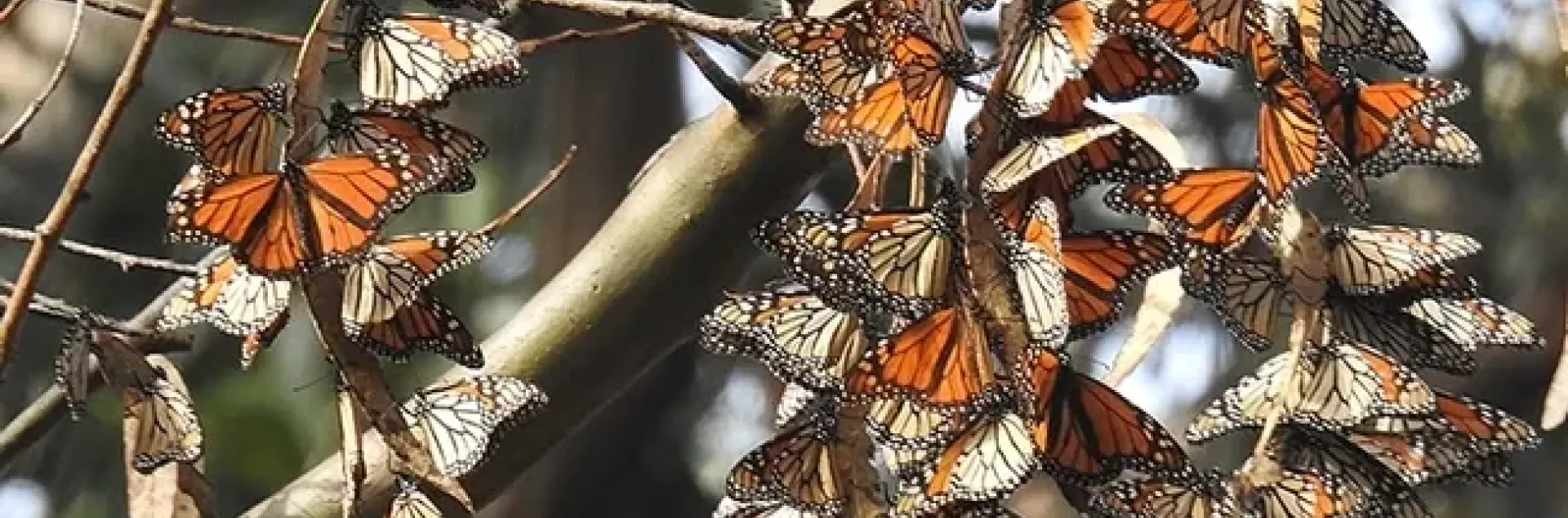
Cover Image: Migratory monarchs overwintering in Santa Cruz. (Photo by Kathy Keatley Garvey)