


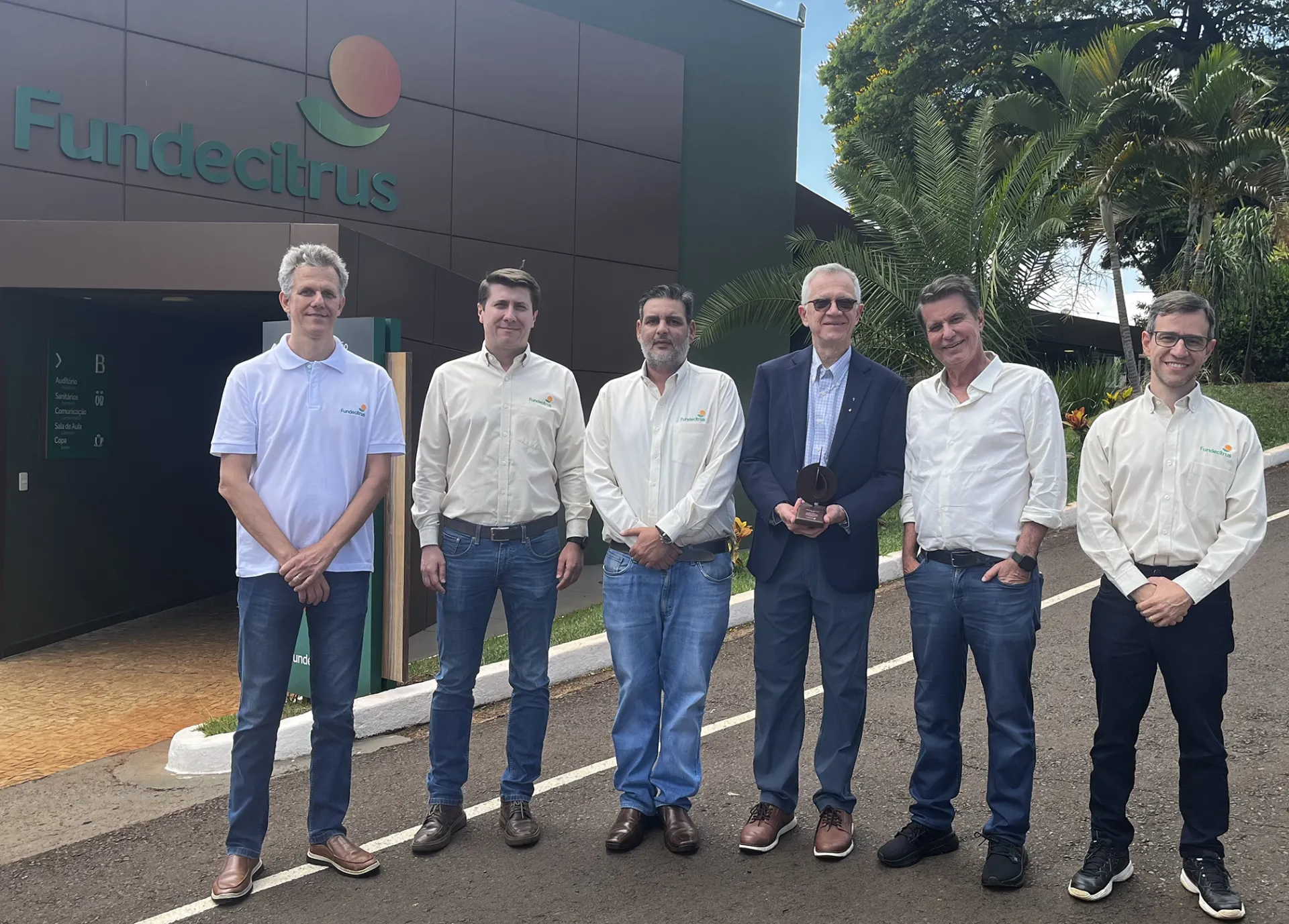
UC Davis Distinguished Professor Walter Leal recently received an award from the citrus research organization, FUNDECITRUS, São Paulo, Brazil, in recognition of his “outstanding contribution to citriculture,” emphasizing his work on the Asian citrus psyllid and a Lepidopteran pest named “bicho furão” (citrus fruit borer).
Leal, a member of the Department of Molecular and Cellular Biology faculty and a former professor and chair of the UC Davis Department of Entomology, is the first U.S.-based researcher to receive the FUNDECITRUS. award.
A native of Brazil and a Fellow of both the Entomological Society of America and the Entomological Society of Brazil, Leal is the principal investigator of a research agreement between UC Davis and the Fundecitrus-Fund for Protection of Citriculture, based in São Paulo.
Leal’s discovery of the sex pheromone of the Asian citrus psyllid--which spreads the deadly citrus greening disease, Huanglongbing (HLB)--may result in the insect version of “The Fatal Attraction.” The team is now working on a formulation to be used in traps.
The Asian citrus psyllid, Diaphorina citris, is a sap-sucking bug that is one of two confirmed vectors of HLB. A native of Asia, it is found in parts of the Middle East, South and Central America, Mexico, and the Caribbean. It was first detected in the United States in 1998 (Palm Beach County, Florida) and is now also found in Louisiana, Georgia, Arizona, South Carolina, Texas, and since 2003, in California (San Joaquin Valley and Central Coast counties, including San Luis Obispo.)
Former UC Cooperative Extension advisor Surendra Dara of San Luis Obispo and Santa Barbara counties (now at the University o Hawaii, Mānoa) earlier said that “The Asian citrus psyllid is a major threat to the multibillion dollar citrus industry in the United States. When an insect pest vectors a deadly disease, the threat is more serious and ACP being an invasive pest made its management even more challenging. Discovery of a sex pheromone by Dr. Leal's team is a major breakthrough not just for managing a dangerous invasive pest, but also a significant contribution to environmental sustainability. I envision this pheromone becoming a clean, green, mean weapon in the IPM arsenal against ACP.”.
Integrated pest management specialist and UC Davis Distinguished Professor Emeritus (on recall) Frank Zalom, of the UC Davis Department of Entomology and Nematology and a past president of the Entomological Society of America, earlier hailed the discovery as a “significant breakthrough in preventing the spread of this serious citrus insect, and may offer a less toxic method for its control.” He was not involved in the study.
Pheromones and other semiochemicals are widely used in agriculture and medical entomology. “Growers use them as lures in trapping systems for monitoring and surveillance, as well as for strategies for controlling populations, such as mating disruption and attraction-and-kill systems,” Leal noted.
ACP feeds on new leaf growth of oranges, lemons, mandarins, grapefruit and other citrus, as well as some related plants. Infected psyllids can transmit the bacterium Candidatus Liberibacter asiaticus, which causes the fatal citrus disease. An early symptom of HLB in citrus is the yellowing of leaves on an individual limb or in a sector of a tree's canopy.
Citrus trees infected with HLB usually die within five years, according to the UC Statewide Integrated Pest Management Program. There is no known cure. “The only way to protect trees is to prevent spread of the HLB pathogen in the first place, by controlling psyllid populations and removing and destroying any infected trees,” UC IPM says on its website.
Cover Image: Asan citrus psyllid. (Courtesy of Wikipeia)