
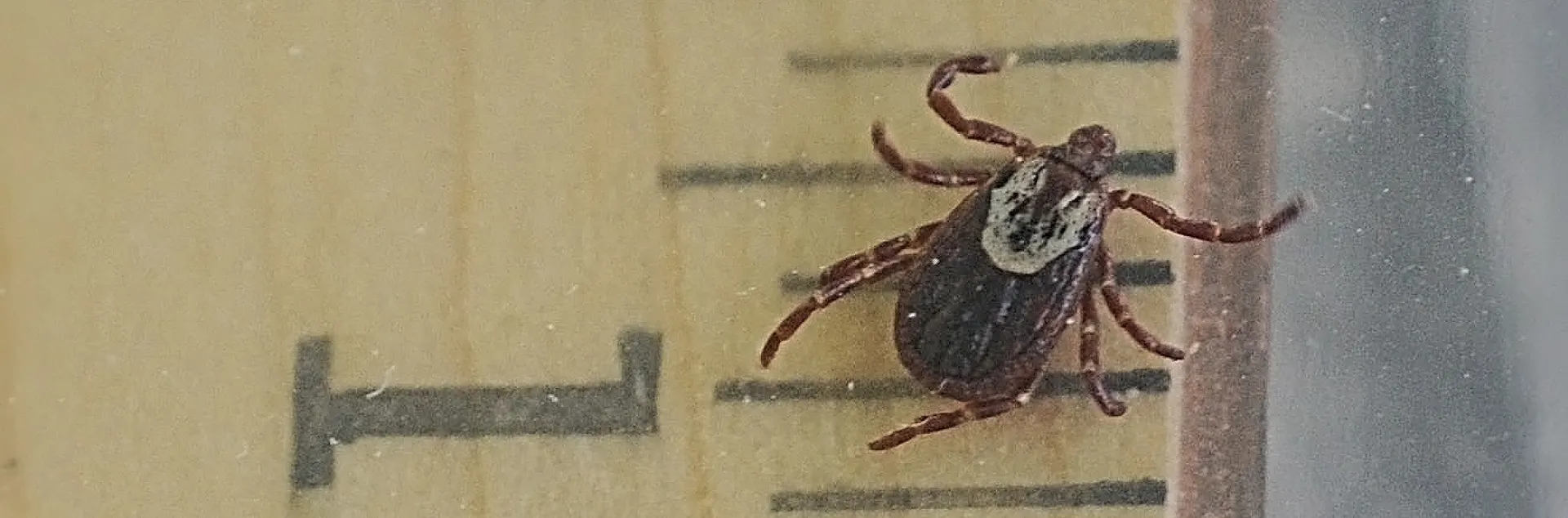

Ever found a tick on yourself, a friend or Fido?
Yes? As the weather warms up, ticks are becoming more and more active.
Ticks can do more than just "tick you off."
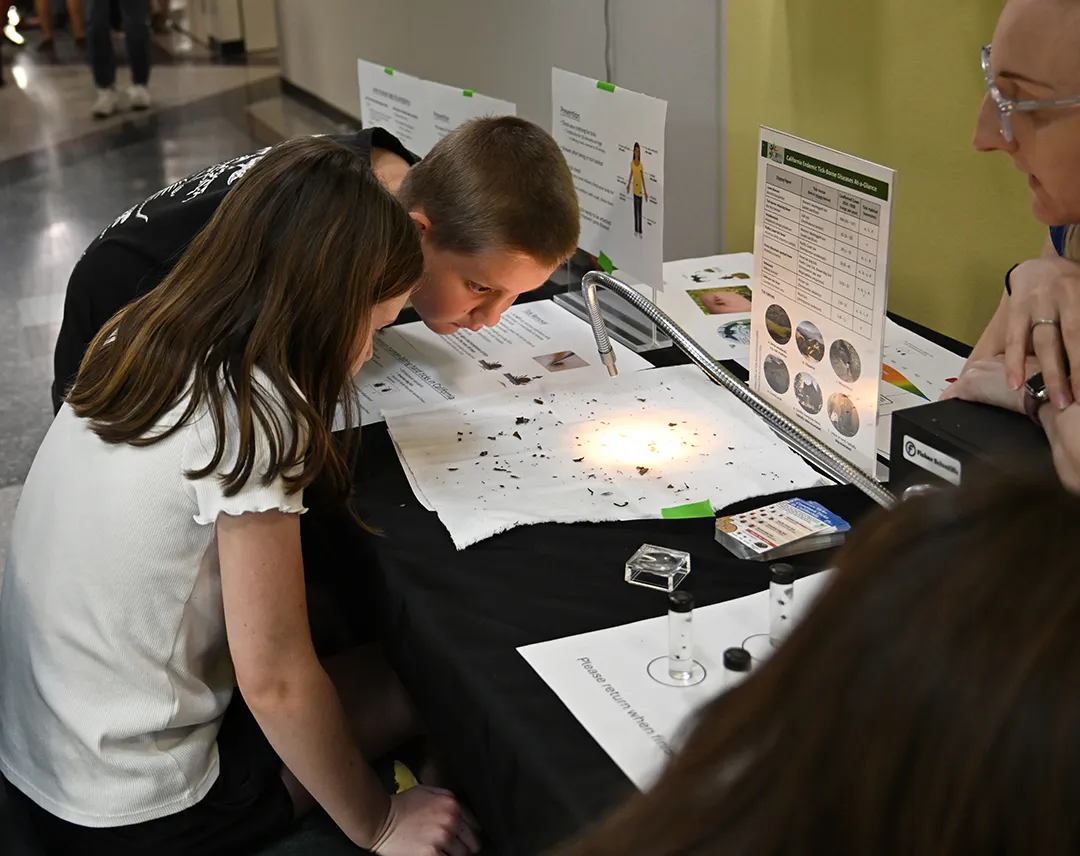
Kim Douglass, a public health biologist with the Vector-Borne Disease Section, California Department of Public Health (CDPH), headquartered in Sacramento, answered scores of questions when she staffed a table at the Bohart Museum of Entomology's recent open house, "Eight-Legged Encounters."
The free and family-friendly event, spotlighting arachnids, drew some 300 visitors who learned about scorpions, tarantulas, vinegaroons, whip spiders, trapdoor spiders, jumping spiders--and ticks!
Ticks, like all arachnids, have eight legs.
Douglass, who received her masters of science degree from Michigan State University in fisheries and wildlife, with a concentration in disease ecology, is dedicated to vector-borne disease prevention, and surveillance and control in California. She serves as valuable resource for local agencies and the public on vector-borne diseases. Her work spans seven California counties, including Yolo.
Literature on her table at the Bohart Museum related that "the common human-biting hard ticks in California" are
- the Western black-legged tick, Ixodes pacificus, a vector for Lyme disease
- the Pacific Coast tick, Dermacentor occidentalis, a vector for Rocky Mountain Spotted Fever, Pacific Coast Tick Fever and tularemia
- the American dog tick, Dermacentor variabilis, a vector for Rocky Mountain Spotted Fever and tularaemia
- the brown dog tick, Rhipicephalus sanguineus, a vector for Rocky Mountain Spotted Fever

Douglas struck up conversations by asking four key questions:
- What do you know about ticks?
- Where do you think you might encounter ticks?
- How can you prevent tick bites?
- What should you do if you find a tick attached to you?
Douglass discussed the answers to these questions and also covered other topics, including host-seeking and blood-feeding behavior, life cycles and seasonal activity, diseases transmitted by ticks in California, and signs and symptoms of Lyme disease. (See website.)
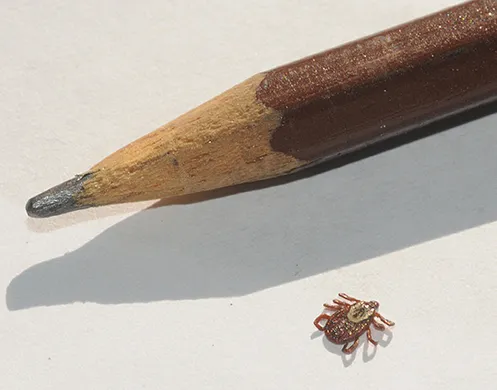
"Most people knew ticks were parasites that drink blood, can carry pathogens that cause disease, could be encountered in nature, and can be removed with tweezers or tick keys if found attached," Douglass said. "People seemed less familiar with what a tick actually looked like and that they are arachnids. Many were surprised to see how small some of the life stages are and how difficult they are to see even on a white cloth. People were also less familiar with Lyme disease, the risks of Lyme disease in California, and the seasonal activity of ticks."
The answers to her four key questions?
- Ticks are small, spider-like creatures that feed by attaching to animals and humans, sticking their mouthparts into the skin, and sucking blood for up to several days.
- Ticks are most often found outside in wooded or brushy areas with tall grass, rocks, logs, and fallen leaves.
- The best way to avoid getting tick-borne diseases is to prevent tick bites by:
- Using tick repellent when going outside in areas where ticks are common
- Wearing light-colored clothing with long pants and long sleeves, and tucking pants into socks or boots
- Conduct a full body check (hairline, armpit, back of knees, groin) for ticks often while you are outside and after you return indoors
- If you find a tick attached to your skin, remove it right away with tweezers. Use tweezers to grab the tick close to your skin and pull the tick firmly, straight out, away from the skin (do not jerk, twist, or burn the tick). Wash your hands and the bite site with soap and water after the tick is removed and apply an antiseptic to the bite site. The sooner a tick is removed, the less likely it is for a person to become infected.
Lyme disease drew many queries. "We discussed that it’s primarily transmitted in California by the Western blacklegged tick, which is typically active fall through early summer," Douglass said. "Early signs and symptoms of Lyme disease (3–30 days after tick bite) include flu-like symptoms, fever, chills, headache, fatigue, muscle and joint pain, and swollen lymph nodes. Additionally, a rash--often appearing as a “bullseye”--is common but may be difficult to see and occurs only in about 70 percent of cases."
Bohart Museum
The Bohart Museum, founded in 1946 and the home of a global collection of eight million insect specimens, is located in Room 1124 of the Academic Surge Building, 455 Crocker Lane, UC Davis campus. It also houses a live petting zoo (tenants include Madagascar hissing cockroaches, stick insects and tarantulas) and an insect-themed gift shop, stocked with T-shirts, hoodies, jewelry, books, stuffed toy animals, books and posters.
Next events? The Bohart scientists will participate in the campuswide UC Davis Picnic Day on Saturday, April 18. They are planning displays and activities from 1 to 4 p.m. at Briggs Hall, home of the UC Davis Department of Entomology and Nematology. Then on Saturday, May 16, the Bohart will host an open house from 1 to 4 p.m. The theme is "Buzz Words: Insects in Literature." All open houses are free and family friendly. Parking is also free.
Director of the Bohart Museum is Professor Jason Bond, the Evert and Marion Schlinger Endowed Chair of Systematics, UC Davis Department of Entomology and Nematology, and the executive associate dean of the College of Agricultural and Environmental Sciences. In addition, Bond serves as president of the American Arachnological Society.
For more information on the Bohart Museum, access its website or email bmuseum@ucdavis.edu. The Bohart is closed March 23-27 for the university's spring break.
Cover image: Dermacentor occidentalis. (Photo by Kathy Keatley Garvey)