


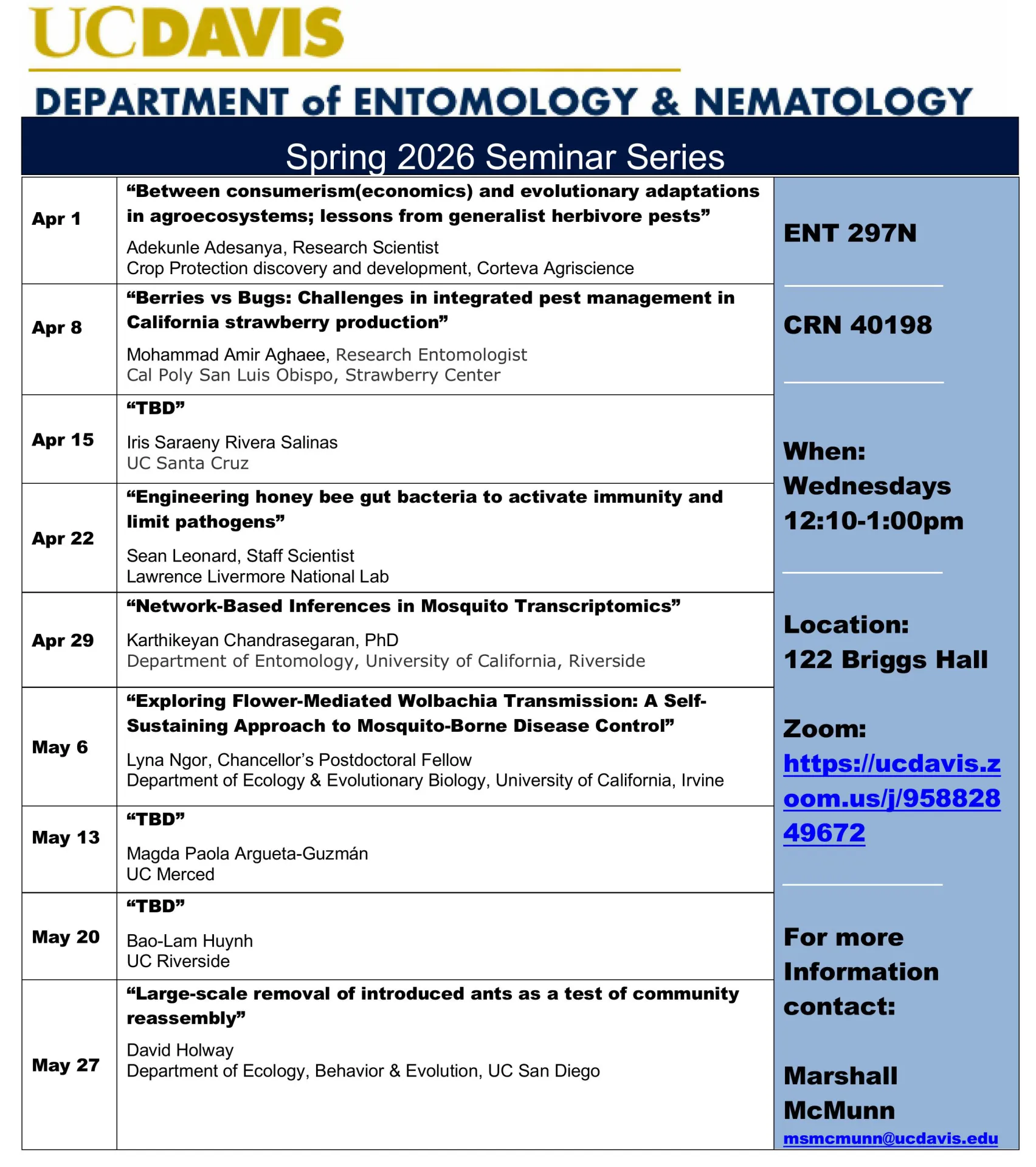
Friday, March 20 marked the first day of spring, and Wednesday, April 1 marks the first of the UC Davis Department of Entomology and Nematology's nine spring seminars.
The seminars will take place on Wednesdays at 12:10 p.m. in 122 Briggs Hall, UC Davis campus, through May 27. They also will be on Zoom. The Zoom link: https://ucdavis.zoom.us/j/95882849672.
Launching the spring series is research scientist Adekunle Adesanya, PhD., of Crop Protection Discovery and Development, Corteva Agriscience, who will discuss "Between Consumerism (Economics) and Evolutionary Adaptations in Agroecosystems; Lessons from Generalist Herbivore Pests" at 12:10 p.m., Wednesday, April 1 in 122 Briggs Hall.
"As the global human population continues to grow, so does the demand for high-quality, affordable food, fiber, and fruit," Adesanya says in his abstract. "At the same time, the amount of arable land available for crop production is steadily declining. These pressures have intensified modern agroecosystems, making the use of natural and synthetic crop-protection agents an essential component of agricultural production. A common consequence of this sustained selection pressure on pest populations is the evolution of pesticide resistance."
"Although extensive theoretical and empirical work has examined how intrinsic pest biology and pesticide modes of action influence resistance," he said, "far less attention has been given to the complex interactions among operational practices, market forces, pest traits, and landscape structure. This talk highlights how economic and ecological factors can drive short-term adaptive responses, drawing on empirical studies of two generalist herbivore pests across diverse cropping systems in the western United States."
Adesanya served as a postdoctoral fellow at the Atkinson Center for Sustainability and the Department of Entomology at Cornell University, before joining Corteva Agriscience as a product development scientist. A native of Nigeria, he holds a bachelor’s degree in crop production and protection from Obafemi Awolowo University in Osun State, Nigeria. He received his master's degree in 2015 from Auburn University, Alabama, where he examined the role of diet breadth and suitability on the activities of detoxification enzymes in the polyphagous Japanese beetle (Popillia japonica). He achieved his doctorate in 2019 in agricultural entomology from Washington State University with an emphasis on the mechanisms and management of pesticide resistance in arthropod pests of specialty crops in the inland Pacific Northwest.
Featured in Entomology Today
In a Sept. 21, 2021 article in Entomology Today, a publication of the Entomological Society of America, Adesanya discussed his research projects with author Piyadarshini Chakrabarti Basu, an assistant professor of entomology at Mississippi State University, and the Physiology Biochemistry and Toxicology Section Representative to the ESA Early Career Professionals Committee. The article, "How One Entomologist is Breaking Barriers in Crop Protection," is online.
Be sure to read his answer when Basu asked him: "If you could be any arthropod, which would you pick and why?"
Below is the list of spring seminar speakers, as announced by coordinator Marshall McMunn, assistant professor. For more information on the seminars or technology issues, contact McMunn at msmcmunn@ucdavis.edu.
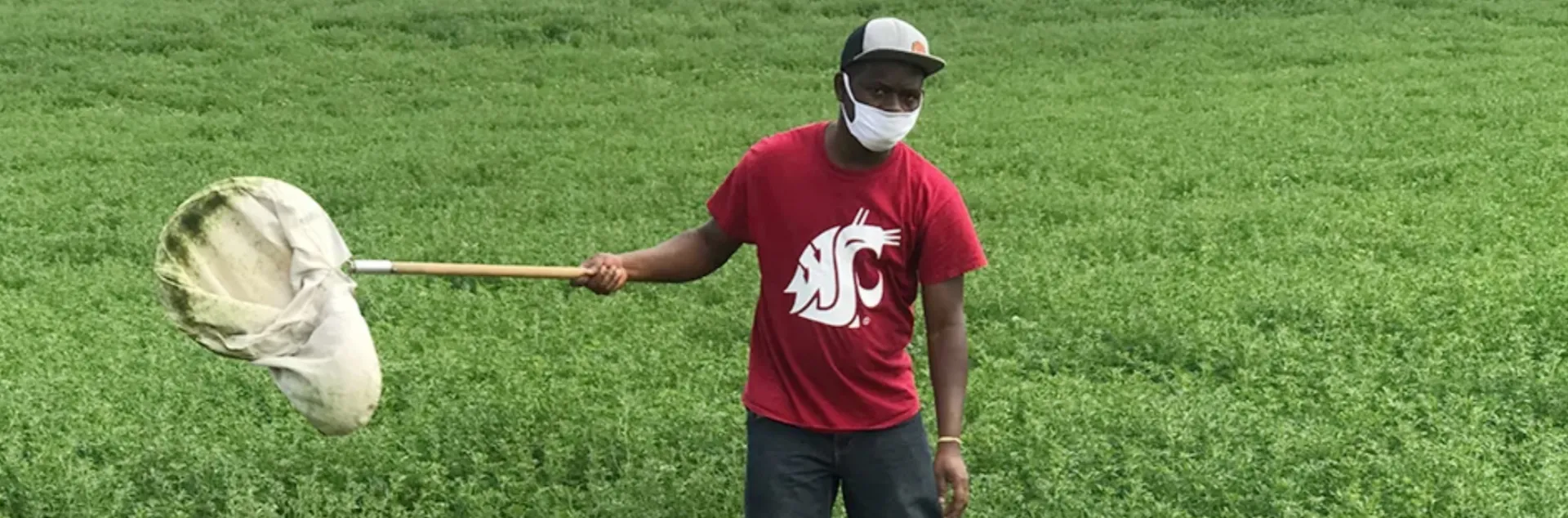
Cover image: Adekunle Adesanya, Ph.D., samples for the western tarnished plant bug Lygus hesperus in alfalfa in Walla Walla, Wash., in July 2020. (Photo by Peter Alege)