


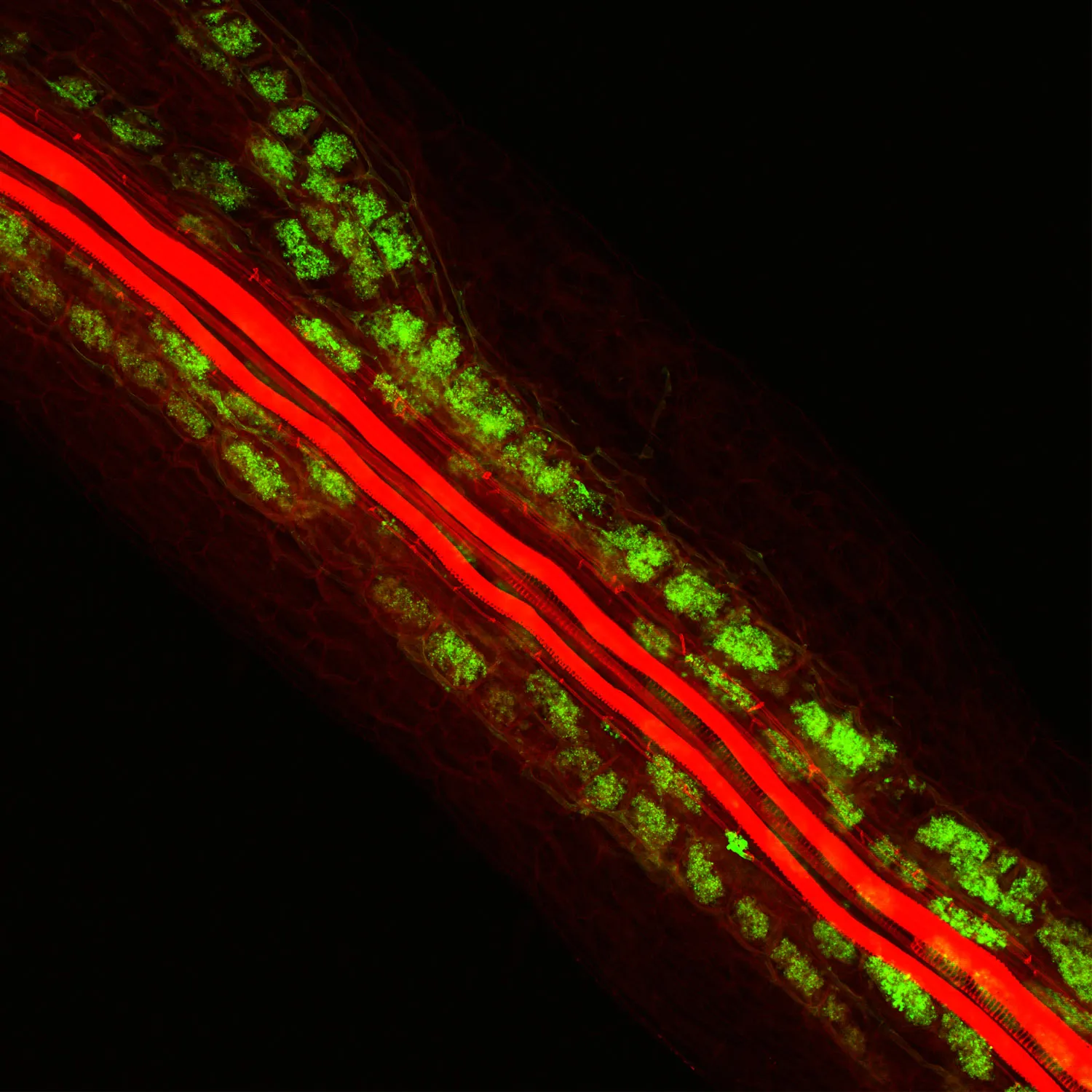
Ever heard of "arbuscular mycorrhiza symbiosis?"
It's a beneficial interaction between plants and fungi.
And that will be the focal point of an upcoming UC Davis seminar by plant molecular biologist Lena Müeller of the Salk Institute's Plant Molecular and Cellular Biology Laboratory, La Jolla.
Mueller, who joined the Salk Institute in January of 2024, studies the unique relationship between fungi and plants that occurs in arbuscular mycorrhizal symbiosis.
The assistant professor will present her seminar on "Control of Arbuscular Mycorrhiza Symbiosis by Peptide Hormones" at the UC Davis Department of Entomology and Nematology seminar on Wednesday, Feb. 11 at 12:10 p.m. in 122 Briggs Hall. It also will be on Zoom at https://ucdavis.zoom.us/j/95882849672.
"Arbuscular mycorrhiza symbiosis is a mutually beneficial interaction of plants with soilborne Glomeromycotina fungi," Müeller says in her abstract. "The host controls the symbiosis through complex signaling networks between colonized root cells and other tissues of the plant. Several genes encoding secreted peptides of the CLE family are upregulated in Medicago truncatula roots during AM symbiosis. The AM-induced MtCLE53 is a negative autoregulatory signal restricting AM fungal root colonization in concert with the shoot-acting receptor-like kinase SUNN."

"We recently found that the pseudokinase CORYNE, known to form a complex with SUNN, is also a negative regulator of AM symbiosis. However, our data indicate that CORYNE is only partially required for MtCLE53 signaling, suggesting CORYNE integrates multiple signaling pathways to modulate AM symbiosis. Our research further shows that CORYNE is part of an as-yet-unknown receptor complex that perceives the novel symbiosis regulator MtCLE16. MtCLE16 is induced in colonized cortex cells and promotes AM symbiosis by dampening host stress and defense responses. We hypothesize that MtCLE16 acts as a local signal amplifier promoting symbiosis. Intriguingly, some AM fungi also produce signaling peptides resembling those of plants, including CLE-like peptides. Functional investigation of the CLE-like peptide produced by the AM fungus Rhizophagus irregularis revealed that it signals through an as-yet-unknown host receptor complex involving CORYNE to manipulate host responses for microbial benefit. Together, our data suggest that AM symbiosis is regulated by at least two distinct CLE signaling pathways with opposite effects on the interaction, and that AM fungi mimic symbiosis-promoting CLE peptides for their own benefit."
A Salk News article, Peptide Imitation Is the Sincerest Form of Plant Flattery, detailed how Salk scientists use small peptides to enhance symbiosis between plants and fungi, offering a sustainable alternative to artificial fertilizers. (Read the findings published in The Proceedings of the National Academy of Sciences on April 14, 2025.
Müeller received her bachelor and master's degrees in biology from the University of Tuebingen, Germany, and her doctorate from the University of Zurich, Switzerland. She studied cell-cell communication mechanisms between male and female gametophytes in the plant genus Arabidopsis. "This spiked my interest in intercellular communication," she related, "and I moved on to conduct my postdoctoral research with Maria Harrison at the Boyce Thompson Institute/Cornell (Ithaca, NY)."
Seminar coordinator Marshall McMunn may be reached at msmcmunn@ucdavis.edu for any technical issues.