
Quick question: Have you visited the Vacaville Museum's incredible gallery exhibit, "The Art of Death?"
If so, did you peruse the insect displays from the Bohart Museum of Entomology, UC Davis?
Frankly, there's so much to see and learn about "The Art of Death"--which runs through Nov. 15--that you might want to make multiple visits!
Location: 213 Buck Ave., Vacaville.
Hours: The gallery is open Thursdays and Fridays from 1 to 4:30 p.m., and Saturdays from 10 a.m. to 4:30 p.m.
Cost: Admission is free, but donations are appreciated.
But back to the Bohart bugs.
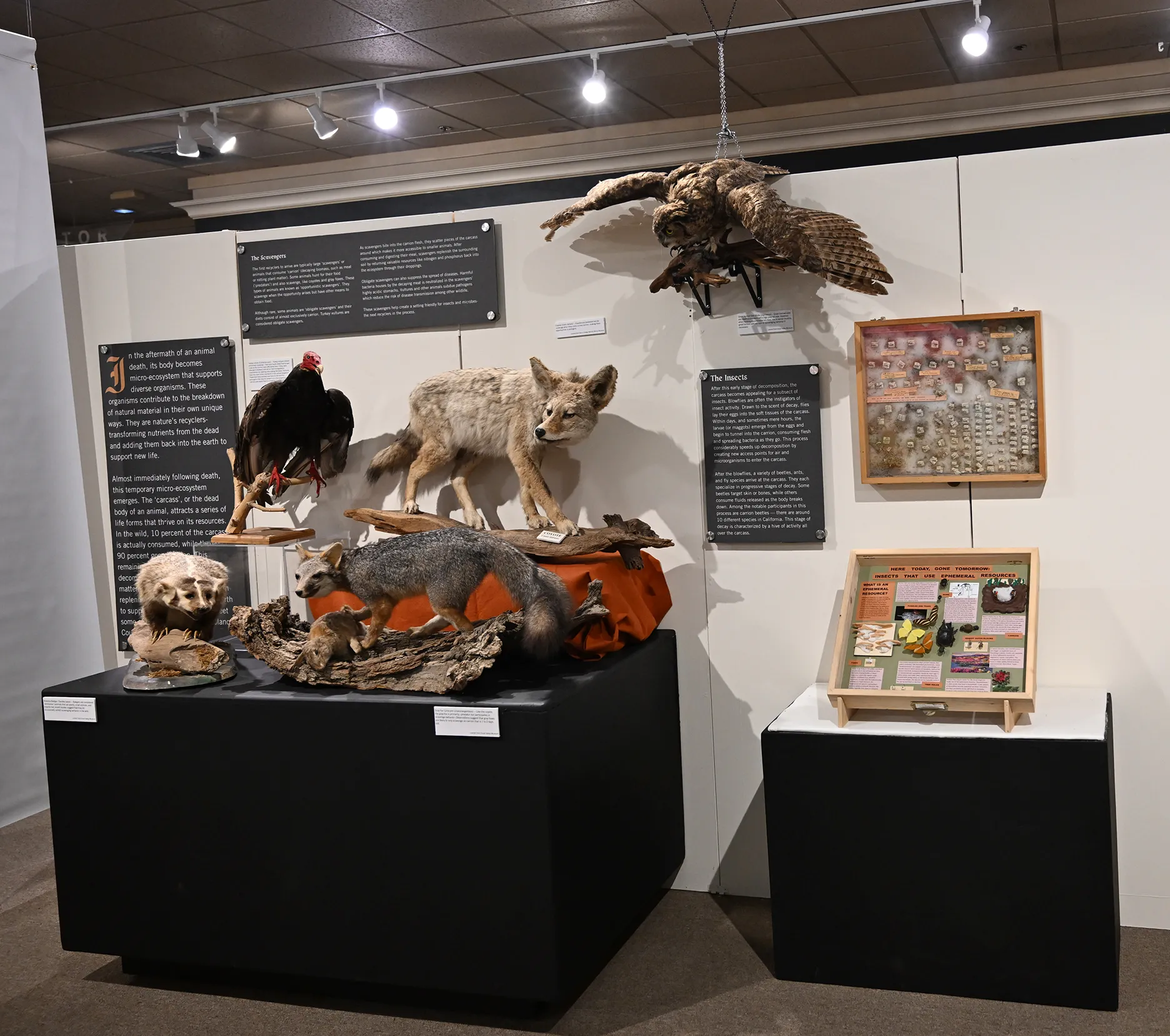
The Bohart Museum's contributions to the Vacaville Museum exhibit includes educational information about multiple insect species, as well as the specimens themselves.
One Bohart displays features three specimens: a monarch butterfly, Danaus plexippus; death's head hawkmoth, Acherontia sp.; and a flame skimmer dragonfly, Libellula saturata.
The death's head hawkmoth is the same species featured in the movie thriller, "The Silence of the Lambs." The moth's name is derived from a skull-like image on the back of its thorax. However, the moth is harmless--unless as someone quipped, "you are a potato plant."
Another Bohart display is a "Dermestid Damaged Drawer," which clearly illustrates what these beetles did to a Bay Area science center collection. Spoiler alert: they destroyed it! Demestids, in the family Coleoptera, are commonly referred to as skin beetles or carpet beetles. Since some dermestids eat insect collections, museum personnel have to watch for dermestid beetle larvae, pupae, exuviae, and damage.
And don't miss the "Ephemeral Resources," an "Oh My Drawer" created by doctoral candidate Tracie Hayes and postdoctoral researcher Elizabeth Postema of the lab of community ecologist/professor Louie Yang, UC Davis Department of Entomology and Nematology. Postema is now a postdoctoral researcher at the Field Museum, Chicago.
In their display, titled "Here Today, Gone Tomorrow, Insects That Use Ephemeral Resources," Hayes and Postema wrote that "ephemeral resources are food, breeding space, or habitat that are only available for a short period of time relative to the lifespan of the consumer. Many insect species use these resources and have unique ways of adapting to the ephemeral nature of the resource they rely on. These systems are important to ecological research because the scarcity of the resource in time can promote strong ecological interactions, making for a microcosm or model of the larger ecosystem."
The scientists categorized the display into seven themes: puddles and tears, dung, desert super-blooms, carrion, fungi, tree holes and bromeliads.
For the puddles and tears category, Hayes and Postema wrote "Various salts and amino acids play an important role in the ecology of insects. These nutrients can be hard to find, but their rarity makes them a great gift for potential mates. To acquire these gifts, many butterflies 'puddle'—i.e. suck up nutrients from shallow, mud puddles. Other species have more unorthodox techniques. The Julia heliconian (Dryas lulia) can be found drinking the salty tears of caiman and other reptiles, and several species sip eye secretions from sleeping birds."
For the carrion category, they wrote: "Many insects rely on the ephemeral resource of carrion for nutrition and reproduction. A mating pair of carrion beetles in the genus Nicrophorus will find a small carcass and dig underneath it to bury it and protect it from competitors. Then, after laying eggs, they will prepare the carcass for their offspring by stripping its fur and covering it in anal and oral secretions. Most pairs will feed their larvae as they develop."
You'll have to head over to the Vacaville Museum to read about the other categories.
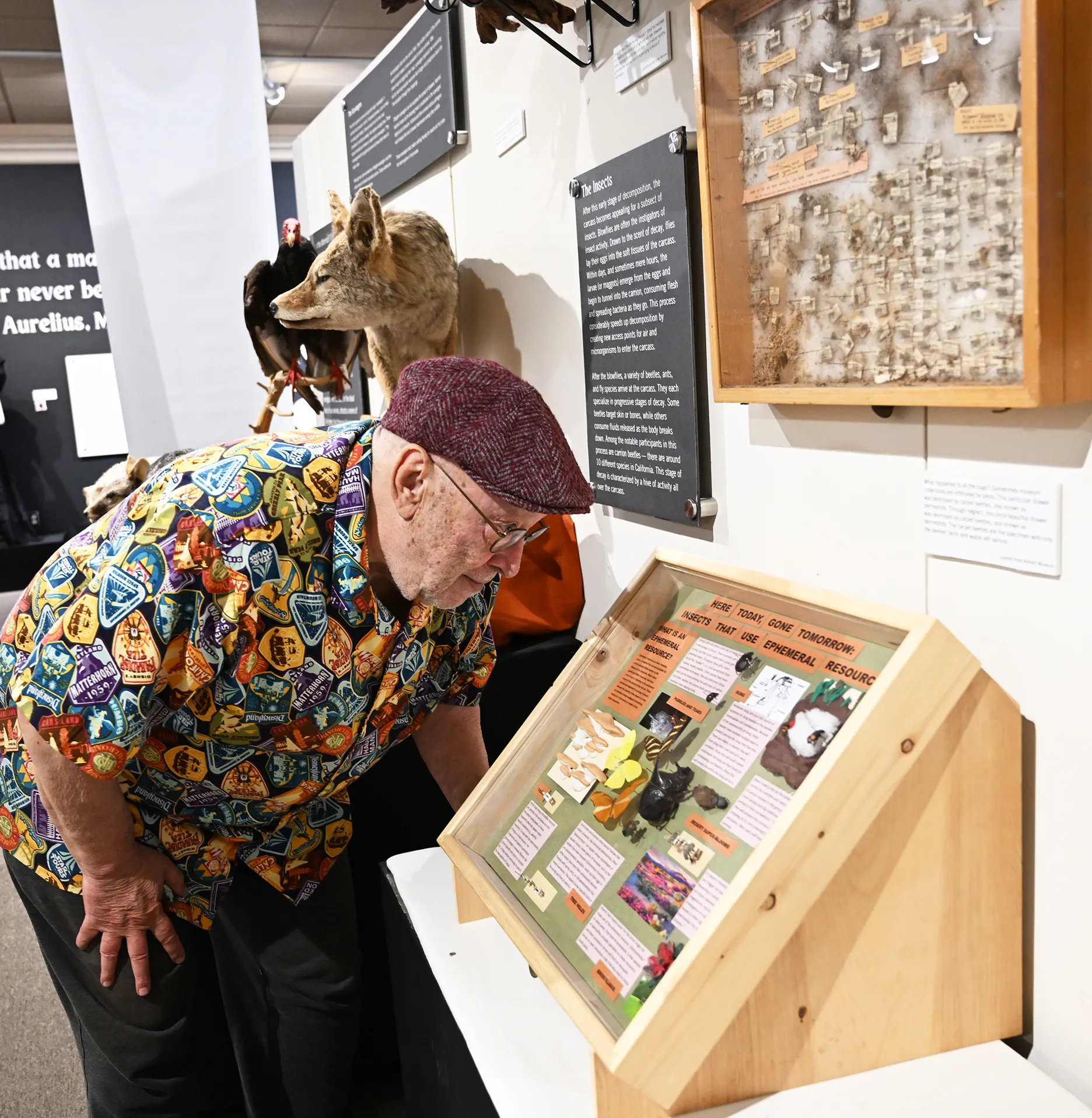
Clara Dawson, executive director of the museum, said "The Art of Death" exhibit is "filtered through the lenses of art, history, science, and culture, and explores the ways society depicts, honors and confronts death to reveal how our relationship with mortality continually evolved." Contributors include Solano County artists. Dawson and Vacaville Museum curator Shelby Sorensen headed the project.
The mission of the Vacaville Museum is to explore history, connect community, and cultivate a future inspired by arts and culture, Dawson said. Through exhibits, publications and educational programs, the museum, which encompasses all of Solano County, continuously promotes the value of community connectivity through shared community heritage, she related.
Meanwhile, there are lot of activities underway that are tied to "The Art of Death" exhibit, including a Sept. 4th program on "Meet the Artists." (See schedule of current events at https://vacavillemuseum.org/events/)
Bohart Museum Gearing Up for Open Houses
The Bohart Museum is gearing up for a series of open houses for the 2025-26 academic year. Free and family friendly, they soon will be announced on the website at https://bohart.ucdavis.edu/.
The Bohart Museum, located in Room 1124 of the Academic Surge Building, 455 Crocker Lane, houses a global collection of eight million insect specimens, plus a live petting zoo (think Madagascar hissing cockroaches, walking sticks and tarantulas) and an insect-themed gift shop, stocked with T-shirts, hoodies, books, posters, jewelry, stuffed animals and more. The director of the Bohart is professor Jason Bond, the Evert and Marion Schindler Endowed Chair of Insect Systematics, UC Davis Department of Entomology and Nematology, and executive associate dean of the College of Agricultural and Environmental Sciences. For more information on the Bohart Museum, email bmuseum@ucdavis.edu.