


What new technologies can you use to control aphids and thrips in California lettuce?
Adelaine "Addie" Abrams, who will receive her doctorate in entomology at the end of the UC Davis quarter, will present her exit seminar on "Same Pests, New Tricks: Precision Technologies for Integrative Pest Management of Aphids and Thrips in California Lettuce" on Friday, Feb. 27 at 11:30 a.m. in 122 Briggs Hall.
Her seminar also will be on Zoom: https://ucdavis.zoom.us/j/94173209963.
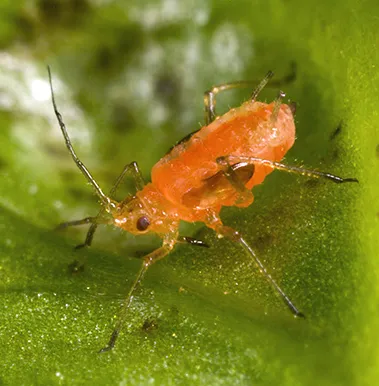
"Two of the most important pests for California lettuce growers are aphids, specifically lettuce-currant aphid (Nasonovia ribisnigri), and western flower thrips (Frankliniella occidentalis)," Abrams writes in her abstract. "Insecticides are heavily relied upon for management, but insecticide resistance may reduce their effectiveness, and a changing regulatory landscape could limit their use. Advances in spray and drone technology offer ways to improve insecticide applications and incorporate non-chemical alternatives into management programs. Automated precision sprayers use photodetection and machine learning to direct sprays in thin bands only over crop plants in a seed line, in contrast to traditional broadcast foliar sprays which treat the entire planted area of a field. New drone technology allows for large, automated releases of laboratory reared predators from the air, making augmentative biological control more feasible for growers hoping to incorporate this approach into their pest management programs."
"Both precision spray technology and drone releases of thrips predators were evaluated for their effectiveness in California lettuce crops," she continues. "Precision spray applications improved the efficacy of both organic and conventional insecticide products, but results do not support a reduction in application frequency when using precision sprays. Drone releases of biological control agents did not reduce thrips populations in any trials, adding to a growing body of evidence suggesting further optimization of the approach is needed. The results of the described studies demonstrate the need for more data to support wider adoption of both approaches."
Lettuce Aphid: Short Life Cycle
"Lettuce aphid is a relatively new pest of lettuce in California," according to the UC California Integrated Pest Management Program (UC IPM) website. "It can be distinguished from green peach aphid by the fact that lettuce aphid does not have strongly converging antennal tubercles. Lettuce aphid has a very short life cycle and their numbers can increase rapidly. Lettuce aphids appear to pass the winter as nymphs and adults on lettuce, radicchio, Nicotiana spp., and some other composites."
"Lettuce aphid feeds deep inside the plant, toward the center on younger leaves," UC IPM says. "In head lettuce it is found almost exclusively at the heart of the plant."
Abrams specializes in integrated pest management, precision ag technology and biological control. She received her bachelor's degree in molecular environmental biology from UC Berkeley in 2011 and a master’s degree in horticulture and agronomy from UC Davis in 2018. Before enrolling at UC Davis, she worked as a researcher under research chemist Spencer Walse at the USDA-ARS laboratory in Parlier, Calif. (2019-2021), and the UC Davis Contained Research Facility in Davis (2012-2019), studying postharvest IPM of quarantine pests.
For any seminar technical issues, contact seminar coordinator Marshal McMunn, assistant professor, at msmcmunn@ucdavis.edu.
Cover image: Addie Abrams in her lab at UC Davis. She now works for Suterra, a global leader in agricultural biocontrol.