

About the Sierra Nevada
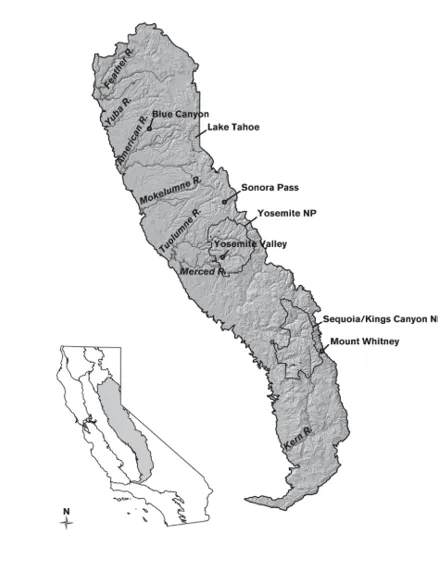
The Sierra Nevada extends from the Southern Cascade Mountains in the north to the Tehachapi Mountains and Mojave Desert in the south. It is bounded on the west by the Central Valley and on the east by the Great Basin. The Sierra Nevada features dynamic topographic features including moderate inclines on the west slopes and steeper slopes in the east, steep river canyons, rolling foothills in between narrow valleys, and rugged mountainous terrain at higher elevations.
The Sierra Nevada ranges in vegetation with elevation. At its lowest elevations on the westside of the Sierra Nevada Foothills, ecosystems are dominated by foothill shrubland and woodland species (from 500 ft to 3500 ft with occasional stands up to 5000 ft). With increasing elevation, vegetation becomes dominated by mixed conifer forest, shifting to subalpine forest then alpine meadow and shrubland. On the drier, eastside of the Sierra Crest, as elevation decreases rapidly, vegetation becomes dominated first by Jeffrey pine, then pinyon-juniper and sagebrush shrublands.
The climate of the Sierra Nevada is Mediterranean, with warm, wet winters and hot, dry summers. Most precipitation falls as snow at higher elevations. Precipitation predominantly moves inland from the Pacific Coast and up the western slope of the Sierra Nevada, causing precipitation to increase with increasing elevation. Once across the Sierra Crest, precipitation decreases dramatically as the air mass descends and warms (rain shadow effect). Typically more precipitation falls in the northern regions than in the south. Generally, years that are drier and warmer than normal have larger and more widespread fires.
Lightning strikes are a common source of ignition, occurring every month. Most lightning strikes occur in mid-afternoon during July and August. There is also a strong correlation between number of lightning strikes and elevation: strikes increase with elevation up to 10,500 ft.
Fire History of the Sierra Nevada
Indigenous burning
Historically, intentional ignitions from Indigenous people contributed to the frequent presence of fires in these landscapes. The Sierra Nevada region is the ancestral lands of many Indigenous tribes that still steward these lands today, including the Miwok, Mountain Maidu, Nisenan, Washoe, and Yokuts tribes to name a few. Tribes burn for many reasons, including for the production of food, medicine, and basketry materials, to aid in hunting efforts, and for cultural and ceremonial purposes. To learn more about other Indigenous tribes in the Sierra Nevada region, visit https://native-land.ca/.
Historic Fire Occurrence
In several of the dry, conifer forest types of the Sierra Nevada, the Mediterranean climate, common occurrence of lightning ignitions, and widespread use of fire by Indigenous people historically promoted frequent surface fires. These fires consumed woody debris and killed smaller trees, so that when the subsequent fire occurred it resulted in low- to moderate-severity effects. There was not enough time between fires to accumulate enough fuel to promote high severity across broad areas. This fire regime also encouraged and maintained plant species with fire-adaptive traits across ecosystems in the Sierra Nevada region.
After Euro-American settlement in the mid-1800s, there was a substantial decline in fire activity – this is likely due to the removal of Indigenous populations and their use of fire, as well as historic logging practices. With the onset of organized fire suppression in the early 20th century, fire activity was even further reduced as lightning ignitions were aggressively suppressed. The lack of fire and historical logging practices combined to result in dramatic increases in tree densities and coarse woody debris.
Because of past management and climate change, in areas were low- to moderate-intensity surface fires were more frequent and extensive, fires are now often suppressed when they are very small, enabling the continued build-up of woody fuels and tree densities. When they escape those initial suppression efforts, it is usually because of very hot dry weather, which results in large, mostly high intensity fires.
Fire Ecology of the Sierra Nevada by Ecoregion
Fire in the Foothill Shrublands/Woodlands
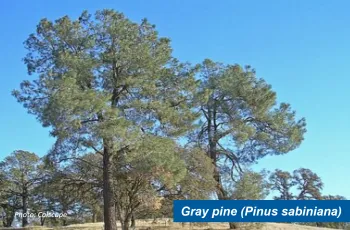
Fire regimes in this region vary with topography and with vegetation type. Foothill conifer stands and woodlands typically experienced fire regimes of high frequency and low- to moderate-intensity and severity (oak woodlands historically had a mean fire return interval of every 12 years). In contrast, foothill shrublands experienced infrequent fires of moderate- to high-severity (median fire return interval of 59 years).
Frequent fire in woodlands and conifer systems historically reduced encroachment by chaparral species and kept stands open, supporting the germination of annual herbaceous species. While shrublands would have occurred historically, particularly on southern aspects and steep slopes, the lack of fire in open woodlands has led to invasion chaparral shrubs, increasing the risk of high-severity fire that can kill trees. These areas can result in vast, dense shrub fields that tend to re-burn high-severity, which can cause the woodlands to convert to shrublands.
Fire in Lower-Montane Forests
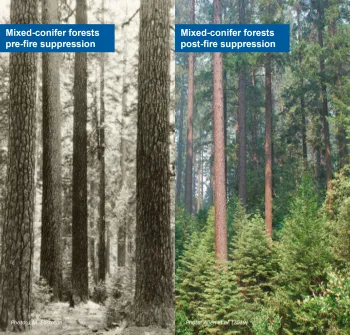
Historically, fire return intervals were short and intensity and severity were low to moderate. The dominant conifer species in this zone all evolved with these fire regimes; which allowed them to develop various fire-adaptive traits. Sierra Nevada mixed-conifer forests have changed since the onset of fire suppression, historic logging practices, and climate change. Forest density has increased along with a shift in species composition toward increasing density overall, particularly of fire-sensitive white fir and incense cedar. Contemporary forest stands with increased stand densities and fuel accumulation are more likely to burn severely. I addition, these dense forests are more susceptible to mortality from drought and insects.. In areas of the southern Sierra that had extensive drought mortality, the additional dead biomass can create extremely high fuel loads, increasing the potential for high-severity fire.
As a result of these increased woody fuels and tree densities, there has been a significant increase in the proportion of area that burns at high severity in this zone. Historically, high severity fire was present in this system, just at smaller scales – likely a few acres to a few hundred acres. In recent years, we have seen high severity patches that are thousands of contiguous acres, which can affect postfire succession and the associated trajectory of the ecosystem. Succession in such fires usually begins with forests initially replaced with a combination of snags, herbaceous plants, and shrubs.
Generally, the larger the high-severity burn patch, the fewer the available seed trees, with increasingly less conifer regeneration except along edges of the patches. Most dominant conifer species in this zone rely on wind-driven seed dispersal for regeneration, with seeds generally travelling only ~200 feet from the parent tree. This means that in very large high severity patches, significant area is likely outside of the dispersal range of surviving mature trees. As a result, forest managers are increasingly working to actively reforest these areas. Where natural regeneration is lacking and no reforestation is undertaken, shrubs tend to come to dominate. In addition, all of the fire-killed trees in these areas will eventually fall and create heavy surface fuel loads. Taken together, these characteristics tend to result in high severity re-burns, which could result in a persistent type conversion to shrubland.
Fire in Upper-Montane Forests
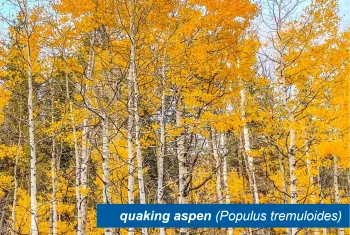
Fire regimes vary in their frequency (25-76 yrs) and severity compared to lower-elevation forests. Lightning is frequent in this zone, and despite ample time for fuel buildup, fires typically are low intensity and slow spreading due to compact fuelbeds, natural fuel breaks (like rock outcrops and moist meadows) and generally cooler, wetter conditions at the higher elevations where these occur. Under extreme conditions, however, these forests can also burn severely.
Fire adaptations in this zone include shrub species that resprout; herbs and grasses reseed or quickly regrow; and conifers, like red fir, western white pine, and lodgepole pine that have thick fire resistant bark. Aspen, the primary hardwood species in this zone, specifically, is a fire follower that resprouts vigorously following more severe fires.
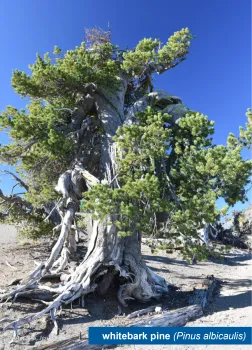
Fire in the Subalpine Forests
Historically, fire regimes in this ecosystem tended to have more mixed-severity fire effects, where there was more moderate and high severity than occurred at lower elevations. These fires tended to burn in the late summer and early fall. Fire return intervals varied due to topography, vegetation, and fuel availability, but generally, these high elevation sites had longer fire return intervals than lower elevation forests.
Lightning is frequent in this zone, but fires do not ignite as often because the conditions are generally cooler and wetter, due to their higher elevation. Because of late melting snowpack and fuel scarcity, the few fires that do ignite are relatively small. Some trees like lodgepole pine are sensitive to even low-intensity fires.
Additional Resources
Check out these resources below to learn more about fire ecology and history in the Sierra Nevada!
- Van Wagtendonk, J., J. Fites-Kaufmann, H.D. Safford, M.P. North, B.M. Collins. 2018. Sierra Nevada Bioregion. In Van Wagtendonk, J. W., N. G. Sugihara, S. L. Stephens, A. E. Thode, K. E. Shaffer, J. A. Fites-Kaufman (Eds.), Fire in California’s Ecosystems. 249-278.
- van Wagtendonk, J. W., N. G. Sugihara, S. L. Stephens, A. E. Thode, K. E. Shaffer, J. A. Fites-Kaufman. 2018. Fire in California’s Ecosystems (2nd ed.). University of California Press. https://www.ucpress.edu/books/fire-in-californias-ecosystems/hardcover.